


Let’s be real: if HIV were a person, it would be that messy ex who refuses to leave your life. You block them, delete their number, do the full moon salt cleanse—and yet somehow, they still find a way to show up at brunch. For nearly four decades, scientists have been trying to ghost this virus permanently. Now, a team of brilliant minds in Melbourne may have finally found the receipts to drag HIV into the daylight—and it’s giving major glow-up energy to the field of HIV cure research.
RELATED: Trump Admin to Gut HIV Prevention Funding—Putting ALL Lives at Risk
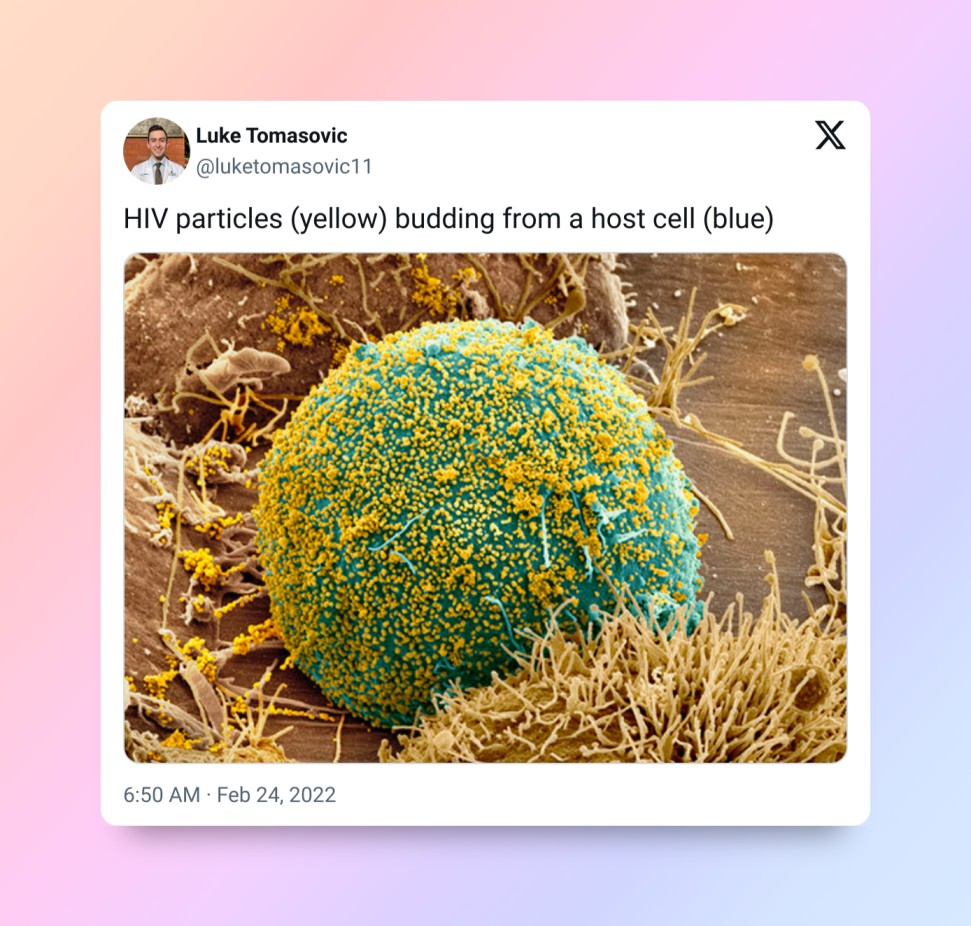
At the heart of this development is something queer people already know a thing or two about: reinvention. Researchers at the Peter Doherty Institute for Infection and Immunity have harnessed mRNA technology—the same star power behind your COVID vaccines—to do something that was, until recently, thought “previously impossible.” They’ve made HIV visible. Not metaphorically. Literally. Visible to the immune system.
Dr. Paula Cevaal, a research fellow at the Doherty Institute and co-first author of the study, explains: “Our hope is that this new nanoparticle design could be a new pathway to an HIV cure.” This design, nicknamed LNP X (which, let’s be honest, sounds like a gender-neutral DJ you met at a queer warehouse party), is a lipid nanoparticle fat bubble that actually gets inside the white blood cells where HIV hides. Once inside, the mRNA tells those cells to expose the virus.
“We sent her back into the lab to repeat it,” Cevaal said of one scientist’s suspiciously good initial results. “And she came back the next week with results that were equally good. So we had to believe it. And of course, since then, we’ve repeated it many, many, many more times.”
Picture it: a team of scientists in lab coats clutching their pearls because their experiment actually worked. “We were overwhelmed by how [much of a] night and day difference it was – from not working before, and then all of a sudden it was working. And all of us were just sitting gasping like, ‘wow’.”
Same, babes. Same.
Let’s take a moment here for perspective: nearly 40 million people are living with HIV globally. Many of them—queer, trans, sex worker, Black, brown, Indigenous—are navigating lives of medication adherence, stigma, and medical bureaucracy. UNAIDS reported that one person still dies from HIV every minute. So while this research is in the early stages, its potential impact is no less than radical.

Of course, science is not Drag Race—progress takes years, and it doesn’t end with a sassy reveal. The next steps include testing this technique in animals and then, if it’s still serving, moving on to humans. It’s a long catwalk to an actual cure, but as Cevaal warns: “In the field of biomedicine, many things eventually don’t make it into the clinic – that is the unfortunate truth; I don’t want to paint a prettier picture than what is the reality.” (Love a scientist who knows not to oversell. The receipts matter.)
Still, she adds: “We have never seen anything close to as good as what we are seeing, in terms of how well we are able to reveal this virus.” That kind of progress is the real tea.
The impact of this research may also go beyond HIV. According to Dr. Michael Roche, a co-senior author, these special white blood cells—the ones now vulnerable to mRNA delivery—also play roles in diseases like cancer. So, this discovery might not just bring HIV into the light; it could be a backstage pass to treating other major illnesses, too.
Naturally, not everyone is clapping in the front row just yet. Dr. Jonathan Stoye from the Francis Crick Institute (a name that absolutely belongs to someone in a BBC drama) said, “One big unknown remains. Do you need to eliminate the entire reservoir for success or just the major part? If just 10% of the latent reservoir survives will that be sufficient to seed new infection? Only time will tell.”
Still, he adds: “That does not detract from the significance of the current study, which represents a major potential advance in delivery of mRNA for therapeutic purposes to blood cells.”
Others, like Oxford’s Prof Tomáš Hanke, were more skeptical, calling hopes that all HIV-hiding cells could be reached “merely a dream.” (It’s always Oxford with the side-eye.)
But let’s not forget: dreams are the blueprint for revolution. Whether it’s fighting HIV, fighting for trans rights, or simply finding a queer space that doesn’t have a $20 cover charge, we’ve always dared to imagine something better.
So here’s to the researchers in Melbourne who dared to dream—and to everyone still living, loving, and thriving with HIV. Science might be catching up, but the queer community? We’ve been fierce since day one.
Source: The Guardian