


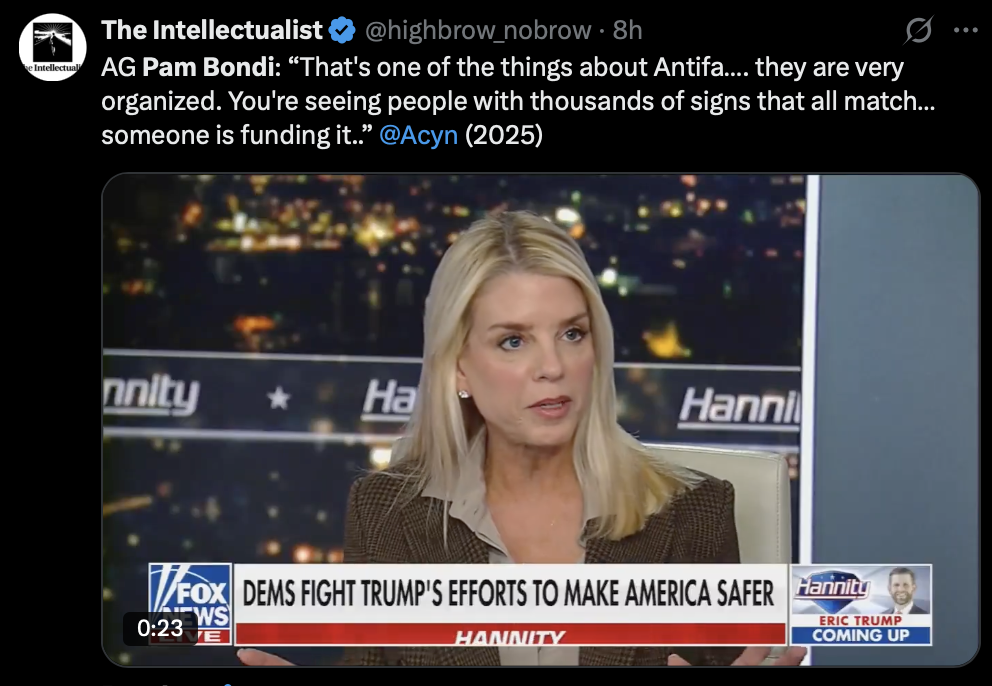
A recently leaked Justice Department memo issued under Attorney General Pam Bondi has prompted renewed discussion about how the federal government defines and prioritizes domestic terrorism. The document, dated December 4, outlines new enforcement directives for the Federal Bureau of Investigation, including the creation of a cash reward system intended to generate information leading to arrests of individuals tied to domestic extremist groups.
While the memo is framed as a public safety measure, its language and emphasis have drawn attention from civil liberties advocates and LGBTQ+ organizations, particularly because of how it characterizes certain ideological movements and activist communities.
RELATED: Cooper Grills Bondi On Nonexistent LGBT Past Support
What the Memo Says
According to the leaked document, the FBI is instructed to “establish a cash reward system for information that leads to the successful identification and arrest of individuals in the leadership of domestic terrorist organizations.” The memo cites existing federal statutes related to domestic terrorism and positions the initiative as part of a broader national security strategy.
However, the examples and definitions included in the memo focus primarily on what it describes as “Antifa-aligned extremists,” with ‘Antifa’ to mean ‘anti-fascism’ or ‘anti-right wing ideology,’ according to Oxford dictionary. Among the ideological motivations identified are views related to immigration policy, what the memo calls “radical gender ideology,” and anti-government sentiment. The document highlights activities such as doxing law enforcement officers and attempts to interfere with immigration enforcement as illustrative threats.
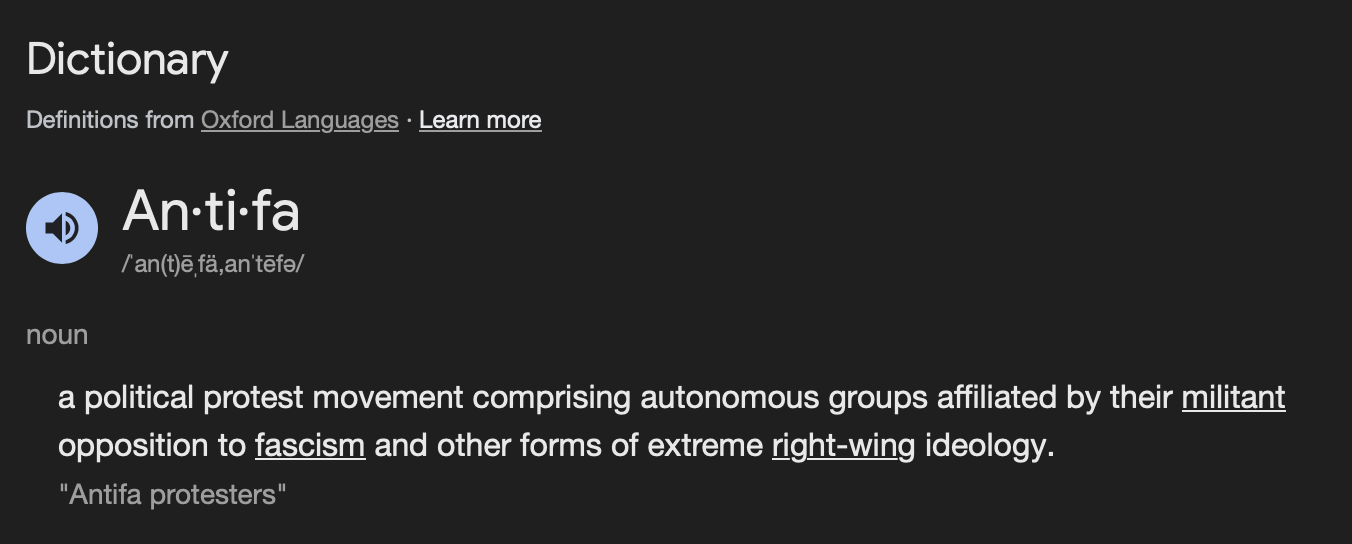 Photo source: Oxford Languages via Google Dictionary
The memo does not reference recent mass-casualty attacks or organized white supremacist violence, which have historically been central to domestic terrorism investigations.
Context Within Federal Policy
Bondi’s framing aligns with positions previously advanced during the Trump administration, including a September executive order issued by Donald Trump that sought to designate ‘Antifa’ as a domestic terrorist organization. At the time, legal scholars and advocacy groups noted that antifa does not operate as a centralized group, but rather describes opposition to fascist ideologies.
Critics argue that treating ideological labels as organizational threats complicates enforcement standards and raises concerns about how broadly federal authority could be applied to protest movements and advocacy work.
Data on Domestic Terrorism
The memo’s emphasis has also renewed attention on long-standing research into domestic extremism. A comprehensive review by the Center for Strategic and International Studies, which examined 25 years of domestic terrorism incidents, found that far-right extremist groups were responsible for the majority of attacks in the United States. The analysis showed that far-right violence increased over time, accounting for roughly two-thirds of attacks in 2019 and approximately 90 percent in 2020.
Similarly, a now-deleted 2024 study conducted by the National Institute of Justice found that far-right extremists were responsible for significantly more ideologically motivated killings than far-left actors. The study reported 227 attacks linked to far-right extremism since 1990, resulting in more than 520 deaths. By comparison, far-left extremists were associated with 42 attacks and 78 deaths during the same period.
The removal of this study from the Justice Department’s website following the death of Charlie Kirk has further contributed to scrutiny of how terrorism data is being presented and contextualized.
Broader Political Narratives
In the aftermath of Kirk’s death, some conservative organizations and commentators attempted to link the incident to transgender issues before details about the suspect were publicly confirmed. The Heritage Foundation later released claims suggesting a connection between school shootings and “transgender ideology,” assertions that independent researchers said were not supported by available data.
These claims were part of broader efforts to encourage federal agencies to recognize new ideological categories of extremism, including proposals for tracking what was described as “Transgender Ideology-Inspired Extremism.”
Structural Changes at the FBI
The discussion surrounding Bondi’s memo has also unfolded alongside internal changes at the FBI. Earlier this year, the bureau reduced staffing in its domestic terrorism unit and discontinued certain analytical tools used to track extremist threats. Many of the affected investigations had focused on white supremacist and far-right groups.
These changes occurred under FBI Director Kash Patel, raising questions among analysts about how future domestic terrorism priorities may evolve.
Why LGBTQ+ Groups Are Paying Attention
For LGBTQ+ advocates, particularly those working on trans rights, the concern is less about a single policy and more about cumulative effects. Labeling gender-related advocacy within the framework of extremism could, in practice, lead to increased scrutiny of protest activity, online organizing, or community support efforts.
Bondi’s memo does not explicitly mention LGBTQ+ organizations, nor does it outline enforcement mechanisms tied directly to identity-based activism. Still, the inclusion of “radical gender ideology” as an ideological marker has prompted calls for clarification from civil rights groups seeking assurances that constitutionally protected speech and advocacy will not be conflated with criminal activity.
As the Justice Department moves forward, the memo has become part of a larger debate about how domestic terrorism is defined, how data is used to support enforcement priorities, and how national security policy intersects with civil liberties—particularly for marginalized communities.
REFERENCE: LGBTQ Nation, Center for Strategic and International Studies, National Institute of Justice