


Rick Garcia didn’t set out to become a legend—but history has a way of finding people who refuse to stay quiet. As news spread of his passing at 69, LGBTQ+ communities across Chicago and Illinois began reflecting on just how much of their present-day freedom carries Garcia’s fingerprints. His life was one of conviction, courage, and a deep belief that justice should be loud, visible, and unapologetic.
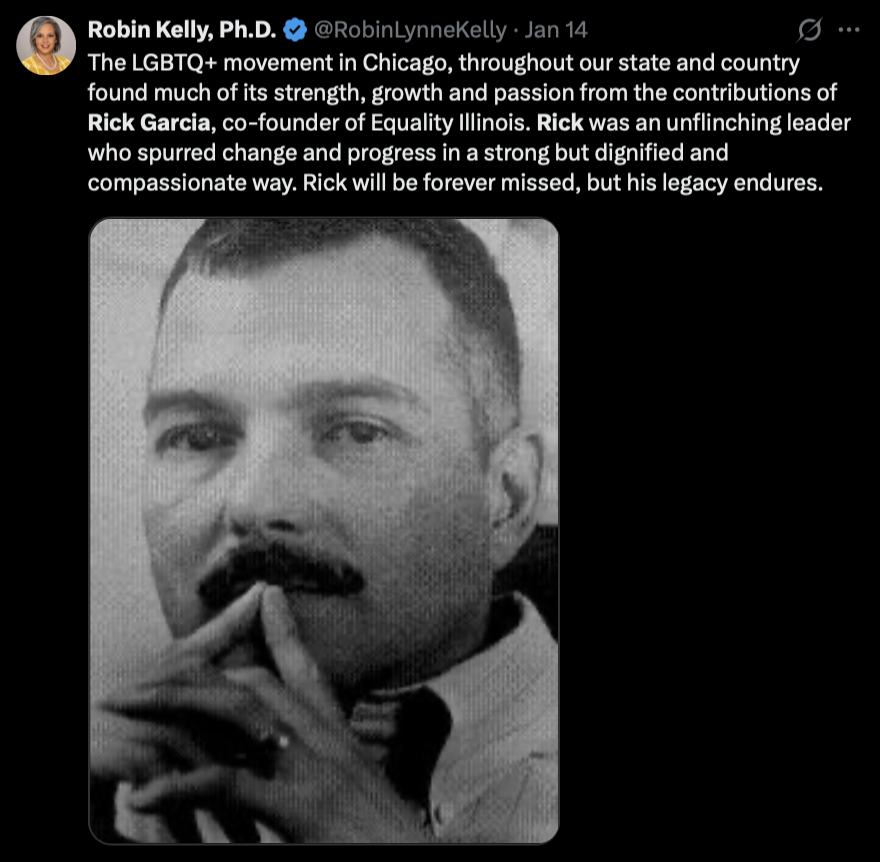
According to reporting from the Chicago Reader, Garcia’s journey into activism began long before Illinois became a national model for LGBTQ+ protections. Raised in St. Louis, he spent his early years organizing with the United Farm Workers, learning firsthand how grassroots movements are built—not overnight, but through persistence. At the same time, he kept his sexuality private, navigating faith, identity, and survival in an era that rarely made room for all three.
RELATED: MLB Trailblazer Billy Bean Dies at 60
Faith, Fire, and Finding His Voice
Rick’s Catholic faith was never something he abandoned—it was something he challenged. He later joined Dignity, a gay Catholic group, and worked with New Ways Ministry in Washington, D.C., advocating for LGBTQ+ inclusion within religious spaces. One of his most defining moments, recalled by the Chicago Reader, came in 1976 when he publicly confronted a theology professor who condemned homosexuality. With television cameras rolling, Garcia reminded the priest—and the world—that gay people are entitled to “friendship, love, and justice.”
It was a moment that captured who Garcia was at his core: respectful, informed, and completely unwilling to let injustice slide by unchallenged.
Chicago, the ‘Gang of Four,’ and a City Transformed
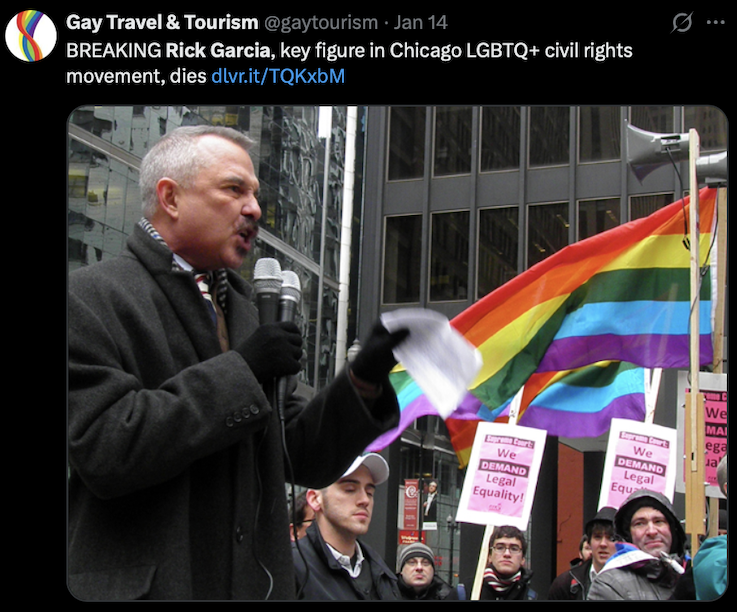
When Garcia moved to Chicago in 1986, the city’s LGBTQ+ protections were still more promise than policy–something that is not unheard of today. An inclusive Human Rights Ordinance had been stalled for over a decade. After its initial defeat—despite support from Mayor Harold Washington—Garcia helped form a renewed push alongside Laurie Dittman, Art Johnston, and Jon-Henri Damski. They became known as the “Gang of Four,” a group that refused to accept delay as defeat.
Their persistence paid off. In 1988, Chicago passed its LGBTQ+-inclusive Human Rights Ordinance, a landmark victory that reshaped the city. Garcia didn’t stop there. He went on to help secure protections at the Cook County level in 1993 and later co-founded what would become Equality Illinois, the state’s leading LGBTQ+ advocacy organization.
Changing the Law—and the Culture
Over the years, Garcia was instrumental in pushing through statewide nondiscrimination protections in 2005 and marriage equality in 2013. These victories didn’t happen by accident. They happened because Garcia understood politics as both strategy and storytelling—knowing when to negotiate, when to push, and when to stand firm.
Even after stepping away from Equality Illinois in 2010, he continued his work at The Civil Rights Agenda, never fully leaving the fight behind.
A Love Story Behind the Activism
Behind Garcia’s public victories was a deeply personal love story. He met his partner, activist Ernie Hunsperger, at a bar in Manhattan more than four decades ago. The two built a life together in New York City before Garcia moved to Chicago in 1986, with Hunsperger later following him.
For decades, they were partners in every sense—romantic, emotional, and political. Before Hunsperger’s retirement in 2007, he spent 15 years supporting Garcia as they both advocated for LGBTQ+ equality in Illinois.
“For four decades Ernie was my best friend, companion, comforter and my rock—the one who challenged me and the only one who could tell me no,” Garcia once said.
Hunsperger passed away in 2020, a loss that deeply shaped Garcia’s later years.
A Legacy That Still Marches On
Rick Garcia’s impact isn’t confined to history books or archived news articles. It lives in every workplace protection, every married couple, every young queer person in Illinois who grows up with more rights than fear.
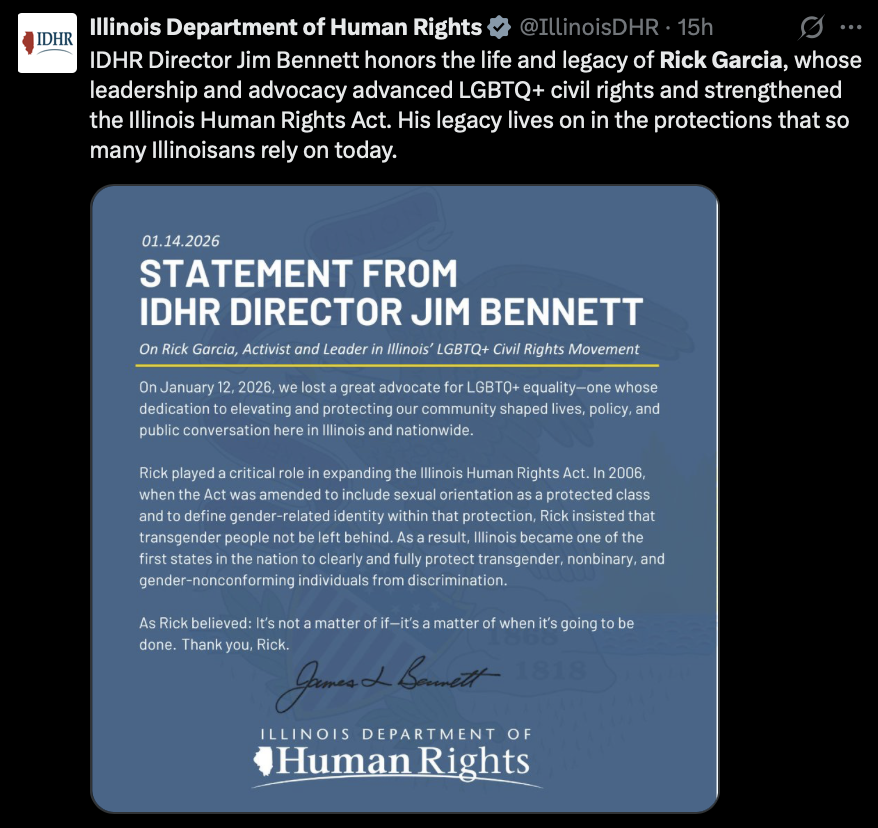
As Equality Illinois called him, he was a towering leader—but he was also a human one. A man of faith and fire. Of strategy and softness. Of love and relentless belief in a better future.
Garcia didn’t just fight for equality. He helped build it. And that legacy, like the movement he gave his life to, isn’t going anywhere.
REFERENCE: Chicago Reader, Windy City Times