


Just when you thought there was no new frontier in sports, 2026 has arrived with a bold new contender: the Sperm Racing World Cup.
Yes, you read that correctly.

A global competition featuring 128 semen samples representing 128 countries, all battling for microscopic glory and a $100,000 grand prize, is officially making waves. Equal parts science experiment, viral spectacle, and men’s health campaign, the event has branded itself as “the sport behind men’s health.”
And honestly? It may be the weirdest brilliant idea of the year.
RELATED: Wait, Sperm Racing Is a Thing? Let’s Unpack That
Wait… What Is Sperm Racing?
According to organizers, sperm racing is a science-based competitive sport where athletes compete by representing countries, advancing through qualifiers, head-to-head matchups, and tournament rounds broadcast publicly.
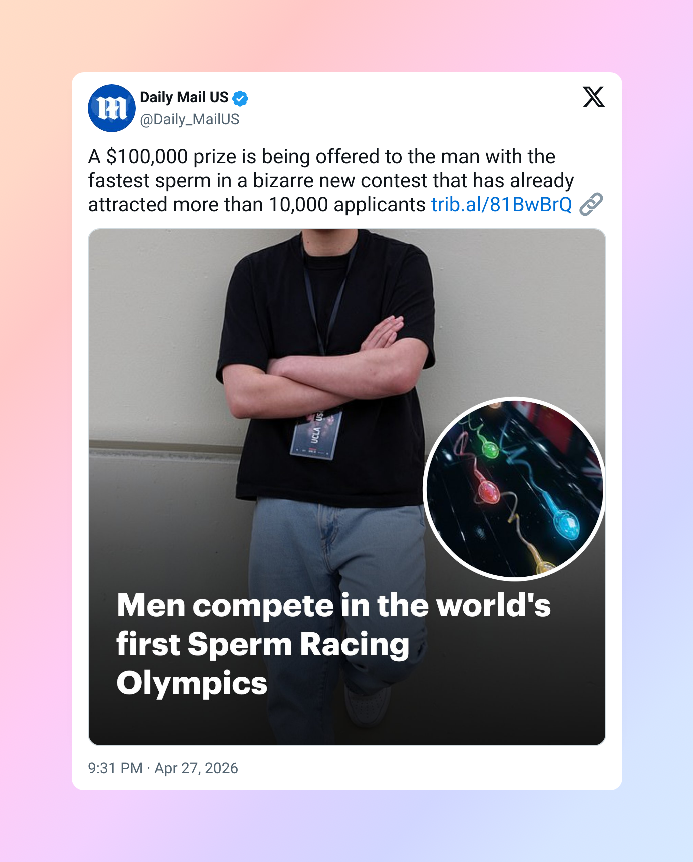
This is not random chance, organizers insist. Advancement is based on eligibility, performance, availability, and competitive structure.
Translation: this isn’t bingo. This is brackets and tiers.
Imagine the World Cup, but microscopic. Tiny athletes. Massive stakes.
How It Works
At the center of the competition is sperm motility—the speed and movement of sperm cells, which is considered a major factor in fertility.
That means the focus isn’t just quantity. It’s performance.
Introducing the Sperm Racing World Cup.
128 Countries. And a $100k grand prize.
Apply below to represent your country: pic.twitter.com/qV1Z0MYuZg
— Sperm Racing (@spermracing) March 11, 2026
The creators describe it like any other sport: if people train for speed, strength, and endurance, why shouldn’t health become measurable, competitive, and culturally exciting too?
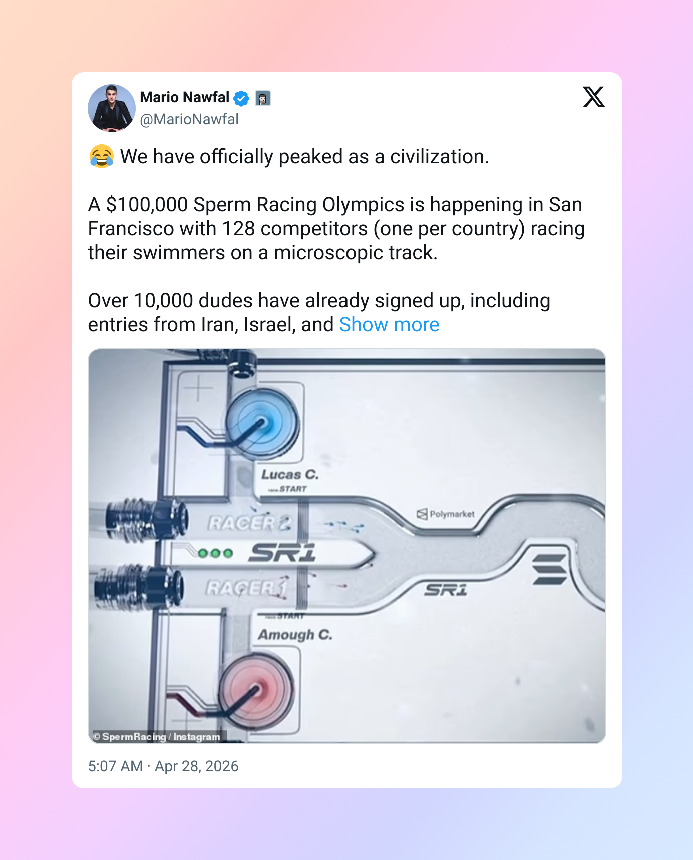
Their answer: build the world’s first racetrack for sperm.
Two competitors. Two samples. One microscopic finish line.
Frankly, the commitment to the bit deserves applause.
SUGGESTED: High Stakes, Hot Nights: The Best Queer-Friendly Casinos for 2026
Who Can Compete?

If you’re suddenly wondering whether national pride is calling your name, the application process has rules.
Competitors must be:
- 18 years or older
- Free of sexually transmitted diseases
- Able to provide biological samples under competition regulations
- Available for recorded content and event coverage
So yes, talent is important—but so is media availability.
A true modern athlete experience.
Why This Exists at All
Behind the jokes and headline chaos is a surprisingly serious mission.
The event was developed by tech entrepreneurs Eric Zhu, Garret Niconienko, Nick Small, and Shane Fan as a way to spotlight declining male fertility rates worldwide.
sperm racing just raised $10M.
we’re building the next olympic sport. pic.twitter.com/noJhs7H3H5
— Eric Zhu (@ericzhu) December 12, 2025
Male fertility has reportedly been decreasing for decades, yet public conversation around it remains limited, awkward, or ignored entirely. That’s where sperm racing enters like a glitter cannon. By turning an uncomfortable health topic into a competitive spectacle, the creators are doing something clever: making people pay attention. Because let’s be honest, many people would skip a lecture on reproductive health.
But a $100,000 tournament? Suddenly everyone has questions.
Breaking the Stigma, One Swim at a Time
At its core, this event is about making men’s health less taboo.
Fertility discussions are often placed entirely on women, while male reproductive health gets treated like an afterthought or punchline. Sperm Racing flips that script by making the topic visible, measurable, and strangely entertaining.
It’s camp. It’s science. It’s wellness with a sense of humor.
And in an age where health content often feels joyless or judgmental, there’s something refreshing about awareness through absurdity.
The Bottom Line
Whether you arrive for the science, the laughs, or pure disbelief, the 2026 Sperm Racing World Cup has already succeeded at one thing: getting people to talk.
And if it sparks bigger conversations about fertility, health, and prevention while entertaining the masses? Even better.
So start stretching. Start believing. Start cheering.
Because the fastest swimmer may soon take home the most unusual trophy in sports history.