

Attorney General Pam Bondi became the center of national attention this week after a House Judiciary Committee hearing spiraled into a deeply personal confrontation involving Jewish lesbian lawmaker, U.S. Rep. Becca Balint, exposing the emotional and political fault lines that often sit just beneath the surface of Washington oversight hearings.
What was scheduled as a formal review of the Department of Justice’s handling of the Jeffrey Epstein files instead became a moment many LGBTQ+ viewers recognized all too well: an identity-based accusation delivered in a public forum that many observers viewed as anti-Semitic in effect, aimed at a Jewish lawmaker and resulting in a boundary being drawn in real time.
RELATED: What Pam Bondi’s Terrorism Strategy Signals for the LGBTQ+
A Tense Room From the Start
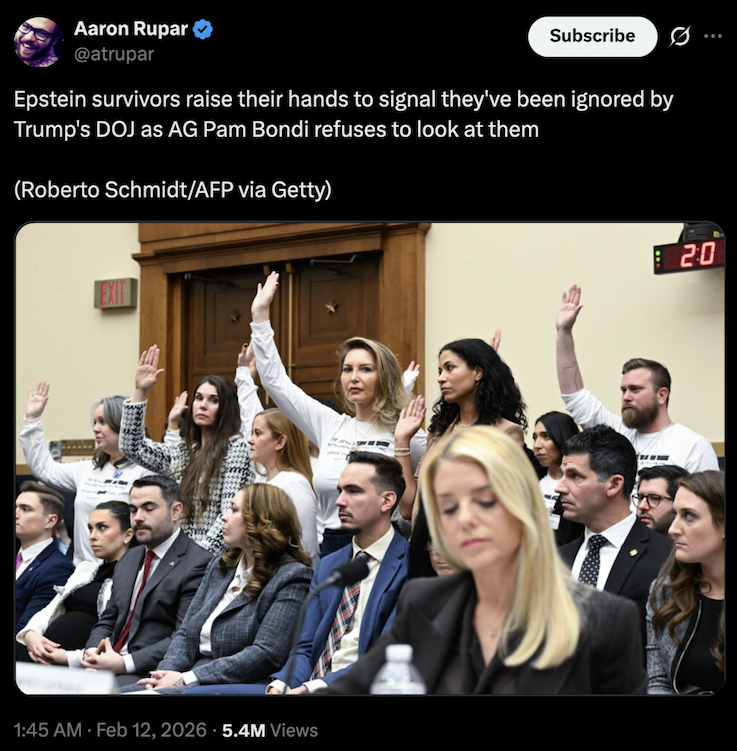
From the opening gavel, the hearing carried a heavy charge. Democratic lawmakers pressed Attorney General Pam Bondi over what they described as a lack of transparency surrounding the Epstein investigation. Their concerns centered on heavily redacted documents, unanswered questions about accountability, and what they saw as a troubling distance between the Justice Department and survivors of Epstein’s abuse.
HOLY SH*T:
Rep. Jayapal just asked Epstein survivors at the DOJ oversight hearing to raise their hand if Trump’s DOJ has not met with them.
Every single victim raised their hand.
Pam Bondi has failed the American people and must resign immediately.
This is bad. pic.twitter.com/c9THybpsxI
— Evan Kilgore 🇺🇸 (@EvanAKilgore) February 11, 2026
Some of those survivors were reportedly seated behind Bondi during the hearing — a detail that underscored the emotional weight of the discussion. Republicans, meanwhile, accused Democrats of staging political theater and defended Bondi’s leadership, framing the criticism as partisan overreach.
For hours, the hearing simmered with frustration, deflection, and competing narratives of responsibility.
The Moment Everything Shifted
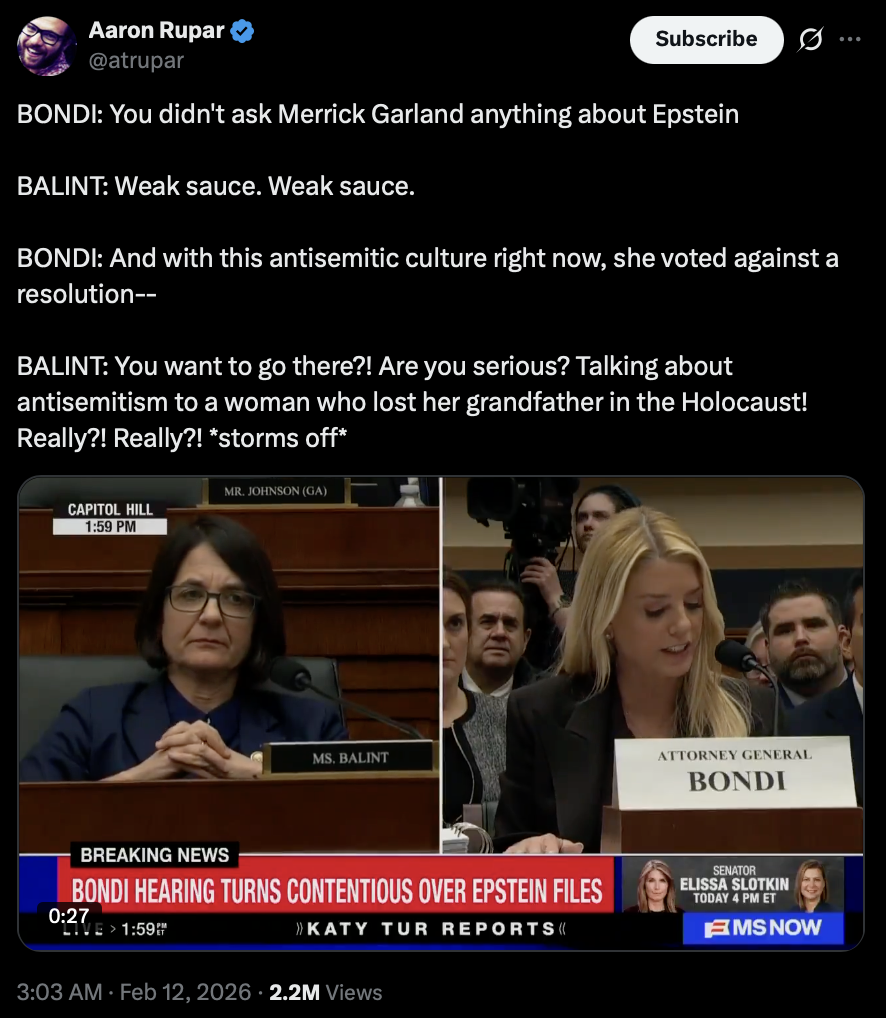
The breaking point came during an exchange with Rep. Becca Balint of Vermont (Democrat), an openly lesbian lawmaker who is also Jewish. After Balint finished her allotted questioning time and yielded back, Bondi asked to respond. Instead of addressing the broader concerns raised about Epstein-related transparency, Bondi criticized Balint for not previously questioning former Attorney General Merrick Garland on the issue.
Rep. Becca Balint: This is not a game, Secretary.
Pam Bondi: I’m Attorney General
Balint: My apologies, I couldn’t tell. pic.twitter.com/wY8GxHOEvl
— jordan (@JordanUhl) February 11, 2026
Balint dismissed the remark as “weak sauce,” capturing the exhaustion many Democrats had expressed throughout the day.
Then Bondi escalated.
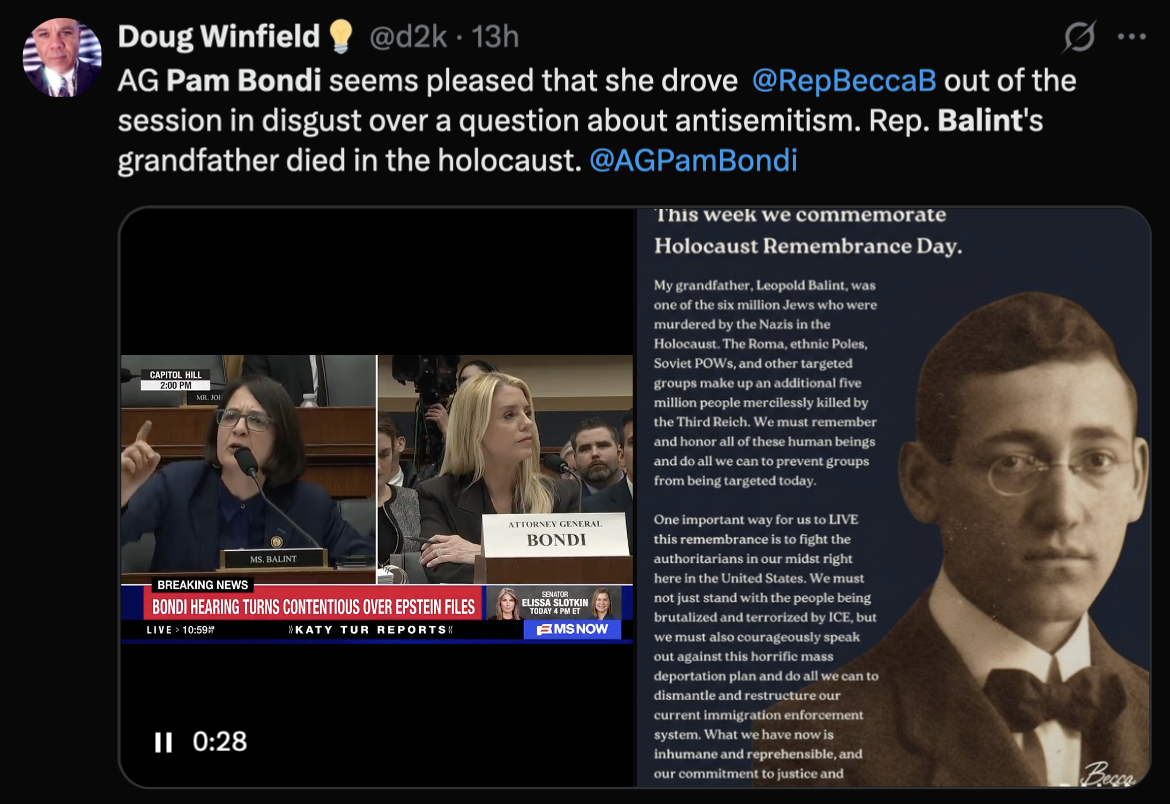
She accused Balint of contributing to what she called an “anti-Semitic culture,” referencing a vote Balint had taken against a resolution. The accusation immediately changed the tone in the room.
Balint pushed back forcefully, reminding Bondi that her own family history includes losing her grandfather in the Holocaust. Moments later, she stood up and walked out of the hearing.
Why This Landed So Hard
For LGBTQ+ audiences — particularly those who are also Jewish, people of color, or members of other marginalized communities — the moment felt painfully familiar. It wasn’t just about policy disagreement. It was about how identity is invoked, questioned, or used as a rhetorical weapon in moments of conflict.
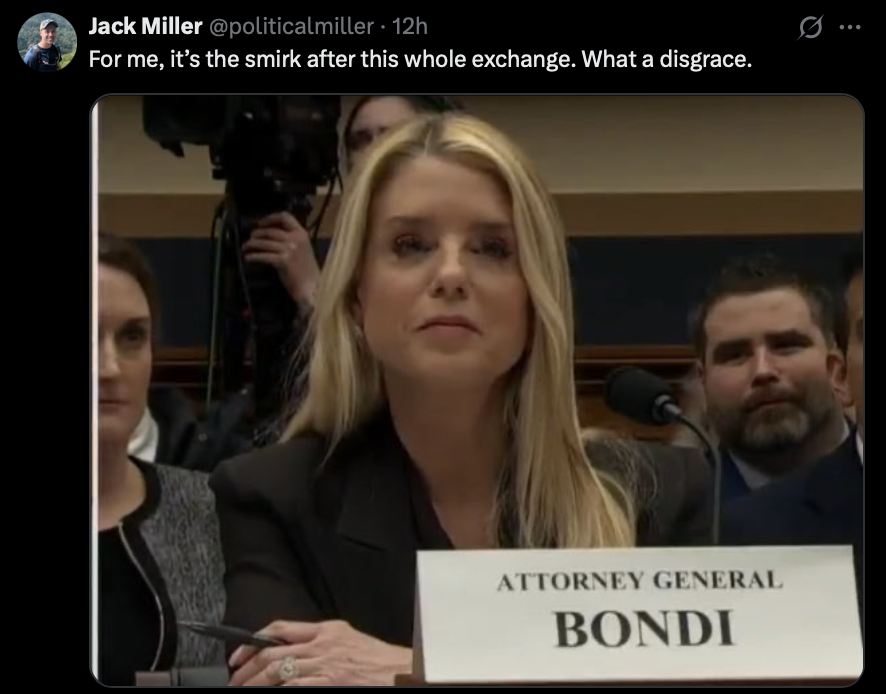
Accusations like anti-Semitism carry immense historical weight. When they are raised without care or context, especially toward someone who is Jewish, they can feel less like accountability and more like erasure of lived experience.
Balint’s decision to leave the room resonated with many queer viewers as an act of self-protection and refusal — a reminder that sometimes the most powerful response is choosing not to stay in a space that has crossed a line.
Survivors Still Waiting for Answers
Lost in the fallout was the original focus of the hearing: survivors of Epstein’s abuse and the unanswered questions surrounding the case. Democrats repeatedly emphasized concerns that survivors have not been meaningfully engaged by the Justice Department and that crucial details remain obscured by redactions.
Rep. Jamie Raskin, the committee’s ranking Democrat, framed the issue as a crisis of trust. He warned that many Americans fear the justice system continues to shield powerful figures while leaving survivors without closure — a concern that resonates deeply within LGBTQ+ communities that have long battled institutional silence.
Rep. Raskin to Pam Bondi: “You redacted the names of abusers, enablers, accomplices, and co-conspirators — apparently to save them from embarrassment and disgrace…Even worse, you’ve shockingly failed to redact many of the victims’ names…You ignored the law.” pic.twitter.com/bkzp7QzTdw
— Home of the Brave (@OfTheBraveUSA) February 11, 2026
Bondi in the Spotlight
The confrontation has placed Bondi under intensified scrutiny, not just for her handling of the Epstein files, but for her tone and approach during oversight. Critics argue that her combative responses and deflections undermine public confidence in the Department of Justice. Supporters contend she is standing her ground against partisan pressure.
But for many watching, the exchange with Balint marked a turning point. It shifted the conversation from bureaucratic transparency to respect, identity, and the consequences of how accusations are made — and against whom.
Bondi: “There is no evidence that Donald Trump has committed a crime”
Lieu: “I believe you just lied under oath.”
Bondi: “Don’t you ever accuse me of a crime”
Lieu: “I’m showing you evidence.”
I think Pam Bondi’s “career” has just come to an end today. pic.twitter.com/tkIiu3mQVB
— Daractenus (@Daractenus) February 11, 2026
Why LGBTQ+ Communities Are Paying Attention
This moment matters because it reflects a broader truth: LGBTQ+ people don’t watch politics solely for legislation. We watch for signals — about whose identities are honored, whose pain is acknowledged, and who is expected to absorb harm quietly.
Seeing a Jewish lesbian lawmaker publicly challenge an accusation tied to her identity — and then choose to leave — struck a chord. Representation doesn’t prevent harm, but it does make moments like these visible.
As debates around the Epstein files continue, so too does a larger conversation about accountability, empathy, and the responsibility public officials carry when invoking deeply charged histories. For communities that have fought for generations to be seen and believed, those choices matter — profoundly.