

When hundreds of thousands of people marched through Budapest for Pride earlier this year, it wasn’t just a parade — it was a bold statement of visibility and defiance. Leading the way was Mayor Gergely Karácsony, who approved the march and walked alongside participants, standing firmly with the LGBTQ+ community despite a national ban imposed by Prime Minister Viktor Orbán’s government.
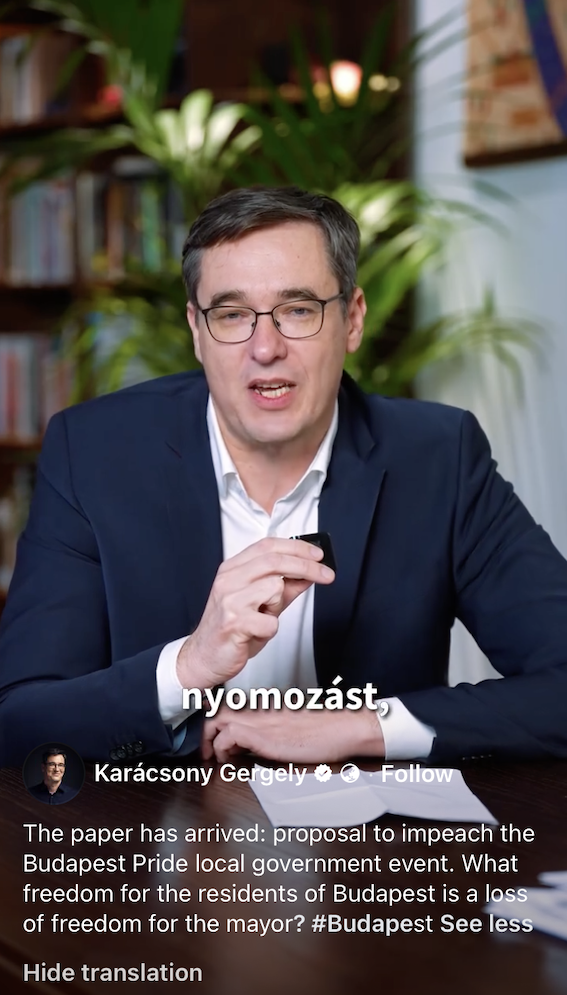 Photo Credit: Karácsony Gergely (Facebook)
Now, the mayor faces criminal charges for allegedly violating Hungary’s new law on freedom of assembly. Karácsony, however, remains unshaken, framing his actions as an act of solidarity and a defense of civic freedoms.
For LGBTQ+ Hungarians and supporters worldwide, the story of Budapest Pride is about more than legality — it’s about courage, visibility, and a city’s mayor putting himself on the line to support his citizens.
RELATED: Why Mamdani’s Leadership Could Transform Queer Safety Nationwide in 2026
A March That Refused to Be Silenced
The Budapest Pride march took place in June and drew hundreds of thousands of marchers, all defying government restrictions. Karácsony didn’t just approve the event; he actively participated, signaling that the city’s leadership was aligned with its queer community.
The atmosphere was defiant yet celebratory. Participants humorously crowned Orbán “King of European Pride,” highlighting the political undertones of the march. For the LGBTQ+ community, this event wasn’t simply a celebration of identity — it was a statement that queer Hungarians would not disappear, even under government pressure.
The Laws Behind the Crackdown
In April, Hungary’s Parliament passed the Assembly Act, a constitutional amendment codifying restrictions on public gatherings involving the “depiction or promotion” of homosexuality. It also formally recognizes only two sexes: male and female.
These restrictions build on earlier “gay propaganda” laws, which limit LGBTQ+ representation accessible to minors. Critics argue the laws are deliberately vague, giving authorities wide latitude to target Pride events, educational programs, and cultural expression.
Orbán has positioned these policies as a defense against what he calls the “degenerate West,” framing LGBTQ+ visibility as a cultural threat. Observers often compare his approach to Russia under Vladimir Putin, citing similar strategies of using anti-LGBTQ+ rhetoric to consolidate power.
“I Stand Proudly” With the LGBTQ+ Community
Karácsony announced on Facebook that police concluded their investigation and recommended charges. He had been questioned by state authorities in August, officially becoming a suspect.
Far from expressing regret, the mayor framed his prosecution as a predictable consequence of defending civil liberties. He said:
“I became a suspect, and if that is the price we have to pay in this country for standing up for our own freedom and that of others, then I am proud of it.”

Karácsony also noted:
“In a system where the law protects power rather than people, in this system that stifles free communities, it was inevitable that sooner or later, as the mayor of a free city, they would take criminal action against me.”
And his commitment to Budapest’s LGBTQ+ community is clear:
“I am proud that I took every political risk for the sake of my city’s freedom, and I stand proudly before the court to defend my own freedom and that of my city.”
Pride, Politics, and Power Plays
The timing of the prosecution is politically significant. Hungary heads toward national elections in April, and critics argue that Orbán’s government is using anti-LGBTQ+ policies as a wedge issue to rally conservative voters.
According to a November Politico poll, Orbán’s ruling Fidesz party trails the opposition Tisza party by seven points among decided voters, though the gap has narrowed slightly in recent months. Targeting Pride and the Budapest mayor appears to be part of a broader political strategy — one that underscores how LGBTQ+ visibility continues to intersect with national power struggles.
International Eyes on Budapest
Budapest Pride drew attention beyond Hungary’s borders. EU politicians joined the march, demonstrating solidarity with the LGBTQ+ community and signaling concern over Hungary’s compliance with European human rights standards.
@greensefa 🌈 300,000 people united for freedom, love & equal rights at Budapest Pride! 🌈 This day was a huge win for freedom and love in Europe — and a clear defeat for Viktor Orbán. But the real hero? Gergely Karácsony, the brave Green Mayor of Budapest. 💚💪 Despite hate and threats, he stood tall and showed true courage by defending Pride and the rights of all people. His leadership inspires us all. We stand firmly with Gergely Karácsony and the citizens of Budapest. Europe stands with Pride.
For the global LGBTQ+ community, Budapest has become a symbol of both resistance and resilience. The mayor’s actions are a reminder that Pride isn’t just about celebration — sometimes, it’s about standing up, openly and courageously, for the people you represent.
Why Budapest Matters to Pride Everywhere
What happened in Budapest shows that Pride remains a contested space, one where visibility and activism often overlap. Karácsony’s stand demonstrates that allyship can be political, personal, and profoundly impactful.
In a time when LGBTQ+ rights are under threat in multiple countries, Budapest Pride reminds us that standing with the community — whether as a citizen or as a mayor — is a statement worth making. And in this case, standing proud in Budapest may be more powerful than any law could ever suppress.
REFERENCE: Politico