

California Governor Gavin Newsom is facing criticism from some LGBTQ observers after a series of social media exchanges that included references to the dating app Grindr.
The comments emerged during an ongoing online dispute between Newsom’s press office and conservative commentator Benny Johnson, highlighting how political messaging can intersect with LGBTQ themes—sometimes in ways that draw backlash.
The Start of the Online Exchange
The situation began in January when Benny Johnson announced plans for what he described as a “fraud investigation” trip to California, referring to the state as “the fraud capital of the world.”
In response, Newsom’s press office posted a short message online:
“We’ll make sure Grindr servers are ready…”
The remark quickly circulated across social media platforms, drawing attention for its tone and implication.
Escalation on Social Media
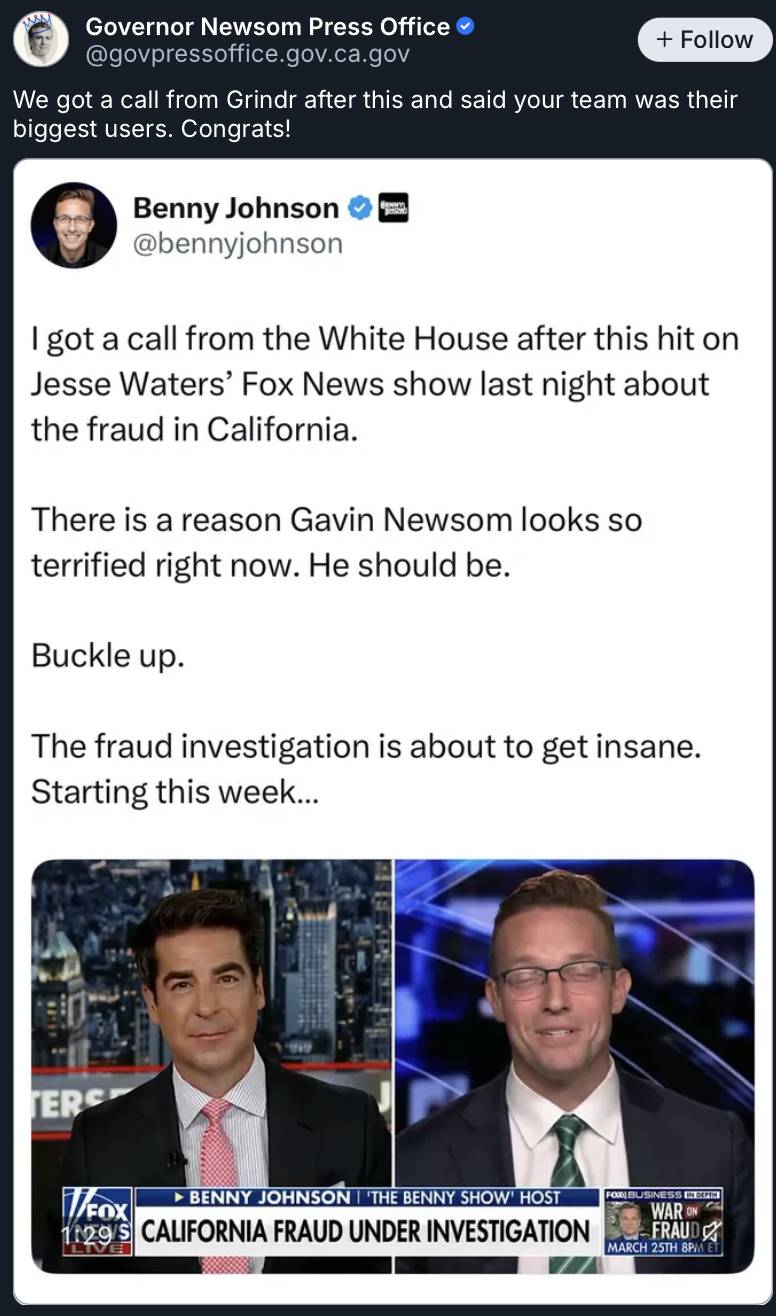
The exchange did not end there. Johnson later claimed on social media that he had received a call from the White House following his media appearances discussing alleged fraud in California.
In response, Newsom’s press office posted on Bluesky again, stating:
“We got a call from Grindr after this and said your team was their biggest users. Congrats.”
In a separate interaction involving a diss track clip shared by conservative rapper Tom MacDonald, the press office replied:
“bro, we get it but he’s not interested… stick to Grindr.”
These responses continued to center around the same theme, extending the online back-and-forth.
RELATED: Did Gavin Newsom Cross a Line With His Grindr Joke About a MAGA Influencer?
Why the Response Is Being Critiqued
While political exchanges on social media often involve humor or sarcasm, some LGBTQ commentators have pointed out that using references to Grindr—or implying someone’s sexuality as part of a joke—can reinforce outdated ideas.
Grindr is widely recognized as a platform used primarily by gay, bisexual, and queer men. When it is used as a punchline, critics argue, it risks framing queerness as something to be mocked rather than normalized.
For LGBTQ audiences, the concern is not about political disagreement, but about how language is used in those disagreements. Even when directed at political opponents, these types of remarks can echo rhetoric that has historically been used in harmful ways.
Messaging and Representation
Newsom has previously positioned himself as a supporter of LGBTQ rights, including advocacy for same-sex marriage and protections for transgender individuals.
California Governor Gavin Newsom:
“I want to see trans kids… There’s no governor that’s done more pro trans legislation than I have.”
— America (@america) December 11, 2025
Because of that record, the tone of these recent exchanges has prompted discussion about consistency in messaging—particularly when engaging with political opponents.
The broader issue raised by critics is whether humor that references queer identity, even indirectly, aligns with efforts to support and affirm LGBTQ communities.
The Bigger Picture
Political discourse online continues to evolve, often becoming faster, sharper, and more public. But for LGBTQ audiences, moments like this highlight how language—intentional or not—can carry broader implications.
As public figures engage in digital debates, the expectation from many in the community remains the same: that support for LGBTQ people extends not just to policy, but also to how conversations are framed in the public sphere.