


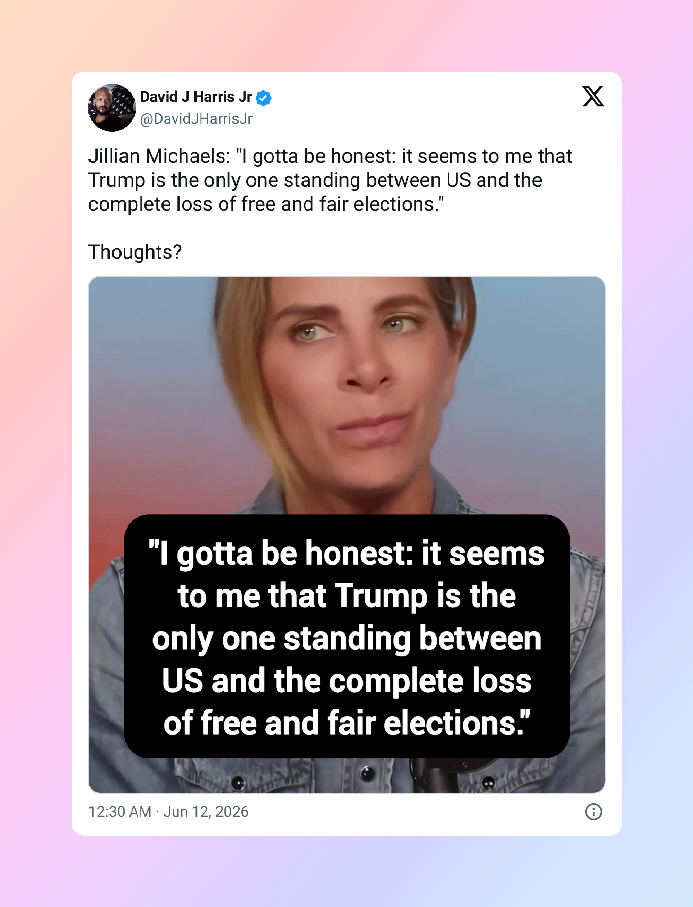
Jillian Michaels first became a household name as the tough-talking trainer on The Biggest Loser. Over the years, however, her public profile has expanded far beyond fitness.
In recent years, Michaels has become increasingly vocal about political and cultural issues, often aligning herself with conservative viewpoints and defending policies associated with both the MAGA and MAHA movements. Those positions have made her a frequent guest in political discussions and have also drawn criticism from people who once knew her primarily as a television personality.
Now, Michaels is once again making headlines after comments about LGBTQ+ visibility, Pride events, and public displays of sexuality sparked controversy online.
RELATED: “Make America Healthy Again”: Trump’s Nominee Draws Mixed Reactions
The Comments That Started the Conversation
During a recent discussion with former ESPN personality Sage Steele, Michaels criticized what she described as inappropriate public behavior at Pride celebrations.
Among her remarks, Michaels argued that adults wearing revealing outfits or displaying kink-related fashion in public spaces should keep those expressions private. She also suggested that such behavior contributes to negative perceptions of the LGBTQ+ community among some straight people.
💥NEW: Jillian Michaels: “You’ve got the gays in the street in a THONG dancing in front of CHILDREN in an S&M outfit. Take your kink to your PRIVATE BEDROOM!”
Sage Steele: “Thank you.” 🙏
Michaels: “If a straight person put themselves in a thong and shook their genitalia in… pic.twitter.com/KU92OfCuKx
— Jason Cohen 🇺🇸 (@JasonJournoDC) June 21, 2026
Her comments quickly circulated online, generating strong reactions from supporters and critics alike.
For some listeners, Michaels was raising a conversation about age-appropriate public events and boundaries in shared spaces. Others felt her language crossed into territory that unfairly stereotyped LGBTQ+ people and reduced an incredibly diverse community to a narrow set of images or occurences.
Particularly controversial was her use of the word “freak out” when discussing some participants at Pride events.
A Debate About Clothing, Visibility, and Double Standards
One criticism frequently raised in response to Michaels’ comments centers on the issue of double standards.
Many LGBTQ+ advocates noted that revealing clothing, costumes, and provocative fashion are hardly exclusive to queer spaces. Similar outfits can be seen at music festivals, sporting events, beaches, concerts, and countless other public gatherings involving people of all sexual orientations, including MAGA events.
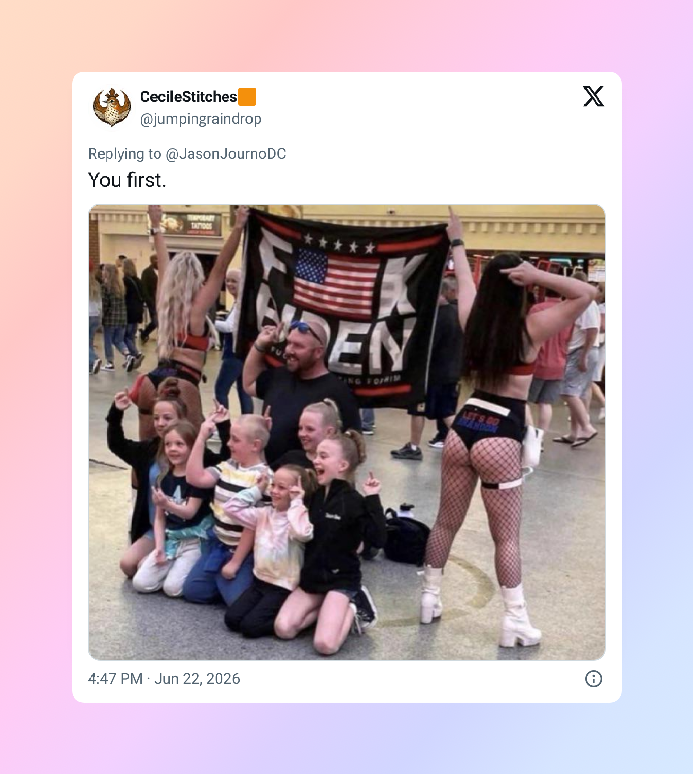
That has led some critics to ask why clothing choices become a larger cultural concern when associated with LGBTQ+ events.
Others argue that Pride celebrations have always contained a wide range of participants and expressions. Family-friendly activities, political activism, community organizations, performers, and nightlife culture often coexist under the same umbrella, making it difficult to define Pride through any single image.
RELATED: Could You Date a MAGA Supporter? Do You Consider It Being a Red Flag?
Michaels’ Political Evolution
Michaels’ comments are also being viewed through the lens of her broader political journey.
The fitness personality has spoken openly about how her views changed over time, including discussions about her marriage to DeShanna Marie Minuto.
Appearing on Dave Rubin’s podcast, Michaels reflected on assumptions she once held about political identity and described conversations with her wife as influential in reshaping her perspective. She acknowledged that the two had significant disagreements early in their relationship and credited those discussions with challenging some of her previous beliefs.
Jillian Michaels: The reality is that when you give gay people a month and veterans a day, I think you have wildly lost sight of your values and your priorities.
pic.twitter.com/JVMxkCwVhs— Defiant L’s (@DefiantLs) June 21, 2026
Why the Conversation Matters
The debate surrounding Michaels’ remarks touches on larger questions that have existed within LGBTQ+ communities for decades.
Who gets to define Pride?
What forms of expression help or hurt public perception?
And should concerns about respectability influence how LGBTQ+ people present themselves in public spaces?
There are no easy answers, which is likely why these conversations continue to generate strong reactions.
What is clear is that Michaels’ comments have reignited an ongoing discussion about visibility, identity, and representation. As Pride continues to evolve, so too does the debate over who gets to shape its future and what that future should look like.