

Around the world, LGBTQ communities continue to experience uneven progress—small legal victories in some countries, painful setbacks in others, and long-standing gaps that remain unresolved. Recent developments in the Philippines highlight how LGBTQ equality is often shaped not just by law, but by culture, religion, and political will.
Together, these cases show a familiar global pattern: recognition arrives in fragments, while full equality remains contested.
The Philippines: A Legal Win That Stops Short
In the Philippines, a recent Supreme Court ruling has marked an important moment for LGBTQ civil rights—though it also underscores how much work remains.
In a decision released on February 5, the Court ruled that same-sex couples may be legally recognized as co-owners of property they acquired and paid for together while living as partners. The ruling clarified that LGBTQ couples fall under provisions of the Family Code governing cohabiting partners who are not legally allowed to marry.
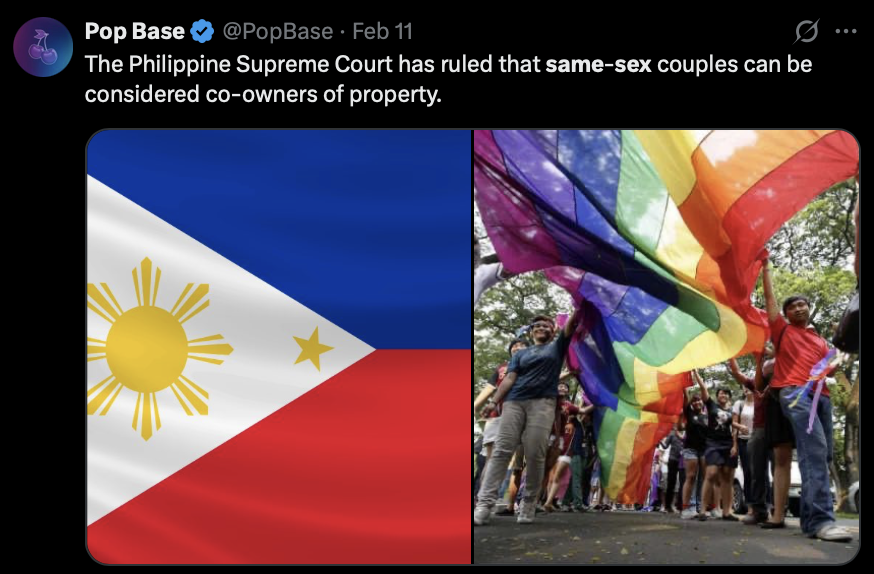
This distinction matters. While Philippine law still defines marriage strictly as between a man and a woman, the Court acknowledged that same-sex couples exist, cohabit, and build lives together—and that those realities must be reflected in property law.
The case stemmed from a dispute between former partners Jennifer Josef and Evalyn Ursua over a home they had jointly financed while living together. Lower courts previously declined to recognize Josef’s claim to co-ownership. The Supreme Court reversed those rulings, emphasizing that shared financial contributions during cohabitation create legitimate property rights, regardless of gender.
The Court pointed to Article 148 of the Family Code, which applies to couples who live together but are not legally allowed to marry. Unlike Article 147, which applies to unmarried couples who can legally wed, Article 148 recognizes shared ownership strictly based on actual contributions—money, labor, or resources.
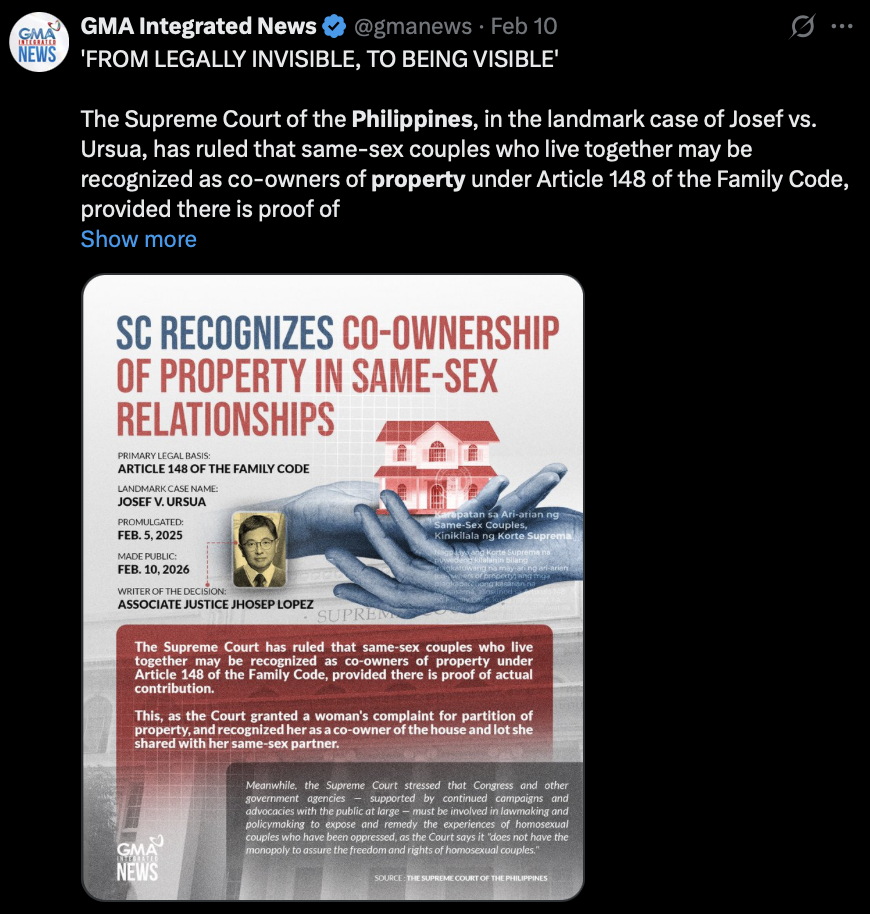
Importantly, the Court stressed that excluding same-sex couples from these protections would make certain intimate relationships legally invisible. In acknowledging LGBTQ partnerships as valid under property law, the decision represents a meaningful step toward recognition.
LGBTQ advocacy groups welcomed the ruling as landmark jurisprudence, particularly in a legal system that has historically excluded queer people. Still, activists were clear: recognition as co-owners is not the same as recognition as couples.
RELATED: Free Train Rides for LGBTQ — Festive Gesture or Awkward Ask?
Recognition Without Marriage: A Persistent Gap
Despite the ruling, same-sex unions and marriages remain unrecognized in the Philippines. The Supreme Court itself acknowledged this gap, openly calling on Congress and government agencies to take responsibility for addressing the rights of LGBTQ couples beyond the courtroom.
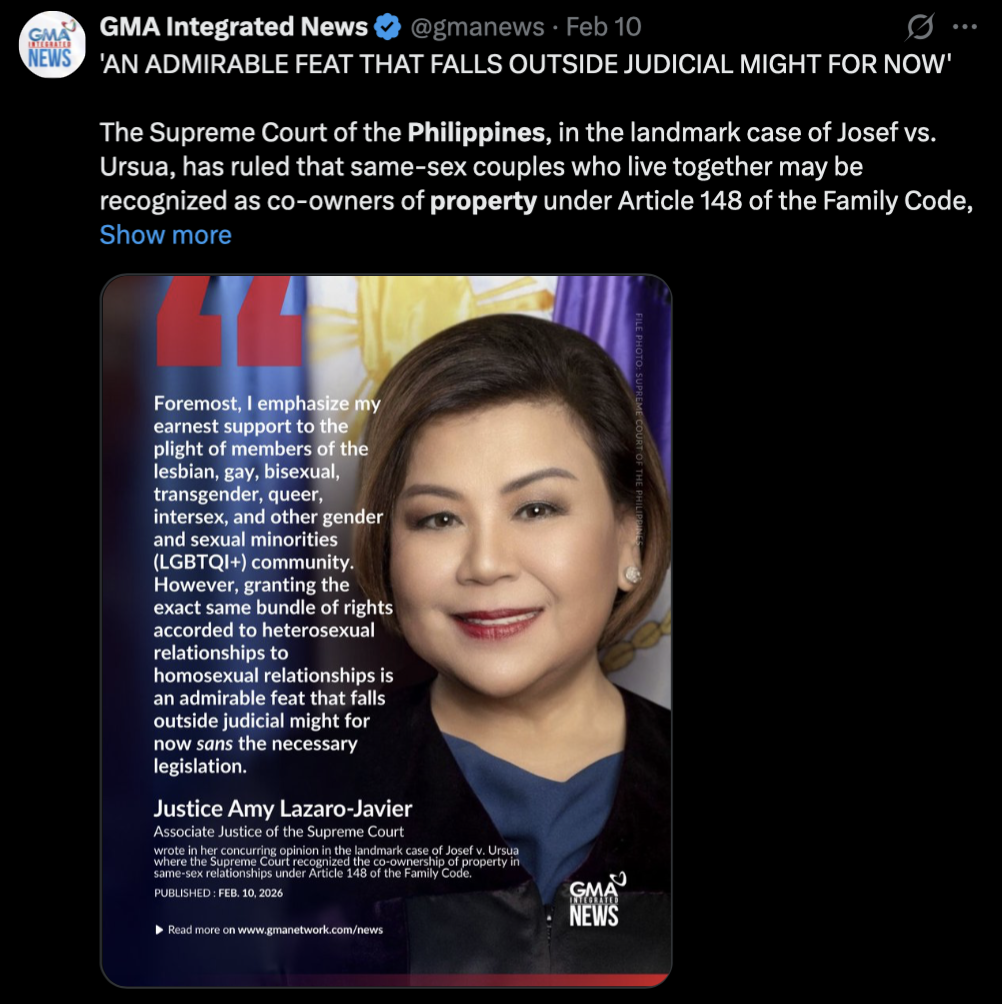
The Court emphasized that while judicial decisions can offer protection, lasting equality requires legislation—laws shaped through public debate, advocacy, and political engagement. It recognized that LGBTQ rights are deeply entangled with moral, cultural, and religious considerations, and that these conversations must happen openly rather than being avoided.
In short: the ruling is progress, but not resolution.
Faith, Law, and LGBTQ Visibility in the Philippines
The Philippines remains a predominantly Roman Catholic country, and religion continues to exert powerful influence over laws affecting LGBTQ people. Despite growing visibility and public support, legal recognition for same-sex couples has long been stalled by deeply rooted religious doctrine and conservative political resistance.
That’s why recent legal developments matter. While marriage equality remains out of reach, the ruling affirms something fundamental: LGBTQ relationships exist, and they cannot simply be ignored under the law. It marks a shift—subtle, technical, but meaningful—within a system that has historically refused to acknowledge queer partnerships at all.
The tension is unmistakable. On one side are lived LGBTQ realities—families, partners, shared lives. On the other are institutions shaped by tradition, doctrine, and fear of change. Progress in the Philippines has not come through sweeping reform, but through careful legal recognition carved out within existing frameworks.
Progress Is Real, But Uneven
The LGBTQ equality movement rarely moves in straight lines, and the Philippines is no exception. Wins are often partial. Recognition arrives in narrow language before it reaches everyday life. And visibility still does not guarantee acceptance.
Still, this moment matters. Legal acknowledgment—even without marriage equality—chips away at enforced invisibility. It affirms that LGBTQ Filipinos are not asking for something abstract, but for recognition of relationships that already exist.
Every ruling, every debate, and every public conversation keeps pressure on institutions slow to adapt. Progress may be incremental, but it is cumulative. And in a country where silence has long been the norm, even limited recognition signals that change—however gradual—is possible.
As much as I am happy with this, corruption is still the number one issue in the Philippines
It will be a long time until Philippines recognizes same-sex marriage. After all, there are only two countries in the world that don’t allow divorce. One is Vatican City and the other is the Philippines.