

If the last few years have taught the LGBTQ community anything, it’s this: progress is never permanent. Rights can expand—and they can be challenged just as quickly. Across the U.S., LGBTQ issues are once again front and center in statehouses, Congress, and ballot boxes, with elected officials drawing clear lines about where they stand. From New York to Virginia to Washington, here’s a roundup of the latest LGBTQ political news that matters right now—and why it matters.
New York’s Erik Bottcher: “The State Must Be a Bulwark”
In New York, voters sent a clear message last week by electing Erik Bottcher, a gay Democrat, to the State Senate. Bottcher easily won the special election, leaving his seat on the New York City Council to fill the vacancy left by Brad Hoylman-Sigal, another openly gay Democrat.
Today, we stood with Senator @SenSchumer at the Stonewall National Monument as he unveiled federal legislation with Congressman @RepDanGoldman to make the Pride Flag a congressionally authorized symbol. 🏳️🌈✊
The Pride Flag belongs here, visibly and permanently. pic.twitter.com/nwnf2I9VYS
— Erik Bottcher (@ebottcher) February 16, 2026
Following his win, Bottcher made it clear that he sees New York as a frontline state in protecting civil rights—especially under the looming influence of Donald Trump and his allies.
“At a moment when Donald Trump and his allies are doubling down on division, cruelty, and attacks on fundamental freedoms, New York must be a bulwark,” Bottcher said in a statement to The Advocate.
Bottcher emphasized that his focus in Albany will extend beyond symbolism. He outlined priorities including lowering the cost of living, expanding affordable housing and tenant protections, strengthening public safety while investing in mental health services, improving public transit, and defending “core rights, including LGBTQ+ New Yorkers’ freedom to live safely, openly, and without fear.” Importantly, he framed his victory not as an endpoint, but a beginning: “This victory is the start, not the finish.” With a general election still ahead, Bottcher positioned himself as steady, values-driven leadership in a political climate increasingly defined by extremism.
Virginia Voters May Decide the Future of Marriage Equality
Down in Virginia, momentum around marriage equality is building. In early February, Abigail Spanberger approved legislation that moves a constitutional amendment one step closer to reality—one that would undo the state’s 2006 ban on same-sex marriage. With that signature, the question now shifts to voters, who will decide in November whether marriage equality should be permanently written into Virginia’s constitution.
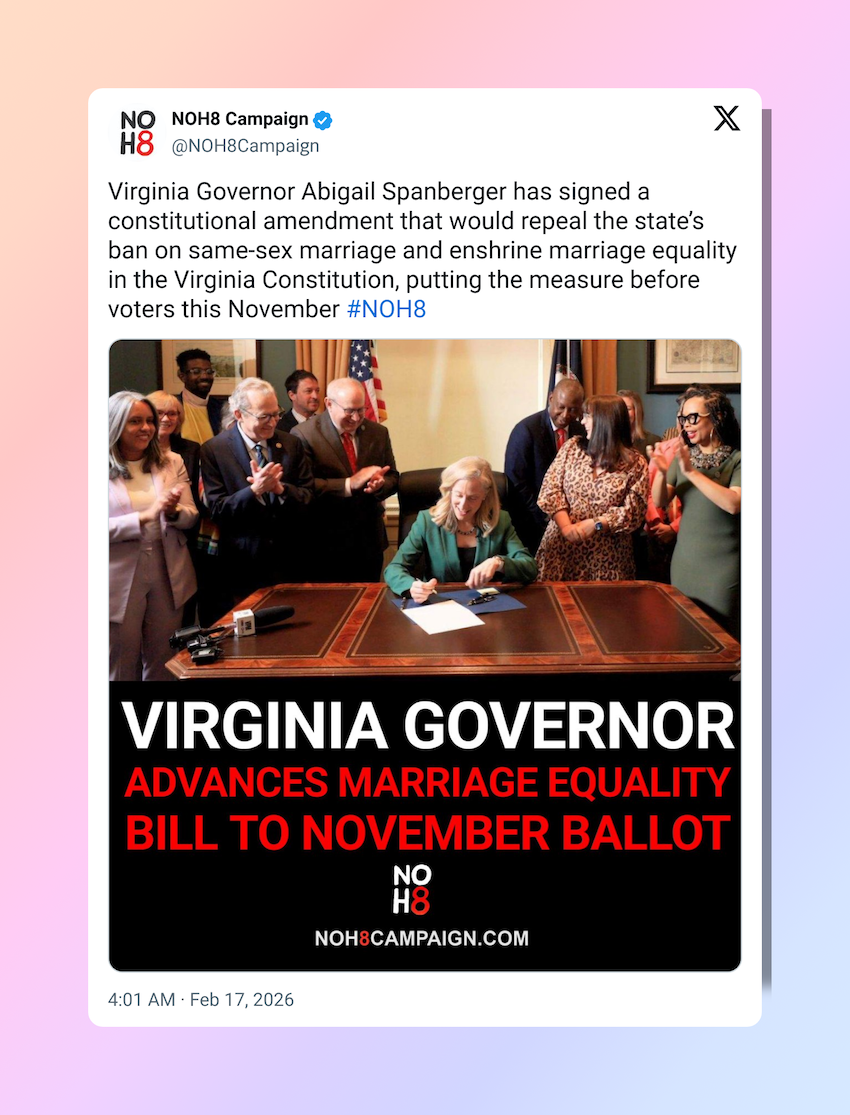
If voters give it the green light, the amendment would make it clear that any two consenting adults can marry—no matter their gender or sexual orientation—and that those marriages must be recognized equally under Virginia law. Even though marriage equality is currently protected at the federal level, LGBTQ advocates have emphasized that state-level safeguards matter more than ever, particularly as conservative legal movements continue to test established rulings. For many Virginians, this ballot measure goes beyond legal housekeeping—it’s an opportunity to formally affirm that LGBTQ families belong, are valid, and deserve lasting protection.
Schumer Moves to Protect the Pride Flag at Stonewall
In Washington, Senate Minority Leader Chuck Schumer took direct aim at the Trump administration after the Pride flag was removed from Stonewall National Monument in New York City. The administration cited a directive claiming the Pride flag was not a congressionally authorized flag—a move that sparked outrage across the LGBTQ community.
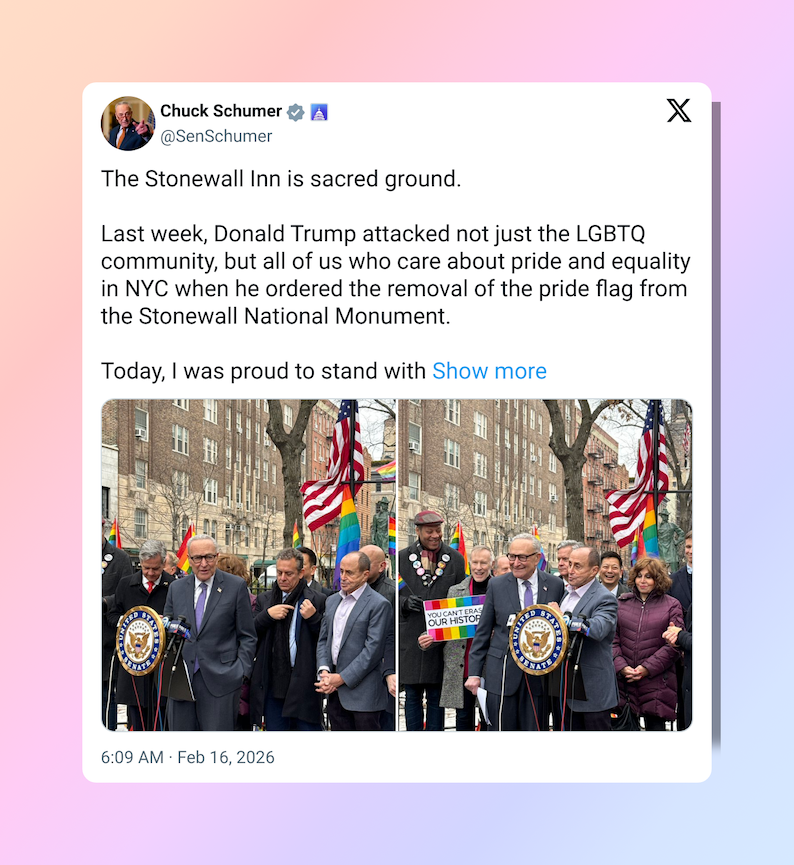
Schumer didn’t mince words, calling the removal “a deeply outrageous action” and “an effing disgrace.” Speaking passionately about Stonewall’s significance, he added,
“It sparked the beginning of a movement that changed America and the world forever, and we’re not going back.”
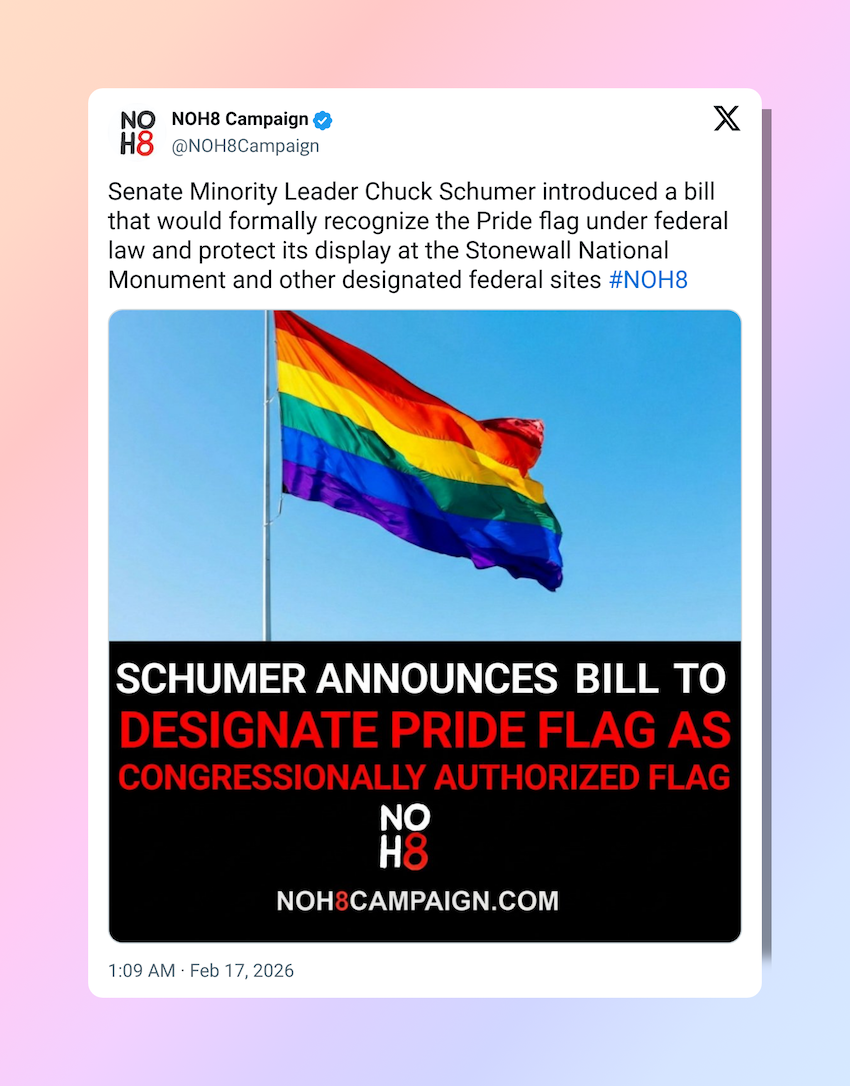
In response, Schumer introduced legislation that would formally recognize the Pride flag under federal law, making it a congressionally authorized flag. The bill would permanently protect the flag’s display at Stonewall and other designated federal sites, effectively bypassing any future attempts to remove it under administrative technicalities. The move builds on Schumer’s prior work supporting LGBTQ rights, including his role in passing the Respect for Marriage Act, which was signed into law by Joe Biden in 2022 and provides federal protections for same-sex marriage should the Supreme Court ever overturn Obergefell v. Hodges.
RELATED: UPDATE: Is the Pride Flag Back at Stonewall?
Why This Moment Matters
Taken together, these stories reveal a larger truth about LGBTQ politics in 2026: visibility alone is no longer enough. Protection must be written into law, defended loudly, and reinforced at every level of government. Whether it’s a newly elected gay state senator calling for resistance, a state preparing to let voters affirm marriage equality, or a Senate leader fighting to keep the Pride flag flying where the modern movement began, the message is clear.
The LGBTQ community is watching. And more importantly, it’s organizing, voting, and refusing to let hard-won rights quietly slip away.