

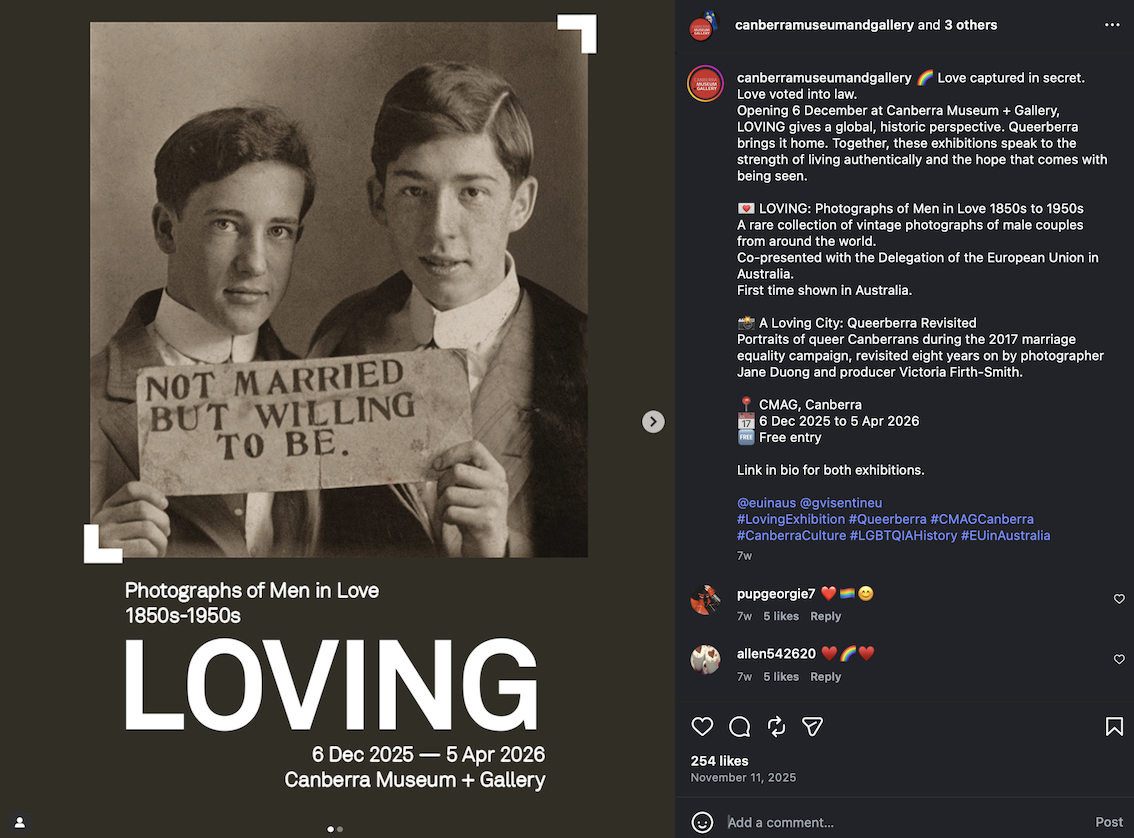
Men have always loved men, even when the world refused to acknowledge it, and LOVING: Photographs of Men in Love 1850s–1950s captures that truth through images that feel both intimate and quietly defiant. Now on display at the Canberra Museum and Gallery, the exhibition offers a rare visual history of male couples whose relationships existed long before legal recognition, visibility, or safety were guaranteed.
RELATED: From College Wrestlers to Hot Men Kissing: Inside This Photog’s Journey
Love Preserved in Plain Sight
Collected over decades by Hugh Nini and Neal Treadwell, the photographs span a century marked by criminalization and silence. Taken between the 1850s and the 1950s, the images document men from around the world in moments of unmistakable closeness. These are not abstract representations of companionship but deeply personal portraits that reveal affection through posture, proximity, and ease.
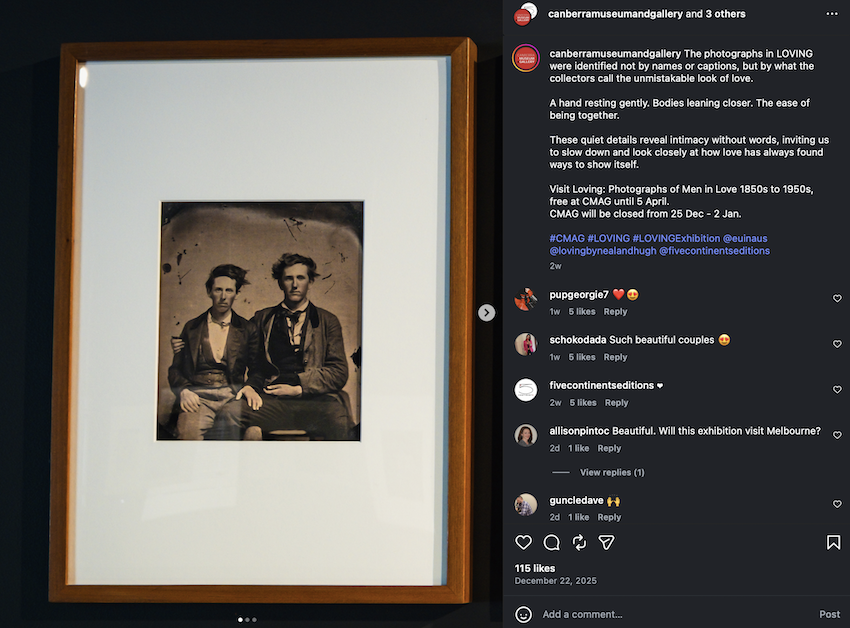
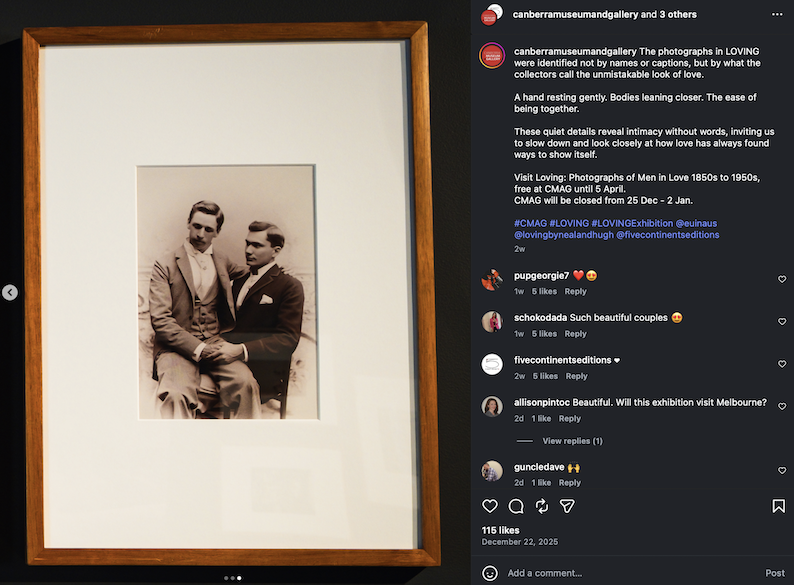
The men photographed sit shoulder to shoulder, lean into one another, or allow a hand to rest gently where only intimacy would permit. In many images, the camera captures something unguarded: a softness in the eyes, a relaxed smile, a trust that feels startling given the risks of the time. Nearly all of the men remain unnamed, yet their emotions speak clearly across generations.
Recognizing Love Without Names
In an interview with ABC News Australia, Nini and Treadwell explained that they identified these photographs not through labels or historical records, but by learning to recognize what love looks like. Over time, they came to understand the visual language of intimacy: the way bodies gravitate toward each other, the ease of shared space, and the quiet confidence that emerges between partners who feel safe together, even briefly.
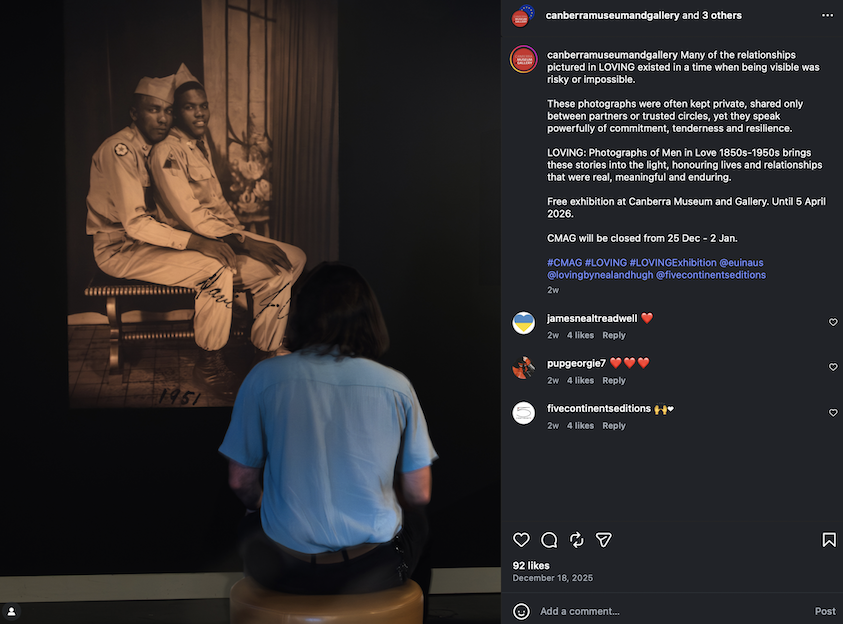
Many of the images were never meant for public view. They were taken for private keeping, for pockets, wallets, and drawers, meant to be shared only between lovers or trusted friends. Yet in preserving these photographs, the men made a subtle declaration that their relationships mattered enough to be remembered.
A Global History of Intimacy
The collection reveals a remarkably diverse portrait of queer life. Soldiers pose before deployments, sailors lean close on docks, working-class men sit together in modest rooms, and wealthier couples appear in professional studios. The settings range from public streets to private interiors, from beaches to photo booths, each location offering a different level of risk and visibility.
Some images even show men embracing or kissing in public spaces, suggesting that queer love was not always entirely hidden, even in eras defined by repression. These moments challenge the assumption that same-sex relationships existed only in secrecy, revealing instead a spectrum of visibility shaped by circumstance, courage, and community.
From Secret Love to Public Recognition
Presented in Australia for the first time and co-presented with the Delegation of the European Union in Australia, LOVING is paired with A Loving City: Queerberra Revisited, a contemporary exhibition that grounds the historical narrative in lived local experience. Created by photographer Jane Duong and producer Victoria Firth-Smith, the project revisits portraits of queer Canberrans taken during the 2017 marriage equality campaign, now seen again eight years later.
Where LOVING documents love captured quietly and often in secret, Queerberra Revisited reflects love stepping into public view and being affirmed by law. Together, the exhibitions form a powerful dialogue between past and present, showing how visibility, safety, and recognition have evolved, while love itself remains constant.
A History That Includes Everyone
The exhibitions also highlight the presence of trans and gender-diverse individuals within queer history, reinforcing that gender diversity is not a modern invention but an enduring reality. These lives, too, were lived fully, even when language and legal frameworks failed to acknowledge them.
Curator Nicole Sutherland has noted that the emotional response to the exhibition has been profound. Visitors often describe a sense of recognition and relief, seeing proof that men like them loved deeply long before modern rights movements existed. The photographs offer validation not only of struggle, but of joy.
Love That Refuses to Disappear
Nini and Treadwell describe themselves not as authors of this history, but as caretakers. Their work ensures that these relationships, once at risk of being forgotten, are now visible to the world. The images do not ask for permission or pity. They simply exist, insisting on their own truth.
Ultimately, LOVING reminds us that queer love did not suddenly emerge in the modern era. It has always been here, waiting in photographs, surviving quietly until it was safe to be seen.