

At this point, the question many LGBTQ+ viewers are asking about Ricky Gervais isn’t why he told trans jokes in the first place. It’s why—years later, amid growing criticism, rising anti-trans legislation, and increased violence against transgender people—he continues to double down.
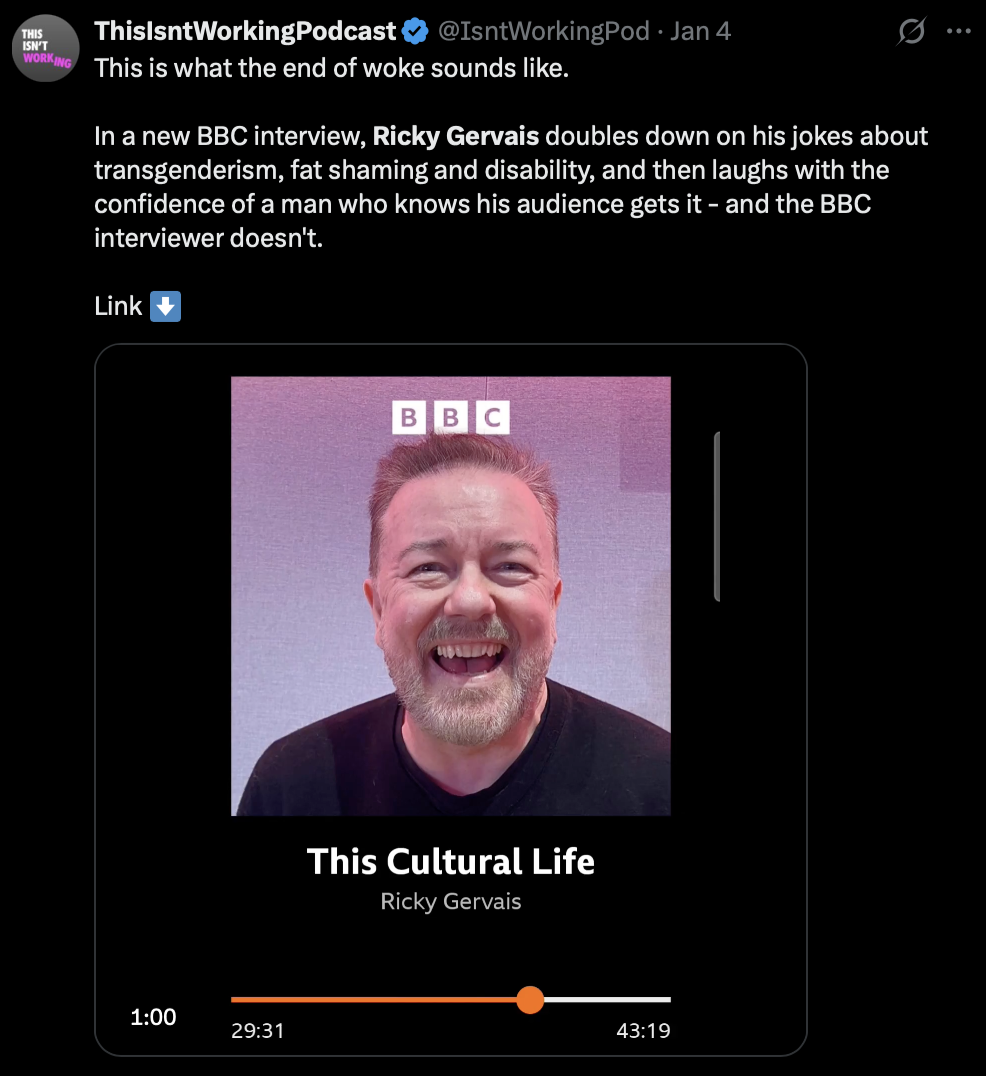
In a recent interview on BBC Radio’s This Cultural Life, Gervais was asked directly whether he had failed to “change in parallel with the times” and whether his increasingly “anti-woke” posture had become part of his public identity. His response was blunt: he believes he’s right.
That answer helps explain not only why the jokes persist, but why they’re getting harsher.
RELATED: A Paper Called Trans People “Demonic.” University Punished Instructor Instead
The “I’m Right” Philosophy
When pressed on why he stands by controversial material—particularly jokes about transgender people—Gervais framed the issue not as one of harm, but of artistic entitlement. He emphasized his right to talk about anything and rejected the idea of revisiting or apologizing for past jokes.
This framing is central to understanding his current approach. To Gervais, criticism isn’t feedback—it’s a threat to creative freedom. And rather than reassess the impact of his humor, he has chosen escalation as a defense mechanism.
He even joked that he intentionally tries to become more offensive over time, so earlier material looks kinder by comparison. For LGBTQ+ audiences, this isn’t self-awareness—it’s a declaration that discomfort is the point.
Comedy as Combat, Not Conversation
Gervais has increasingly positioned himself as a cultural contrarian: a comedian standing against what he characterizes as excessive sensitivity or “wokeness.” In this framework, transgender people are not treated as a marginalized group navigating real-world consequences—but as symbols in a broader culture war.
That distinction matters.
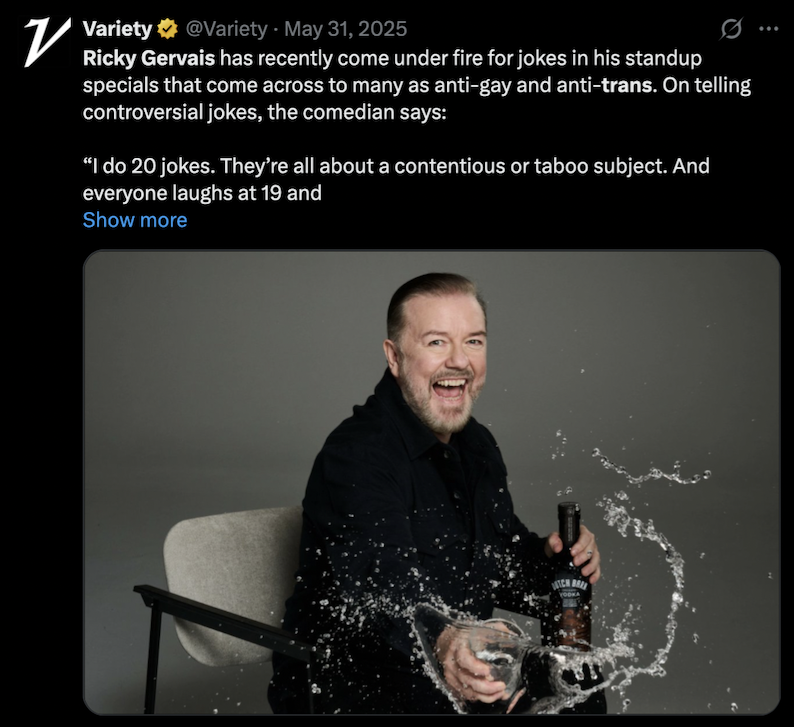
Comedy that “punches up” historically challenges power. But Gervais’ trans jokes punch sideways—or downward—at a community facing disproportionate rates of harassment, legislative targeting, and violence. When challenged on this imbalance, his response has not been reflection, but resistance.
For many LGBTQ+ viewers, this is where the frustration deepens. The refusal to engage with context suggests that the outrage itself has become part of the act.
“Trans Rights Are Human Rights”—With a Catch
Perhaps the most confusing—and painful—aspect of Gervais’ defense is his insistence that he supports trans rights. In his 2022 Netflix special SuperNature, he explicitly said so, before immediately undercutting that claim with demeaning jokes about trans bodies.
Ricky Gervais on Trans Women (SuperNature) 🤣🤣 pic.twitter.com/pdqKhBRiW0
— Baroque (@Maxx_Stein) April 25, 2024
This rhetorical move—affirmation followed by mockery—has been widely criticized by LGBTQ+ advocates as hollow. Support is not a disclaimer that cancels out harm. And intent does not erase impact.
For trans viewers, hearing their identities reduced to punchlines—especially by someone who claims allyship—feels less like satire and more like betrayal.
Why He Won’t Rework the Material
Gervais has said he would consider adding trigger warnings to older content but would not alter or retract jokes. This compromise signals how he understands responsibility: warning audiences, rather than changing behavior.
But trigger warnings don’t address the core issue for LGBTQ+ audiences—that these jokes reinforce stereotypes, legitimize ridicule, and echo rhetoric used to justify discrimination. The harm doesn’t begin when viewers press play; it exists in how the material circulates, who it empowers, and what it normalizes.
The Bigger Picture for LGBTQ+ Audiences
So why does Gervais think this is still okay?
Because his comedy now operates within a feedback loop that rewards controversy. Each backlash reinforces his image as a fearless truth-teller. Each critique becomes proof, in his view, that he’s challenging something sacred. And platforms continue to give him space—often framing criticism as part of the entertainment.
For LGBTQ+ people, especially trans individuals, the stakes are not theoretical. When influential figures mock trans identities, it doesn’t exist in isolation. It lands in a world where lawmakers debate trans healthcare, where schools restrict trans students, and where violence against trans people remains alarmingly high.

Why It Feels Worse Now
What makes Gervais’ doubling down feel particularly harsh is timing. In an era when trans people are fighting for basic safety and recognition, jokes that reduce them to anatomy feel less like edgy comedy and more like piling on.
The issue isn’t that comedy can’t be uncomfortable. It’s that discomfort should challenge power, not entrench it.
The Bottom Line
Ricky Gervais isn’t “making it worse” by accident. He’s doing it deliberately—because escalation has become his answer to accountability. He believes being challenged means he’s doing something right.
For LGBTQ+ audiences, especially trans viewers, that belief reveals the core problem: when a comedian prioritizes provocation over people, the joke stops being about humor—and starts being about harm.
And that’s why so many are no longer laughing.