

In a political landscape where divisive rhetoric often steals the spotlight, Rob Jetten, the 38-year-old leader of the Dutch centrist D66 party, is rewriting the script. With his upbeat “yes we can” attitude and a campaign that spoke to everything from climate change to housing crises, Jetten has captured the attention of voters across the Netherlands—and with good reason. He’s now poised to become the youngest and first openly gay prime minister in the country’s history.
RELATED: Gavin Newsom Goes Full Throttle Against Trump’s ‘Anti-Woke’ Agenda
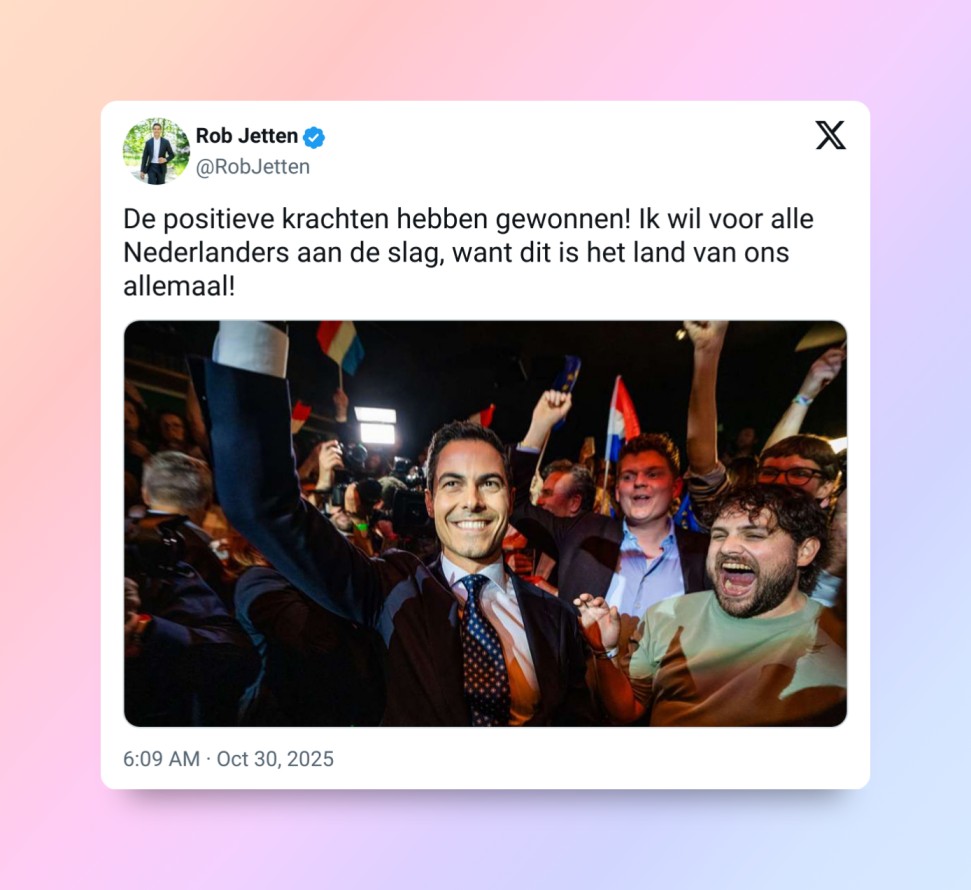
A Campaign Transformation: From Climate Minister to Charismatic Candidate
But it wasn’t always smooth sailing for the former climate minister, who once found himself boxed into the role of the “nagging environmentalist.” In fact, his transformation from climate warrior to charismatic candidate has been one of the more striking shifts in recent Dutch political memory. Jetten’s campaign trail was a masterclass in modern political branding: polished messaging, a well-funded media blitz, and a strategic pivot from traditional issues like education and climate to more polarizing topics like immigration and housing. And it worked. His party’s strong performance in the recent election has put him on track to form a coalition and assume the role of prime minister.
RELATED: No Pride Flags Allowed. But a Gay Congressman Might Be Coming to Town
Tackling Divisive Issues: Immigration and Housing Crisis
While many expected Jetten’s campaign to be dominated by his party’s historic environmental stance, he quickly proved that he could meet the Dutch electorate where they are—on tough topics like migration and housing. His bold stance against far-right firebrand Geert Wilders, whom he accused of “hijacking” Dutch identity for political gain, was central to his strategy. “Together we can beat Wilders, I am ready,” Jetten posted on Instagram on election morning, channeling optimism at a time when so much of the conversation in Dutch politics had been about fear and division.
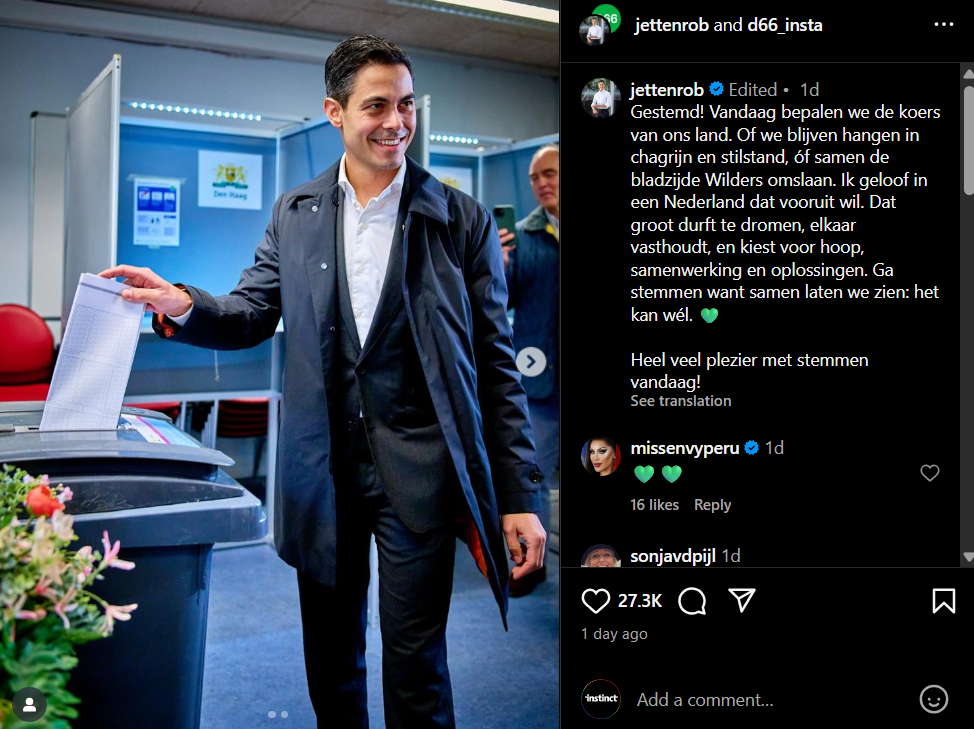
Jetten’s approach to leadership has struck a chord, even among political rivals. Kajsa Ollongren, a fellow D66 party member and former defense minister, didn’t mince words when talking about Jetten’s talent: “Rob is without a doubt one of the most talented politicians the Netherlands has ever had. I’m sure that if we win as the exit polls say we do, he’ll want to unite the country and turn around the negative spiral that Wilders has pushed the country in.”
A Personal Touch: Jetten’s Love Story and Viral “Bromance”
While Jetten’s politics are certainly front and center, his personal life is equally fascinating. Jetten would be the Netherlands’ first openly gay prime minister, but don’t expect his sexuality to overshadow his political platform. The Netherlands has long been a leader in LGBTQ rights, and his party was instrumental in legalizing same-sex marriage back in 2001—the first country in the world to do so. Still, Jetten’s openness about his sexuality has captured public imagination in ways beyond policy.

A TikTok video went viral in 2021 showcasing his “bromance” with another Dutch politician, and it ultimately led to one of the most heartwarming love stories in recent political history. Through the magic of social media, Jetten met his fiancé, Nicolas Keenan, an Argentinian international hockey player. The two will marry next August, a ceremony that will no doubt be celebrated by many fans who adore the politician’s charming and relatable persona.

“We met at a supermarket, and he recognized me from the TikTok video compilations,” Jetten said of their meet-cute. It’s not every day a national leader finds love in the aisles of a grocery store—especially in this era of soundbites and staged photo ops.
A Pragmatic Approach to Immigration and Housing
But it’s not all lighthearted romance and viral videos. Jetten’s leadership is grounded in hard-nosed political realities, and his proposals to combat illegal immigration, as well as address the country’s chronic housing shortage, show that he’s not just a pretty face in the political arena. To discourage dangerous migrant journeys, Jetten has suggested asylum applications be processed from outside the EU, and he’s called for increased spending on integration programs. “People that really are fleeing from war and violence are received in a decent way, learn the language, and can participate (in society),” he said, adding that “the rotten apples” must be deported.
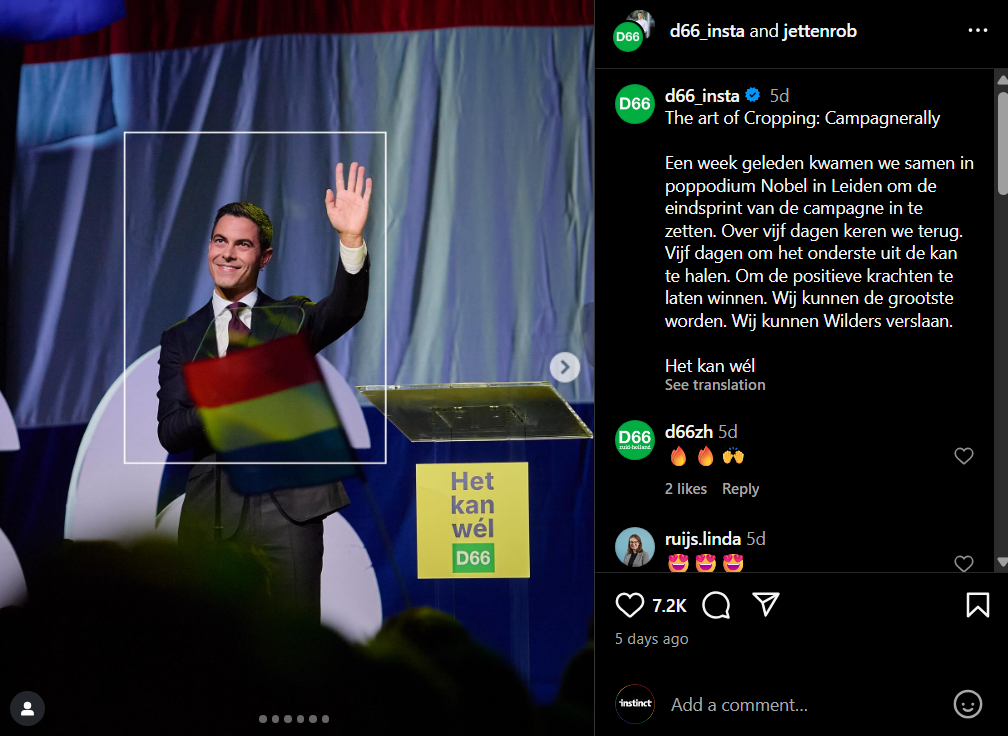
As for the housing crisis—a top concern for many voters—Jetten’s proposal to build 10 new towns and contribute 2 billion euros annually to housing initiatives is a bold step to address the shortage. And to speed up the process, he’s suggested cutting red tape to enable the construction of 100,000 new homes every year. The ideas are big, but for Jetten, the approach is pragmatic. His pitch to Dutch voters: Cooperation over confrontation, optimism over fear.
Uniting the Country: A Contrast to Wilders’ Divisive Politics
It’s a stark contrast to the tactics of his political opponents, particularly Wilders, who has drawn ire for his divisive rhetoric and vitriol towards marginalized groups. The far-right leader has even been accused of using women’s and LGBTQ rights as a political tool to further his anti-Muslim agenda. Jetten, on the other hand, stands firmly against such divisive politics, calling for unity over division.
Looking Forward: Rob Jetten’s Vision for the Netherlands
In many ways, Rob Jetten represents the kind of leader the Netherlands—and the world—needs right now. A politician who can blend pragmatism with hope, optimism with strategy, and above all, lead without succumbing to the toxic negativity that has too often characterized global politics.
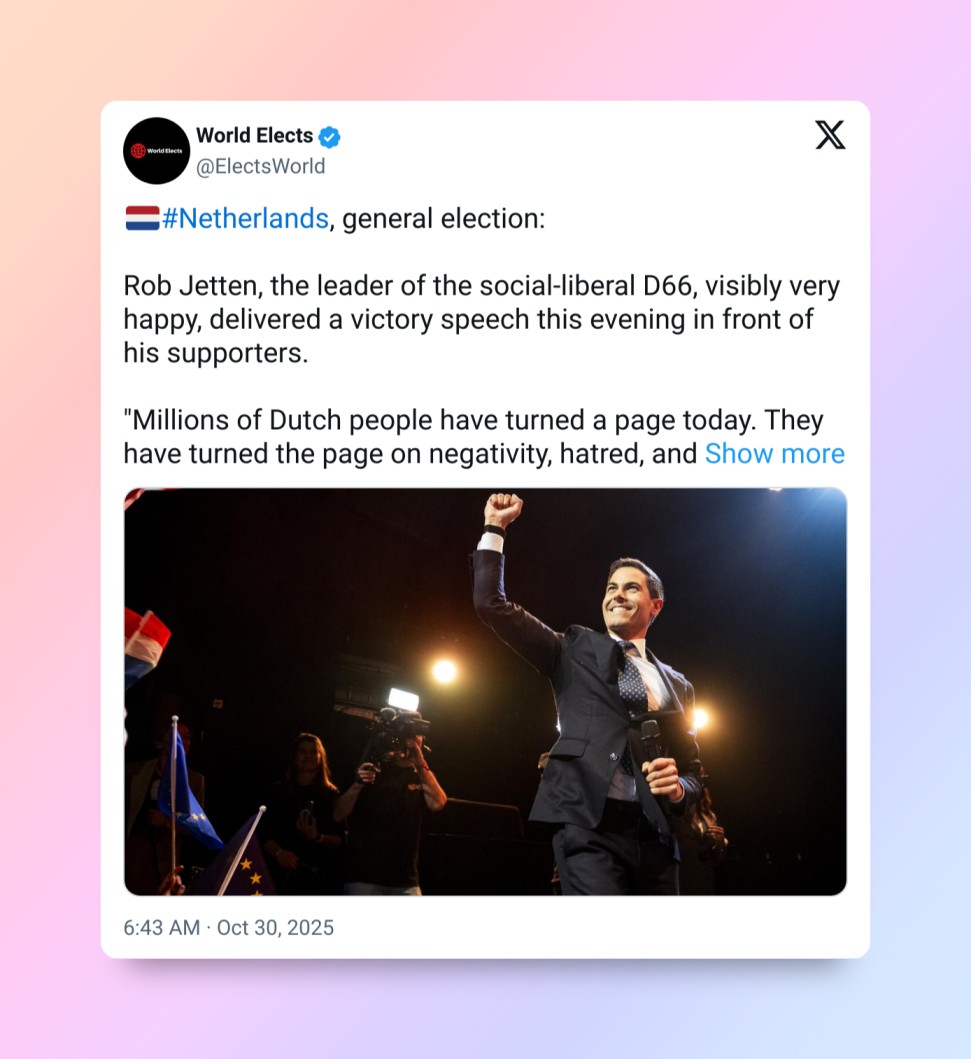
Whether he’s shaking up the political status quo or simply proving that love, leadership, and a bit of TikTok magic can go a long way, one thing’s for sure: Rob Jetten is a name to watch, and the Netherlands’ political future looks brighter than ever with him at the helm.
@dwnews It’s a neck and neck finish in the Dutch elections, with the centrist D66 party and the far right Freedom Party tied in first place at 26 seats apiece according to projected results. Geert Wilders’ Freedom Party (PVV) remains popular and influential — but will likely be relegated to opposition. The PVV walked out on its own coalition government earlier this year over disagreements on immigration policy, and now centrist rivals are refusing to work with it. Rob Jetten’s D66 party was the big winner of the night, seeing its support surge. Coalition negotiations could take months, but the results may pave the way for Jetten to become the Netherlands’ youngest and first out gay prime minister — marking a comeback for the Dutch political center.
Source: Reuters
This is a fascinating and truly inspiring article about Rob Jetten potentially becoming the Netherlands’ first openly gay Prime Minister. It’s incredible to see a leader blending optimism with pragmatic policy on issues like immigration and housing. Speaking of navigating complex systems, the challenges he faces with policy and integration remind me of the intricate work bioinformaticians do to understand and manage pathogens. I recently read a detailed guide on the tools and mindset required for that kind of high-stakes analysis at https://biovirus.org/navigating-the-viral-landscape-a-bioinformatician-s-guide-to-pathogen-analysis. It makes me wonder, for a leader like Jetten, what are the most critical “bioinformatic” tools—data analysis, forecasting models, etc.—that a modern government should employ to successfully integrate diverse populations and predict the outcomes of such complex social policies?
Some but not all refugees are homophobic and transphobic. Like some of the Dutch, especially right wing people and orthodox evangelicals, some Muslims and non-religious people.
I do not blame why the Dutch voted for Wilders. After all, there has been a huge uptick of violence against LGBTQ by muslim refugees.
I really hope he meant it when he said: that “the rotten apples” must be deported.
But how does one can prove the people who are asylum/refugees are the “People that really are fleeing from war and violence are received in a decent way, learn the language, and can participate (in society).”