


Sidephobia is raising questions about gay sex, sexual preferences, and why some people still seem to have strong opinions about what happens in someone else’s bedroom. Gay sex has a surprisingly efficient filing system. Top. Bottom. Vers. And now, increasingly, side. But what happens when someone doesn’t fit neatly into the positions everyone seems to know?
RELATED: Forget the 50/50 Rule: Bisexuality Doesn’t Need a Balanced Dating History
That’s the question behind a statement making the rounds on X — and whether sidephobia is becoming a bigger part of the conversation around gay sex:
“Why are gay people so sidephobic? What’s wrong with being a side? “
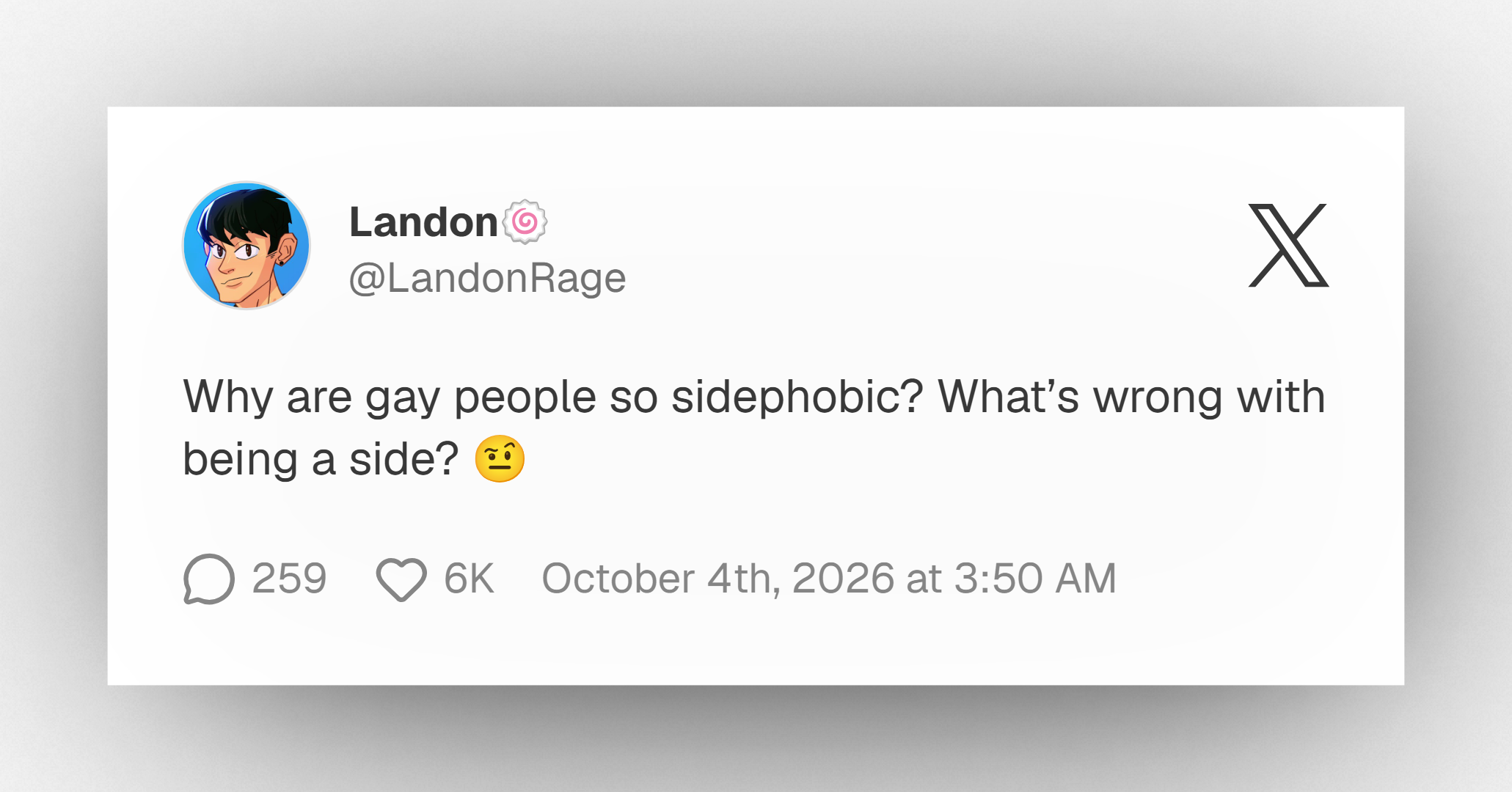
It sounds like a simple question, but it taps into a much bigger conversation about how gay men talk about sex — and why penetration can sometimes be treated as if it’s the required main event.
So, what exactly is a side?
A side generally refers to a gay man who doesn’t engage in anal penetration and instead prefers other forms of sexual intimacy. Psychotherapist and sex therapist Joe Kort has written about the term extensively, explaining that he coined “side” after realizing there wasn’t really a word for gay men who didn’t identify as tops, bottoms or versatile. That doesn’t mean they aren’t having sex. Far from it.
RELATED: Locktober: A Gay Guy’s Guide to Chastity and Oct’s Kinkiest Challenge
Oral sex, mutual masturbation, kissing, touching and other forms of non-penetrative intimacy can all be part of a side’s sexual life. A 2026 study published in the Journal of Sex Research similarly describes “Side” as a label for men who primarily engage in non-penetrative sex.
In other words, “side” isn’t a polite way of saying “not sexually active.” It’s a sexual preference and, for some people, an identity that helps explain what they actually want.
Why did “side” become necessary?
For a long time, gay male sexual conversations were dominated by the top-versus-bottom framework, with versatile offering the middle ground. That left some men wondering where they fit.
Kort has described feeling like an outsider because he didn’t engage in anal sex. His experience eventually led him to develop the term “side,” which later spread beyond his own writing and into gay dating culture.

Grindr eventually added “side” as a sexual-position option in 2022, giving users a way to identify themselves without forcing their preferences into the existing top, bottom or versatile categories. And honestly, it was probably overdue.
Dating apps already ask people to summarize their entire personality in a few photos, a handful of emojis and whether they reply within three business days. Giving people another way to describe what they actually want seems fairly reasonable.
Is sidephobia actually a thing?
Here’s where the conversation gets interesting. “Sidephobia” isn’t something we need to present as an established medical or academic term. But the attitude it is trying to describe — dismissing, misunderstanding or stigmatizing people because they don’t have penetrative sex — is certainly documented.

The Guardian spoke with sides who described feeling rejected, misunderstood or even treated as though they were somehow less complete as gay men because they weren’t interested in penetration. That’s not exactly imaginary.
The 2026 Journal of Sex Research study also found that participants understood “Side” in ways that went beyond a simple sexual preference, connecting it with bodily comfort, psychological safety, well-being and resistance to established sexual-role expectations.
So whether you personally like the word sidephobia or think it sounds like something invented during an exceptionally online afternoon, the underlying issue is worth discussing.
Maybe sex doesn’t need a default setting
Part of the problem is the assumption that everyone is supposed to want the same thing.
If someone says they’re a top, most people don’t immediately demand an explanation. If someone says they’re a bottom, that’s usually understood as a preference. If someone says they’re versatile, nobody calls a family meeting.

But tell someone you’re a side and suddenly the questions can begin. Are you sure? Have you tried it? What happened? Is it because of an ex? Maybe you’ll change your mind. And that’s where a perfectly ordinary sexual preference can start feeling like something that needs to be defended.
The reality is much less complicated. Some people enjoy anal sex. Some don’t, and sidephobia shouldn’t turn that difference into a judgment. Some people like it occasionally. Some prefer other forms of intimacy entirely. None of those preferences makes someone more or less gay.
The point isn’t to make everyone a side
The conversation shouldn’t turn into another competition over which sexual preference is supposedly better.

Sides don’t need to convince tops and bottoms to become sides. Tops and bottoms don’t need to justify themselves to sides. Versatile men aren’t failing to commit to a position. And nobody needs to earn a gold star for having the “right” kind of gay sex.
The useful thing about the word side is that it gives people another option when the traditional labels don’t describe them.
The 2026 research suggests that, for the men studied, the term can represent more than what they don’t do. It can also reflect comfort, agency and a different way of approaching sexual intimacy. Maybe that’s ultimately what this whole debate is about.
Not whether “sidephobia” deserves to become the next great gay vocabulary word, but whether people can stop treating someone else’s sexual preference like a problem that needs solving.
Because if someone is happy with the sex they’re having, isn’t that kind of the whole point?
What do you think? Do you think “sidephobia” describes a real attitude toward gay men who don’t have penetrative sex, or is it simply another label for an old problem with sexual expectations?
Source: Psychology Today