

What began as a typical reaction paper for a psychology course at the University of Oklahoma quickly spiraled into a political firestorm, placing a trans graduate instructor at the center of an increasingly heated debate. The assignment, focused on how society interprets gender roles, was submitted by student Samantha Fulnecky, who used her paper to argue that strict gender binaries are divinely mandated. She also referred to transgender identities as “demonic,” a characterization that deeply alarmed LGBTQ+ students and faculty.
Her paper did not address the actual academic questions posed in the assignment, according to the instructor. But after the essay was posted online by the campus chapter of Turning Point USA, the dispute grew far beyond the classroom walls.
RELATED: The Worst Colleges For LGBTQ Students In The Country Are…
The Instructor’s Reasoning: Evidence Over Ideology
Graduate teaching assistant Mel Curth, who is trans, graded the paper based solely on academic criteria and assigned a zero. Curth explained in detailed comments that the grade reflected the paper’s lack of empirical support, failure to answer the prompt, and reliance almost entirely on personal ideology.
Curth wrote:
“Please note that I am not deducting points because you have certain beliefs, but instead I am deducting point for you posting a reaction paper that does not answer the questions for this assignment, contradicts itself, heavily uses personal ideology over empirical evidence in a scientific class, and is at times offensive.”
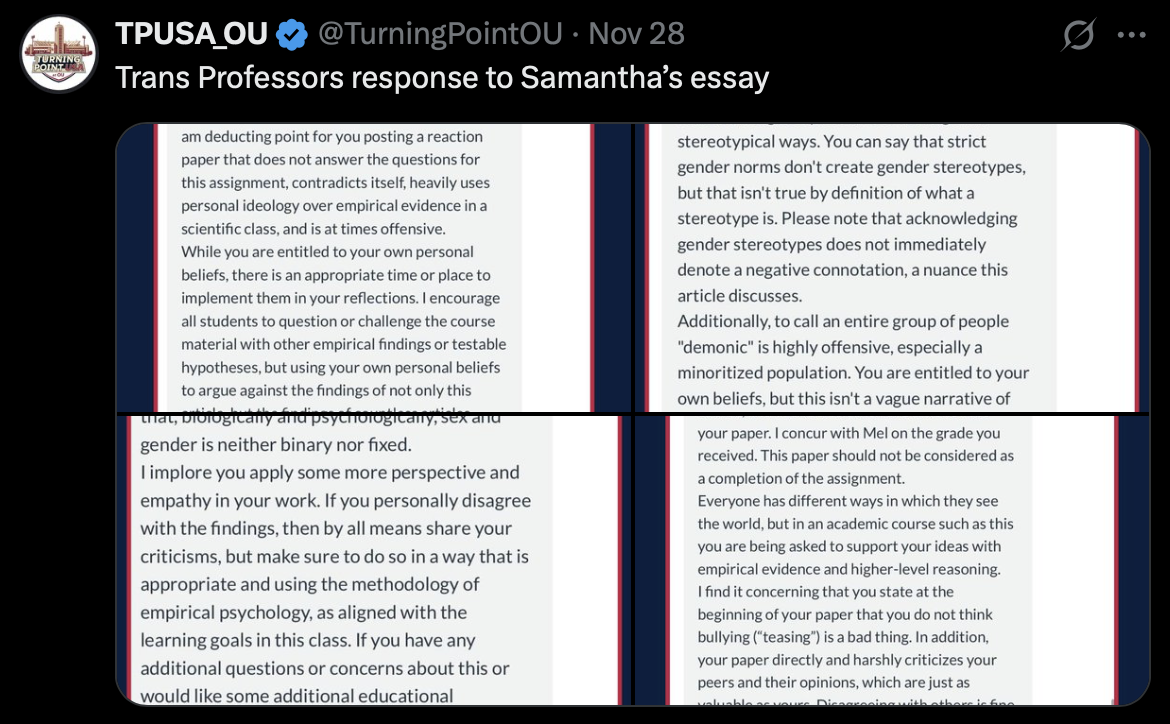
Curth also responded directly to the harmful characterization of transgender people, saying:
“To call an entire group of people ‘demonic’ is highly offensive, especially a minoritized population.”
A second instructor, Megan Waldron, independently reviewed the submission and agreed that the paper did not align with the course’s academic expectations.
Student Files Complaint, University Launches Review
In response, Fulnecky filed a religious discrimination complaint, arguing that she followed the rubric and should not be penalized for citing scripture or holding certain beliefs.
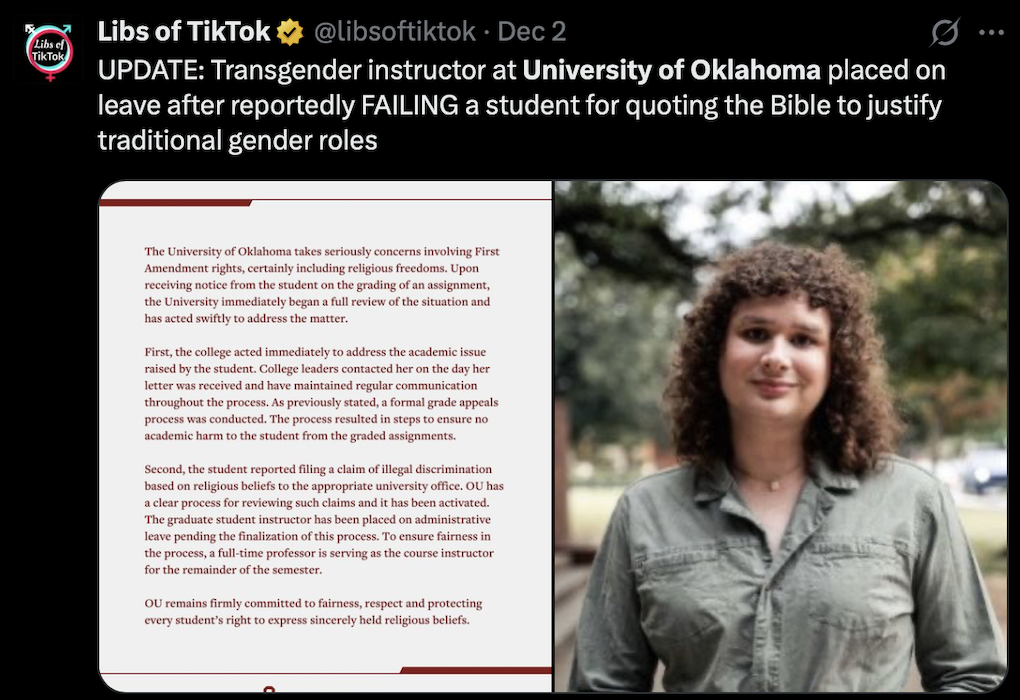
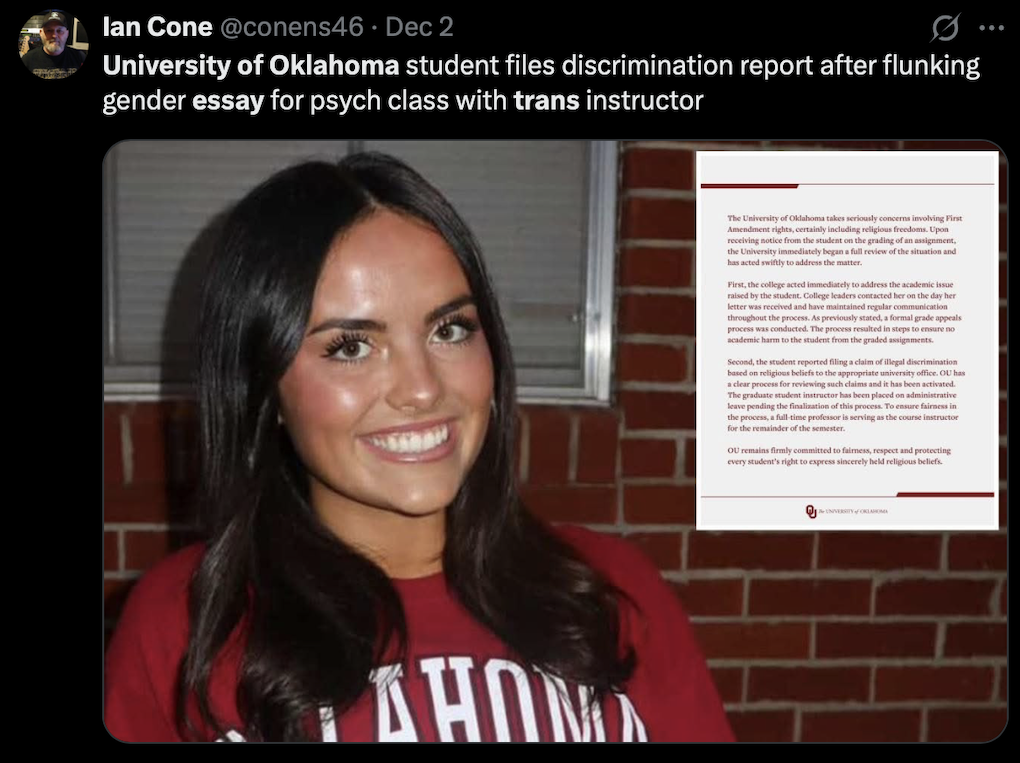
OU released a statement, which currently has 36 million views, affirming that it “takes seriously concerns involving First Amendment rights, certainly including religious freedoms.” The university said it quickly began a full review, assured the student would face “no academic harm” during the process, and placed Curth on administrative leave “to ensure fairness.” OU emphasized that the trans instructor would not suffer academic or financial consequences during the investigation. A full-time professor has since assumed teaching responsibilities for the course.
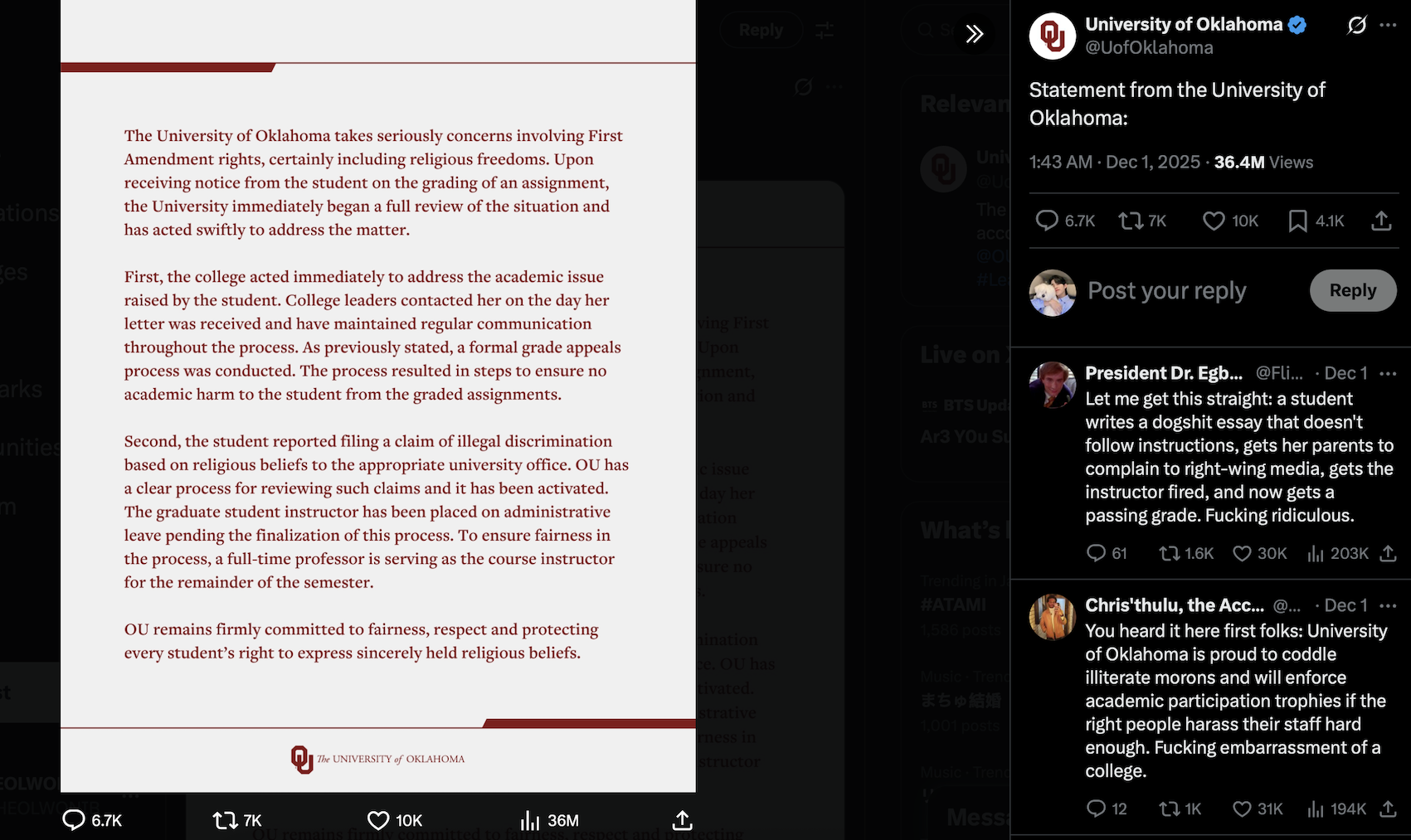
Some of the comments left by the internet folks on their post include:
- “Let me get this straight: a student writes a dogsh*t essay that doesn’t follow instructions, gets her parents to complain to right-wing media, gets the instructor fired, and now gets a passing grade. Fucking ridiculous.”
- “You heard it here first folks: University of Oklahoma is proud to coddle illiterate morons and will enforce academic participation trophies if the right people harass their staff hard enough. Fucking embarrassment of a college.”
- “forgive me, but the student in question couldn’t string together a complete sentence if her life depended on it and is claiming “christian persecution” because the world doesn’t bend to her. firing an educator over this is embarrassing. shame”
Political Actors Enter the Discussion
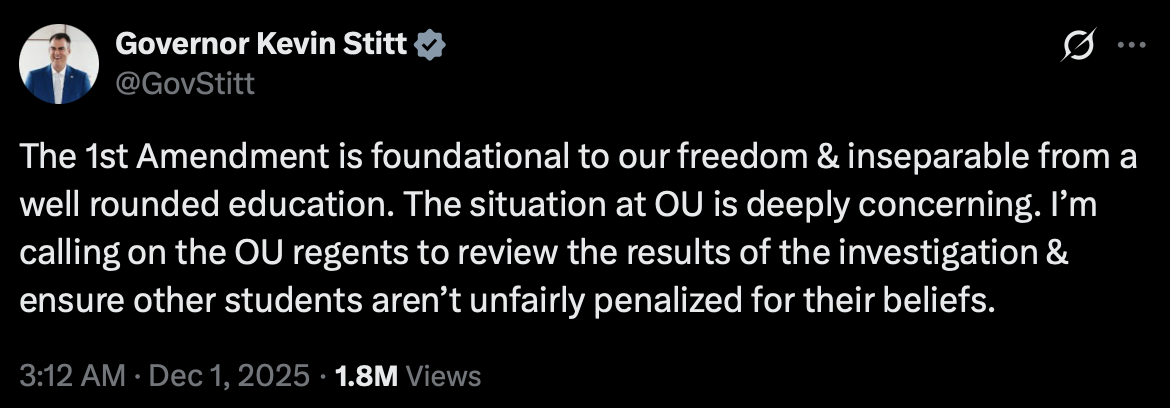
The debate intensified when Oklahoma Governor Kevin Stitt took to social media to issue a public directive to OU’s Board of Regents. Stitt framed the situation as a matter of free expression and academic balance, stating:
“The 1st Amendment is foundational to our freedom & inseparable from a well rounded education. The situation at OU is deeply concerning. I’m calling on the OU regents to review the results of the investigation & ensure other students aren’t unfairly penalized for their beliefs.”
His comments elevated what began as an academic disagreement into a statewide culture-war moment, positioning the trans instructor’s grading decision as a political flashpoint.
Turning Point USA Amplifies the Conflict
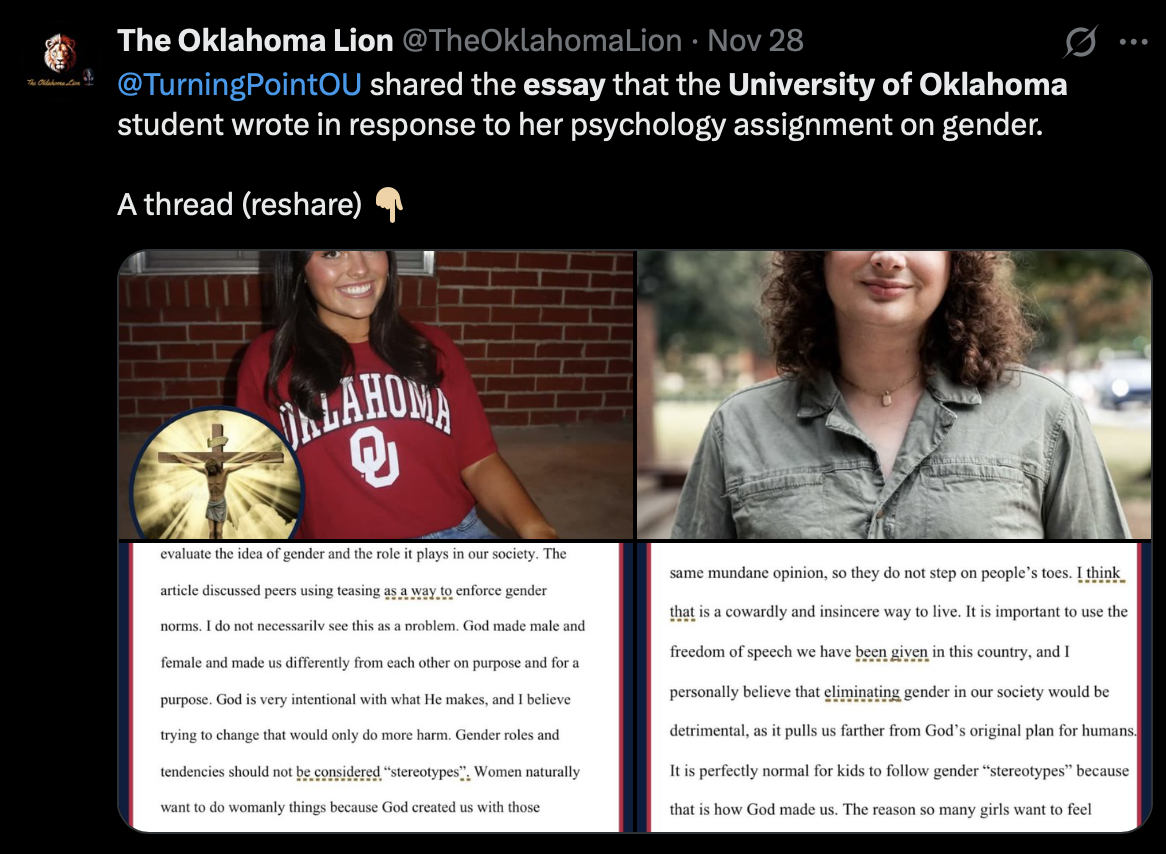
Turning Point USA’s campus chapter continued fueling the controversy, claiming that Fulnecky’s grade amounted to discrimination “for quoting the Bible.” Their posts included rhetoric attacking Curth personally, calling the trans instructor “mentally ill” — language that stigmatizes both LGBTQ+ people and individuals with mental health conditions. They argued that conservative students are silenced in classrooms and hailed Fulnecky as an example of “standing up” for her beliefs.
For a psychology course at the University Oklahoma, Samantha Fulnecky was asked to write a 650-word essay reacting to an article about how people are perceived based on societal expectations of gender.
In her essay, Fulnecky argued that traditional gender roles should not be… pic.twitter.com/R3J4FaGEtw
— TPUSA_OU (@TurningPointOU) November 27, 2025
The Broader Impact on Trans Students and LGBTQ+ Safety
For many LGBTQ+ students on campus, especially those who are trans, the situation feels like a painful reminder of how quickly academic concerns can be co-opted into anti-LGBTQ+ narratives. The initial description of trans people as “demonic,” followed by online targeting of a trans educator, has heightened anxieties about classroom safety, academic legitimacy, and respect for lived identities.
While OU’s investigation is still ongoing, the conflict has already revealed the fragility of academic spaces when political actors intervene. It also underscores the need for universities to uphold rigorous standards — not as a punishment for belief, but as an essential part of scientific education.
For the LGBTQ+ community watching this unfold, this is more than a grade dispute. It’s a reflection of the broader cultural struggle over whose identities are validated, whose expertise is respected, and whose safety is protected in educational spaces.