

Just when it felt like marriage equality had settled into the fabric of American life, Waco, Texas, is once again making headlines. This time, it’s not about football, magnolias, or true-crime documentaries—it’s about a renewed legal challenge to same-sex marriage that could have national consequences.
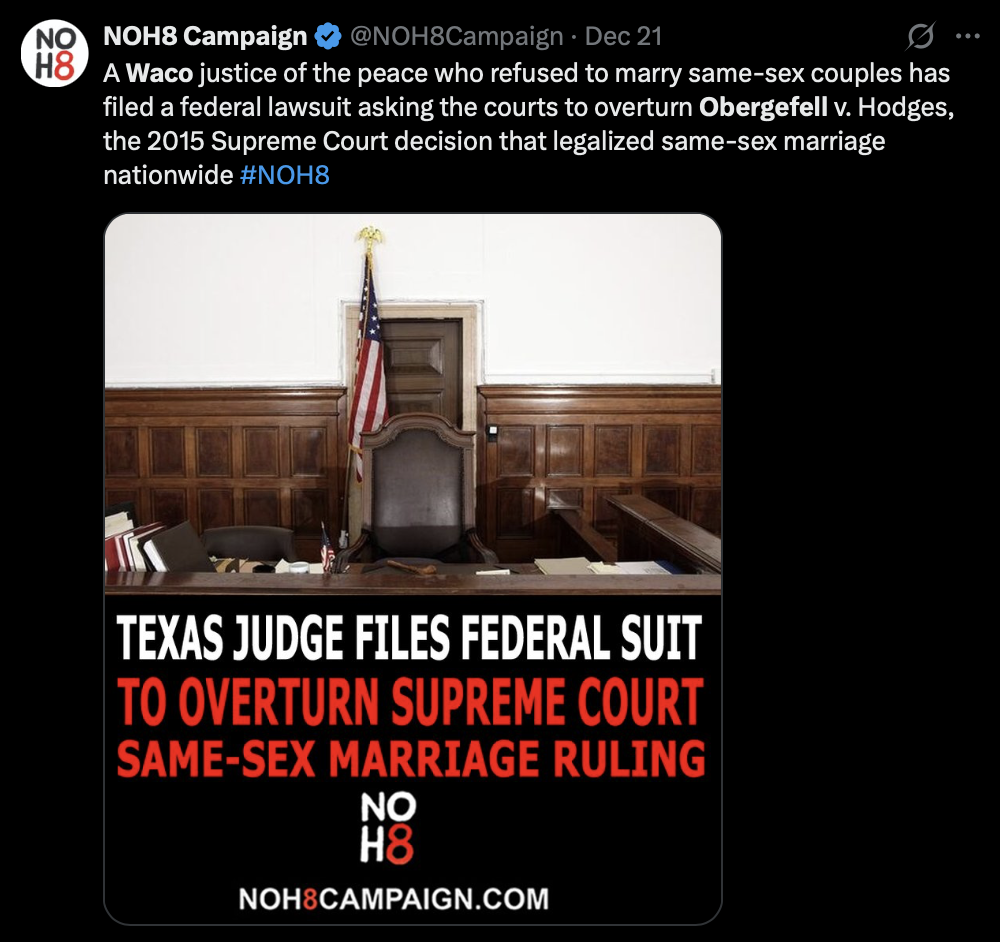
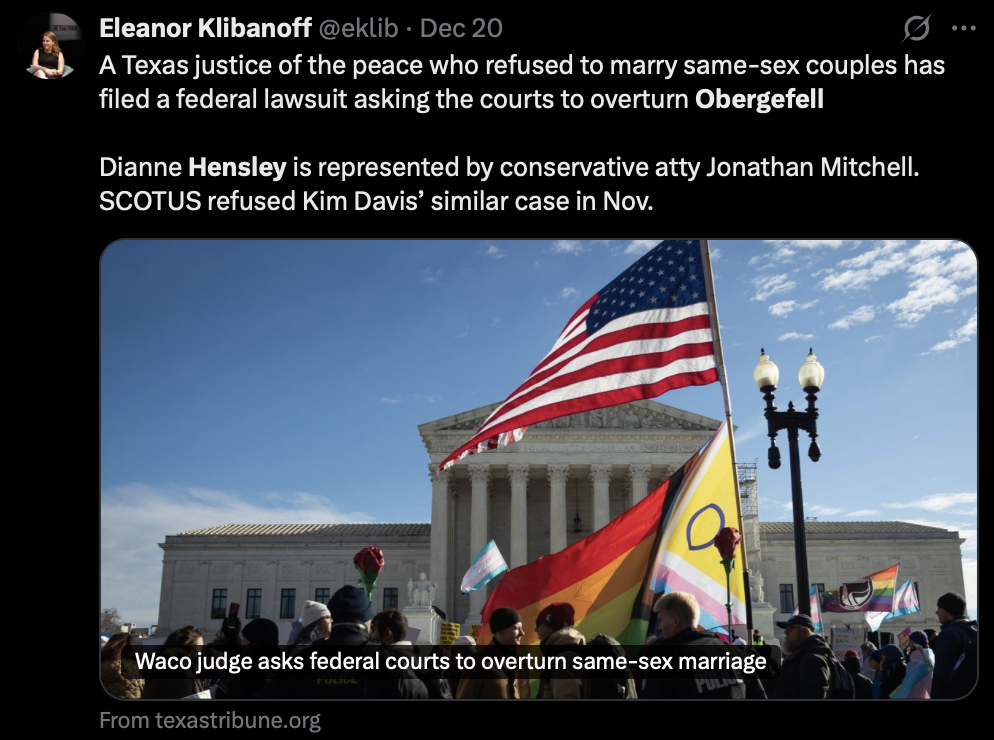
At the center of the controversy is Dianne Hensley, a Waco justice of the peace who has filed a federal lawsuit calling for the courts to overturn Obergefell v. Hodges, the landmark 2015 Supreme Court ruling that legalized same-sex marriage across the United States.
For LGBTQ+ Americans who remember the long road to marriage equality, the case feels like an unsettling echo of fights many believed were firmly in the past.
RELATED: Ten Years After Marriage Equality, Obergefell Faces Its First Direct Challenge
What the Waco Lawsuit Is Actually Arguing
Hensley’s lawsuit is directed at the State Commission on Judicial Conduct, Texas’ oversight body for judges. Her argument isn’t subtle: she claims that Obergefell was wrongly decided and that the Supreme Court overstepped its authority by recognizing same-sex marriage as a constitutional right.
Representing Hensley is Jonathan Mitchell, a name that raises alarms for civil-rights advocates. Mitchell is widely known for crafting Texas’ 2021 abortion law that helped set the stage for the downfall of Roe v. Wade through Dobbs v. Jackson Women’s Health Organization.
In court filings, Mitchell argues that federal courts lack the authority to recognize what he describes as “new” constitutional rights, and he urges the judiciary to return decisions about marriage back to the states—much like what happened with abortion.
How This Waco Dispute Began
The roots of the case stretch back nearly a decade. Shortly after Obergefell was decided, Hensley stopped officiating weddings entirely, citing religious objections to same-sex marriage. About a year later, she resumed performing weddings—but only for opposite-sex couples—while directing same-sex couples elsewhere.
That decision triggered scrutiny from the State Commission on Judicial Conduct, which eventually issued a public warning, arguing that selectively performing marriages raised questions about judicial impartiality.
Hensley challenged that warning in court. Although the commission later withdrew it after procedural developments at the state level, the underlying disagreement never disappeared. Instead, it escalated—culminating in this new federal lawsuit filed in Waco.
Texas Judges, Religious Claims, and a Legal Gray Area
The Waco case doesn’t exist in isolation. Another Texas judge has pursued a similar lawsuit, seeking assurance that he would not be disciplined for performing weddings only for heterosexual couples. Earlier this year, the 5th U.S. Circuit Court of Appeals revived that case and sent it back to the Texas Supreme Court for clarification.
In response, the Texas Supreme Court amended its judicial conduct rules, adding language that allows judges to opt out of performing wedding ceremonies due to sincerely held religious beliefs.
But here’s the key distinction: according to the State Commission on Judicial Conduct, opting out entirely is different from opting out selectively. The commission maintains that judges cannot welcome straight couples into their chambers while turning away same-sex couples without undermining public trust in the judiciary.
Mitchell argues that this position still leaves Hensley vulnerable to discipline—a claim that forms the backbone of the Waco lawsuit.
Why Obergefell Is the Real Target
While the case is framed as a dispute over judicial discipline, its broader ambition is unmistakable. The lawsuit explicitly invites courts to reconsider Obergefell itself, using the same legal logic that unraveled abortion rights after Dobbs.
This strategy has been attempted before. In 2023, the Supreme Court declined to hear a similar case involving Kim Davis, the former Kentucky official who refused to issue marriage licenses to same-sex couples. But legal experts note that repeated challenges are often designed not to win immediately, but to keep pressure on the courts.
In that sense, Waco is less a final battleground than a staging ground.
Why This Matters Beyond Waco
For LGBTQ+ Americans, the lawsuit is a reminder that legal victories can be fragile. Marriage equality remains the law of the land—but it exists in a post-Dobbs legal landscape where previously settled rights are being reexamined.
What happens in a federal courtroom in Waco may not overturn marriage equality tomorrow. But it contributes to a broader effort to reopen questions many thought were closed.
And history has shown that when those doors reopen, the consequences can be profound.
The Bigger Picture
At its core, this case is about more than one judge or one city in Texas. It’s about whether same-sex couples will once again be forced to rely on geography to determine their rights—and whether the hard-won promise of equality under the law can withstand sustained legal attack.
For now, Obergefell stands. But as Waco proves, the fight over marriage equality is not just history—it’s present tense.
REFERENCE: The TExas Tribune
Why must some people spend their life living in negativity? What others do is none of my business, especially if no is being hurt by their actions.
What really matters, at least to those who support and defend the text of our Constitution and its documented “legislative intent”, which gives context to its text, is nowhere in our federal Constitution is there a provision which forbids distinctions in law being based upon “sex” other than the Nineteenth Amendment.
The majority opinion in Obergefell v. Hodges ignores centuries of history that defined marriage as a union between a man and a woman, while it conversely relies upon centuries of history to establish marriage is a fundamental right, thereby contradicting its own method used to arrive at its conclusion. Additionally, the majority opinion is in conflict with Dobbs v. Jackson Women’s Health Organization, which established a “history and tradition” test, stating that any right not explicitly mentioned in the Constitution must be deeply rooted in the nation’s history and tradition to be protected under the Due Process Clause.
The bottom line is, the majority opinion in Obergefell, in essence, set itself up as members of an unelected, omnipotent, constitutional convention, and substituted their personal feelings and predilections as being the rule of law, ignoring the Tenth Amendment and Article V, which is the only lawful way to alter the terms and conditions set forth in our Constitution.
What is the remedy? Our Supreme Court ought to rehear Obergefell and return the subject matter of marriage to the States where it properly belongs. Keep in mind that prior to Obergefell, same-sex marriage was legal in 36 states plus Washington D.C. It’s time for our Supreme Court to correct the subjugation of our system of law found in, and wrongfully imposed by Obergefell.