


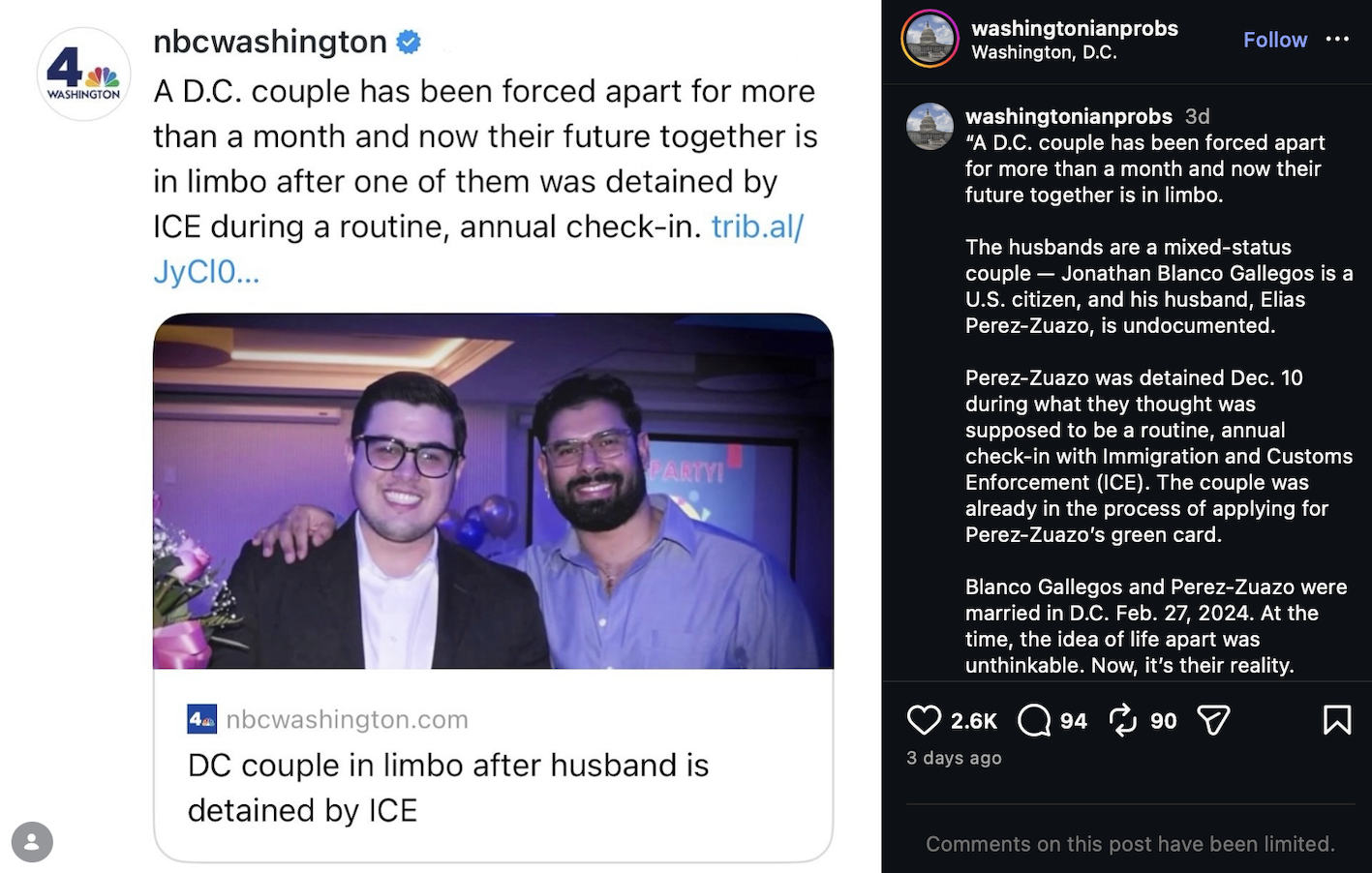
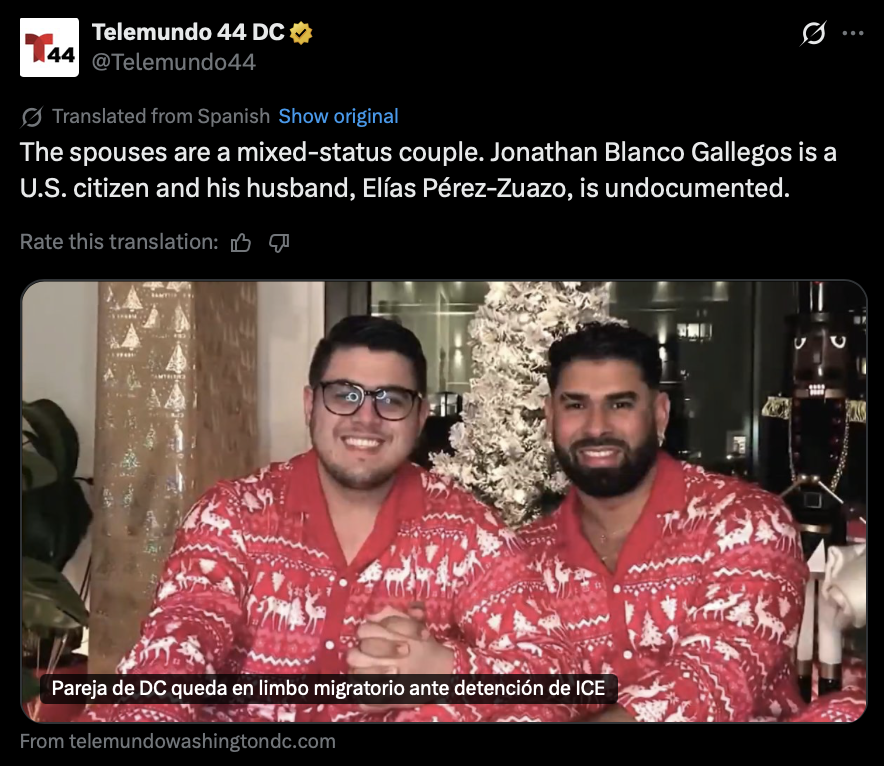
Immigration and Customs Enforcement (ICE) upended what Jonathan Blanco Gallegos and Elias Perez-Zuazo believed would be a stable start to married life, separating the D.C.-based couple less than a year after they said “I do.”
Their story, first reported by NBC Washington, has drawn attention not only because they are a married same-sex couple, but because their situation reflects broader tensions around immigration enforcement, LGBTQ safety, and due process.
Blanco Gallegos is a U.S. citizen. His husband, Perez-Zuazo, is undocumented. Together, they are what immigration advocates refer to as a mixed-status couple—a reality shared by thousands of LGBTQ families across the country.
RELATED: Throwing Bagged Dog Crap at an LGBTQ+ Center is NOT a Crime?
What Was Supposed to Be Routine
On December 10, Perez-Zuazo attended what he and his husband believed would be a routine, annual ICE check-in at a facility in Chantilly, Virginia. According to Blanco Gallegos, these check-ins had always been straightforward, typically lasting less than an hour.
This time was different.
After waiting in the parking lot for hours, Blanco Gallegos realized something was wrong. Eventually, an ICE agent emerged—not with his husband, but with Perez-Zuazo’s personal belongings. He was informed that his husband had been detained.
There was no paperwork handed over, no immediate explanation, and no clear timeline for what would happen next.
A Relationship Built During Legal Limbo
Perez-Zuazo is originally from Panama. He entered the United States without documentation in November 2021, according to his husband. After crossing the Texas-Mexico border, he was processed by immigration authorities and released on his own recognizance, allowed to live in Washington, D.C. with a sponsor while his immigration case moved forward.
The couple met in 2023, began dating, and eventually married in February 2024 in Washington, D.C. At the time, separation felt unthinkable.
They had already started the process of adjusting Perez-Zuazo’s immigration status through marriage. His I-130 petition, the first formal step toward permanent residency through a spouse, had been approved—typically a promising sign.
That progress now feels fragile.
Conflicting Claims and Legal Uncertainty
ICE later released a statement asserting that Perez-Zuazo had previously been ordered removed by an immigration judge in 2021. However, his attorney disputes this claim.
NBC Washington reported that a search of the Executive Office for Immigration Review database produced no public record of a deportation order. Perez-Zuazo’s attorney has said that the documents he reviewed do not support ICE’s claim and argues that if a removal order had truly been issued, Perez-Zuazo would not have remained in the U.S. for years afterward.
In response, the legal team has filed a habeas corpus petition in federal court, challenging the legality of the detention and seeking clarity on his status.
As of now, there is no public timeline for Perez-Zuazo’s release—or confirmation of whether deportation proceedings are actively underway.
The LGBTQ Stakes Are High
Beyond the legal confusion, Blanco Gallegos has voiced deep concern about what deportation would mean for their safety and future as a married gay couple.
Panama does not offer the same legal protections for same-sex couples as the United States. Same-sex marriage is not recognized, and LGBTQ advocacy groups have long documented social and legal challenges faced by queer people there.
For Blanco Gallegos, the fear is not abstract—it’s personal.
ICE Detention in a Broader Context
Perez-Zuazo’s case unfolds amid a significant increase in ICE detentions nationwide. Data cited by NBC Washington from Syracuse University’s Transactional Records Access Clearinghouse shows that the number of people held in ICE custody increased by nearly 40,000 between 2024 and 2025.
BREAKING: Absolute mayhem as ICE invades Minneapolis neighborhood, grabs teenagers and tussles with local residents observing their actions. This does not make America safe.
Share widely.pic.twitter.com/lDfnI1uRp3
— Really American 🇺🇸 (@ReallyAmerican1) January 15, 2026
Immigration advocates argue that LGBTQ individuals—especially those in same-sex relationships—face compounded vulnerabilities within detention systems that were not designed with queer families in mind.
For gay couples like Blanco Gallegos and Perez-Zuazo, the stakes are emotional, legal, and deeply human.
Life on Pause
Back in D.C., Blanco Gallegos describes a home that feels suddenly hollow. The routines they built together—sharing meals, planning their future, simply existing as a married couple—have been abruptly disrupted.
Their case is still unfolding. For now, all they can do is wait.
And in that waiting, their story has become a stark reminder: when ICE intervenes, even legally married LGBTQ couples can find their lives placed on hold, with no clear end in sight.