


Need to use the bathroom? Idaho’s anti-trans bathroom law is set to take effect on July 1, and critics argue that the legislation raises serious concerns about privacy, personal safety, and how exactly the state intends to enforce it.
What began as a debate over restroom access has evolved into a much larger conversation about government authority, civil liberties, and the everyday experiences of transgender people simply trying to go about their lives.
And now, a recent courtroom exchange involving DNA testing has only intensified those concerns.
Idaho’s New Bathroom Law Arrives July 1
Earlier this year, Idaho lawmakers approved House Bill 752, which was signed into law by Governor Brad Little in March.
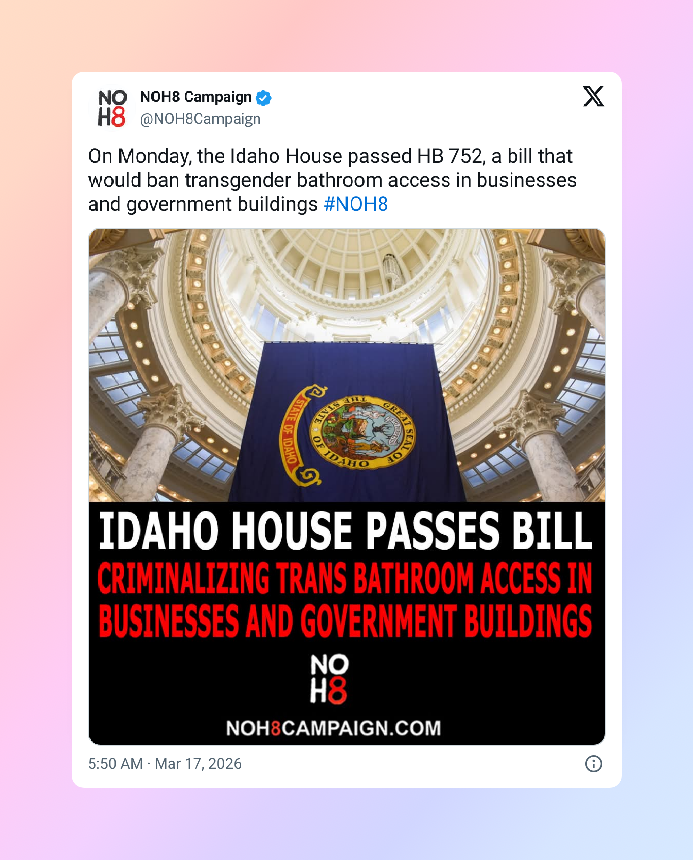
According to the Idaho Capital Sun, the law is scheduled to take effect on July 1 and will criminalize transgender people using bathrooms or changing facilities that align with their gender identity in certain locations, including government-owned buildings and places of public accommodation such as private businesses. When the law takes effect, Idaho will be joining Kansas, Florida, and Utah as the only other states to ban transpeople from using their preferred gender identity.
Under the law, individuals who “knowingly and willfully” enter a bathroom or changing room designated for the opposite sex can face criminal penalties.
A first offense is classified as a misdemeanor and can carry a sentence of up to one year in prison. A second offense within five years may be prosecuted as a felony carrying a sentence of up to five years in prison.
Supporters argue the law protects privacy and safety in sex-segregated spaces.
Opponents argue that it places transgender people in impossible situations while creating new challenges for enforcement.
RELATED: HB 561 Says ‘No Rainbow Here’—$2,000 a Day to Be Gay
The Enforcement Question Nobody Seems Able to Answer
One of the biggest questions surrounding bathroom laws has always been practical. How exactly does anyone determine who belongs in a particular restroom?
That question took center stage during a recent federal court hearing challenging Idaho’s law.
According to reporting from the Idaho Capital Sun, Idaho Solicitor General Brian Church Zarian suggested enforcement would be relatively straightforward “there is DNA testing.”
The comment immediately drew attention because it raised a host of additional questions.
Would someone have to consent to a DNA test?
Would law enforcement need a warrant?
Who decides when such testing becomes necessary?
And perhaps most importantly, what would trigger suspicion in the first place?
The Problem With DNA Testing
The suggestion of DNA testing introduces a practical issue that is impossible to ignore. Before anyone could request a DNA test, someone would first need to assume that a bathroom user might be transgender. That assumption itself becomes a form of scrutiny. In other words, the process would seemingly require someone to look at another person and decide they appear suspicious enough to warrant further investigation.
Critics argue that such a framework could affect far more than just transgender people. Anyone whose appearance does not fit someone else’s expectations of masculinity or femininity could potentially find themselves facing uncomfortable questions.
During the hearing, Zarian indicated he doubted that people would be asked to undergo DNA testing on the spot. However, the discussion itself highlighted the difficulties involved in enforcing the law.
What Advocates Are Saying
Kell Olson, an attorney with Lambda Legal representing transgender Idahoans challenging the law, argued that the legislation does not make people safer than they already are today. Instead, he argued that it creates new risks for transgender individuals.
“If I just go to a restaurant with my family and want to wash my hands before dinner, this law comes into play,” Olson said during court proceedings, as noted by Idaho Capital Sun.
He described what many transgender people may face once the law takes effect.
Do they enter the restroom that aligns with their gender identity and risk violating the law?
Or do they enter a restroom based on their sex assigned at birth and risk harassment, confrontation, or someone calling the police because other patrons believe they do not belong there?
Olson argued that either choice can create safety concerns. To be pragmatic, this becomes an everyday problem
A Debate Bigger Than Bathrooms
As July 1 approaches, Idaho’s bathroom law is moving from political talking point to everyday reality.
The debate is no longer simply about signs on restroom doors. It is about privacy, dignity, personal safety, and how laws are enforced in practice.
Supporters view the legislation as a necessary safeguard. Critics see it as an unnecessary burden that places transgender people under heightened scrutiny.
But regardless of where someone stands politically, one question remains difficult to ignore:
If enforcing a bathroom law requires discussions about DNA testing, investigations, or determining who looks masculine or feminine enough to enter a restroom, has the conversation moved far beyond bathrooms themselves?
take a look at the The Gay and Lesbian Community Center of Southern Nevada bathroom. One bathroom for anyone. No separate ones for anyone else. Fully approved by the government agencies and the local community.