

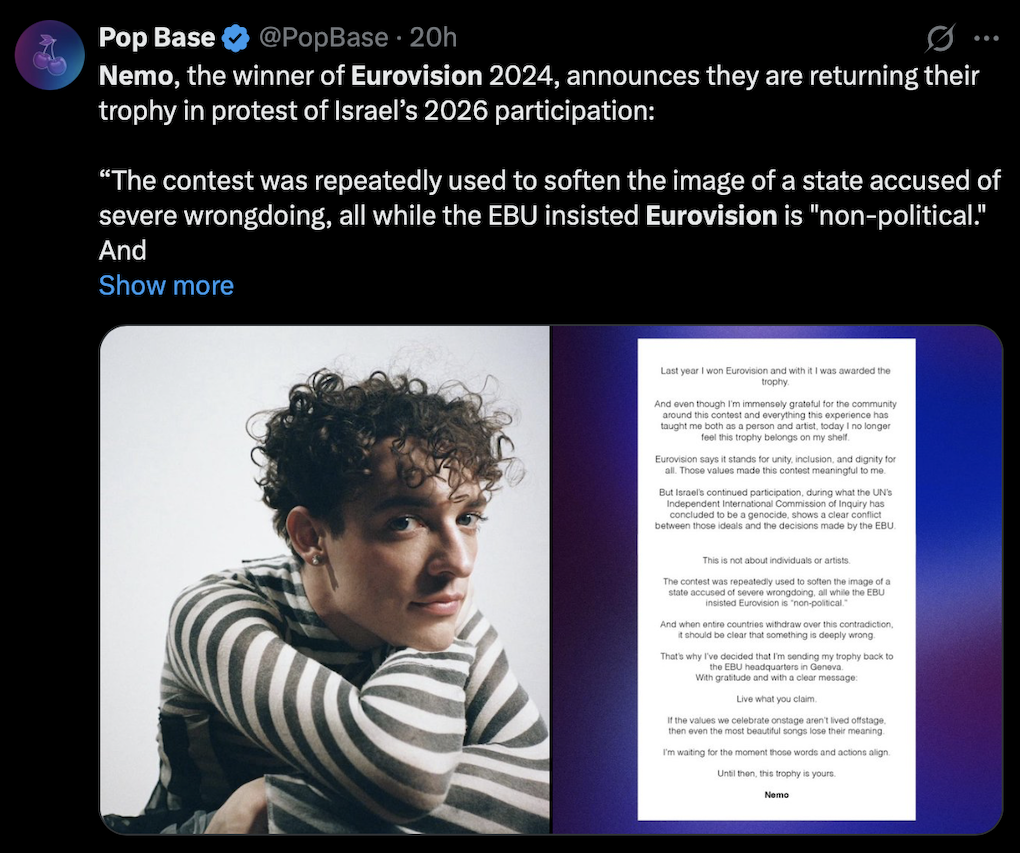
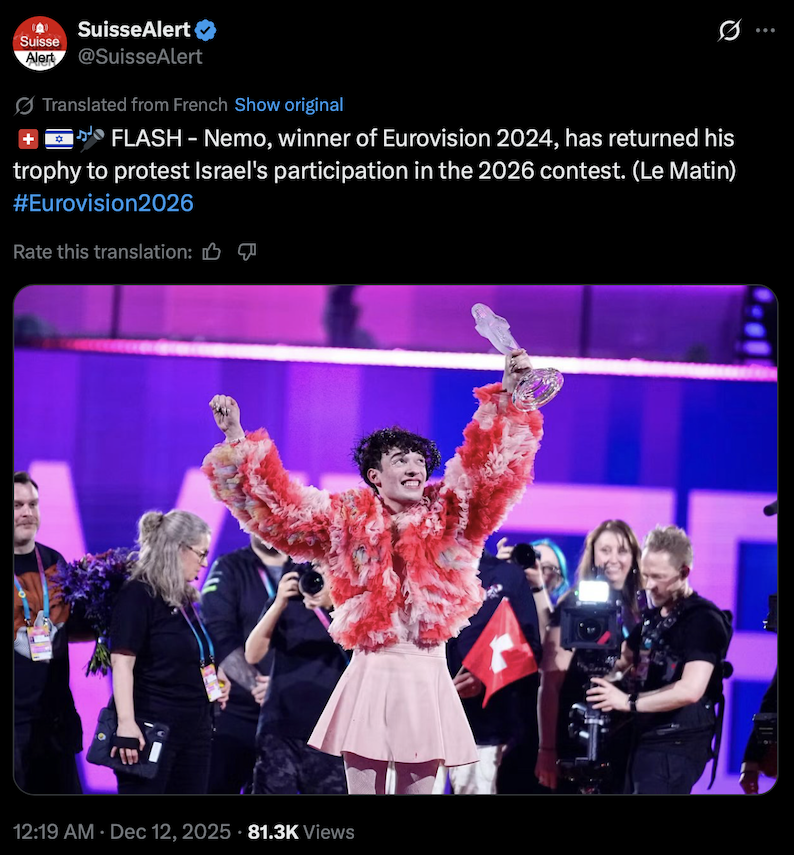
Eurovision has always claimed to be more than a song contest. It’s a spectacle, a community, and for queer audiences especially, a glitter-drenched yearly ritual of unity and joy. But this week, the bright lights flickered. Nemo, Switzerland’s Eurovision 2024 winner and one of the competition’s most captivating stars in recent years, announced they are returning their trophy in protest of Israel’s inclusion in the 2025 contest.
Their decision, posted on December 11, sent a shockwave across the global Eurovision fandom—a fandom that is never shy about passion, politics, and principles. But this time, the conversation feels heavier.
RELATED: ‘Milkshake Man’ About to Shake Up Eurovision 2025 with Unfiltered Pride
Nemo’s Stand: “This Trophy No Longer Belongs on My Shelf”
Nemo’s win in 2024 was celebrated not just for its musical brilliance but for how boldly it centered self-expression and queer identity. That same courage is now reshaping the Eurovision landscape.
In their statement, Nemo wrote,
“Last year I won Eurovision and with it I was awarded the trophy… today I no longer feel this trophy belongs on my shelf.”
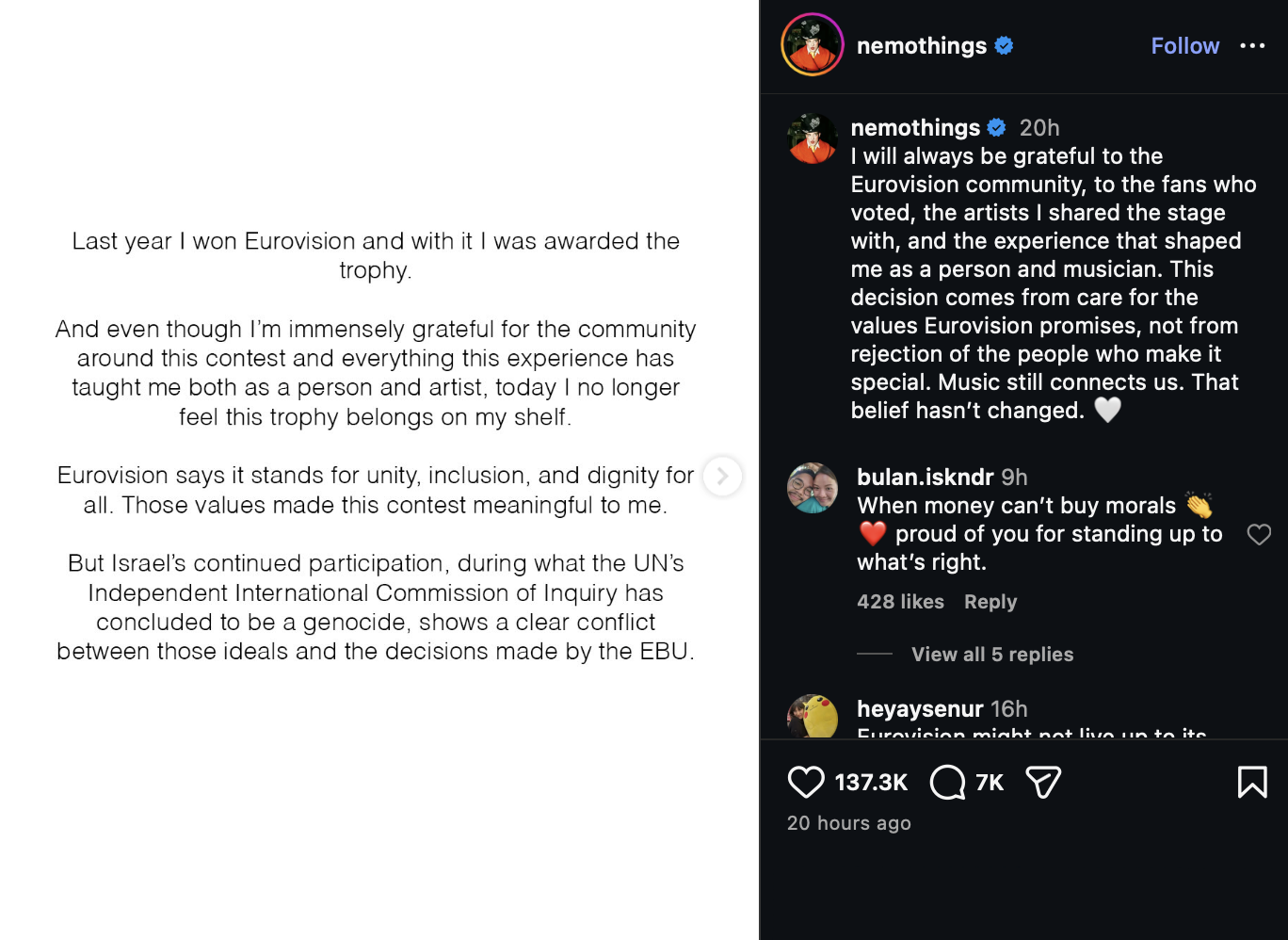
They praised the community, the fans who voted, and the fellow artists who shared the stage. But they also made clear why they could no longer keep the award.
Eurovision, they said, claims to stand for “unity, inclusion, and dignity for all,” but those values are allegedly contradicted by the continued participation of Israel. The conflict between the contest’s ideals and its decisions had become impossible for them to reconcile.
Eurovision’s self-inflicted damage continues as 2024 winner Nemo sends a clear message to the EBU by returning their trophy in protest at Israel’s participation & disappointment at the contest’s betrayal of the values it claims to celebrate #GazaGenocide https://t.co/c5i3KTTXEE https://t.co/zFYFg455UI pic.twitter.com/Beq84mWyap
— Artists for Palestine UK (@Art4PalestineUK) December 11, 2025
Their caption added a tender note that resonated deeply with fans:
“This decision comes from care for the values Eurovision promises, not from rejection of the people who make it special. Music still connects us. That belief hasn’t changed.”
For a winner to return their trophy is unprecedented—an act that instantly enters Eurovision history.
A Contest Under Pressure
Eurovision prides itself on being apolitical, though anyone who has watched for more than five minutes knows politics swirl just beneath the sequins. This year, however, tensions have moved front and center.
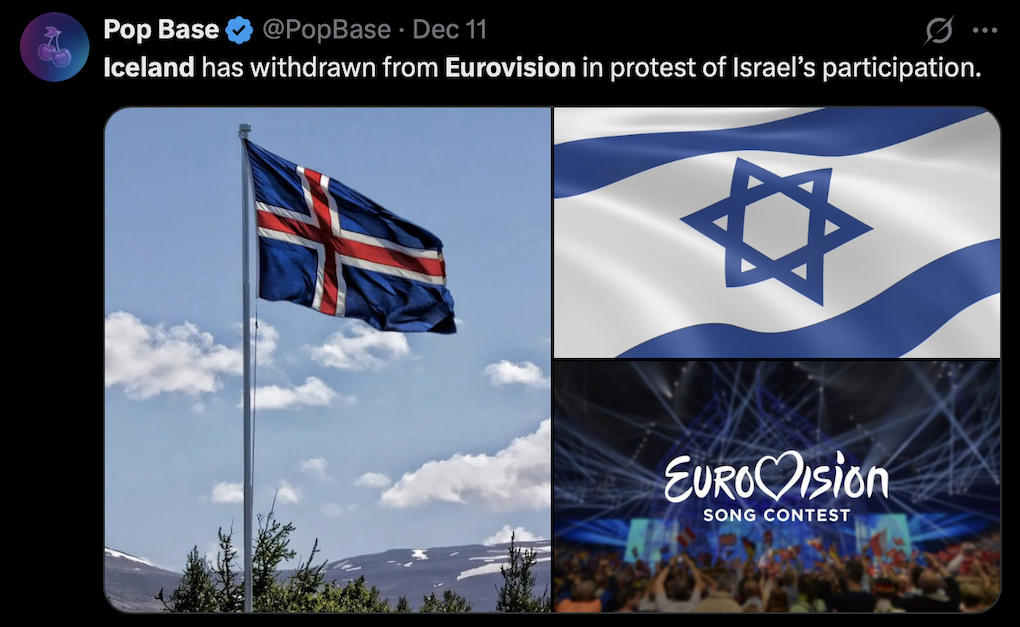
Israel’s participation amid the ongoing war in Gaza has ignited fierce backlash. Countries across Europe have faced internal debates, political pressure, and public outrage. Iceland made headlines after its national broadcaster, RÚV, formally withdrew from the 2025 contest, joining Slovenia, Ireland, the Netherlands, and Spain in boycotting or refusing to broadcast the event.
According to reporting from The Guardian, RÚV’s board voted to pull out after the European Broadcasting Union (EBU) again declined to expel Israel. Iceland said it had repeatedly raised concerns that “had not been addressed.” The broadcaster’s conclusion was stark:
“Given the public debate in this country… neither joy nor peace will prevail regarding the participation of RÚV in Eurovision.”
For a competition that thrives on joy, camp, and escapism, that statement hits hard.
Protests, Policy Shifts, and a Growing Divide
The war in Gaza has already cast a long shadow over recent Eurovision events. Protests erupted outside venues. Organizers tightened rules around political flags and audience behavior. Tensions seeped into rehearsals, press rooms, and fan communities.
Last week, EBU members met to discuss the situation. They agreed to implement stricter contest voting rules in response to allegations that Israel had previously manipulated votes in favor of its contestants. But they stopped short of excluding any broadcaster, including Israel—an omission that has fueled the current crisis.
The rift is widening between member nations, artists, and fans. The question is no longer just whether Eurovision can remain a political-neutral zone, but whether such neutrality even exists.
Where Eurovision Goes from Here
Eurovision has weathered scandals, geopolitical disputes, and decades of shifting cultural tides. But Nemo’s symbolic return of the trophy, combined with growing broadcaster withdrawals, represents a turning point.
For queer fans—those who have embraced Eurovision not only as entertainment but as a glittering sanctuary—the moment feels bittersweet. Nemo’s act is a reminder that LGBTQ+ communities often stand at the forefront of insisting that joy and justice must coexist.
As 2025 approaches, Eurovision finds itself at a crossroads. Will it rise to meet the values it claims to champion? Or will the cracks deepen?
One thing is certain: the music might still connect us, as Nemo believes—but only if the stage feels true, fair, and worthy of the voices standing on it.
REFERENCE: The Guardian
Unfortunately, it looks like more and more countries will boycott or refuse to participate. Artists from Portugal claim they will not join Eurovision should they win.