

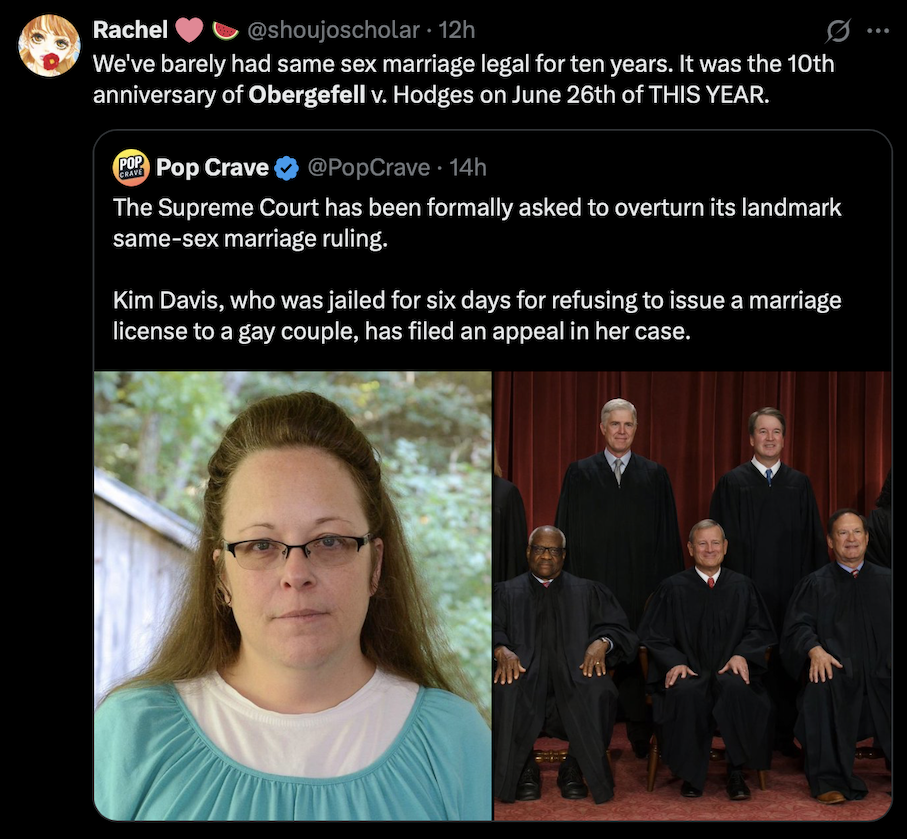
In June 2015, the Supreme Court’s decision in Obergefell v. Hodges forever changed the legal and cultural landscape of the United States. By recognizing marriage equality as a constitutional right under the 14th Amendment, the Court affirmed that love and commitment between same-sex couples were entitled to the same dignity and legal recognition as any other marriage.
RELATED: Love Wins, 10 Years Later: Why Obergefell Still Matters
Now, ten years later, that decision faces its first direct legal challenge. And at the center of it is Kim Davis, the former Rowan County Clerk from Kentucky who became a national figure in 2015 for refusing to issue marriage licenses to same-sex couples.
How We Got Here
Davis, tasked in her role as county clerk with issuing marriage licenses on behalf of the U.S. government, refused to do so for a gay couple, citing her religious beliefs. Her refusal directly defied the Supreme Court’s new ruling at the time. The standoff ended with Davis spending six days in jail in September 2015 for contempt of court.
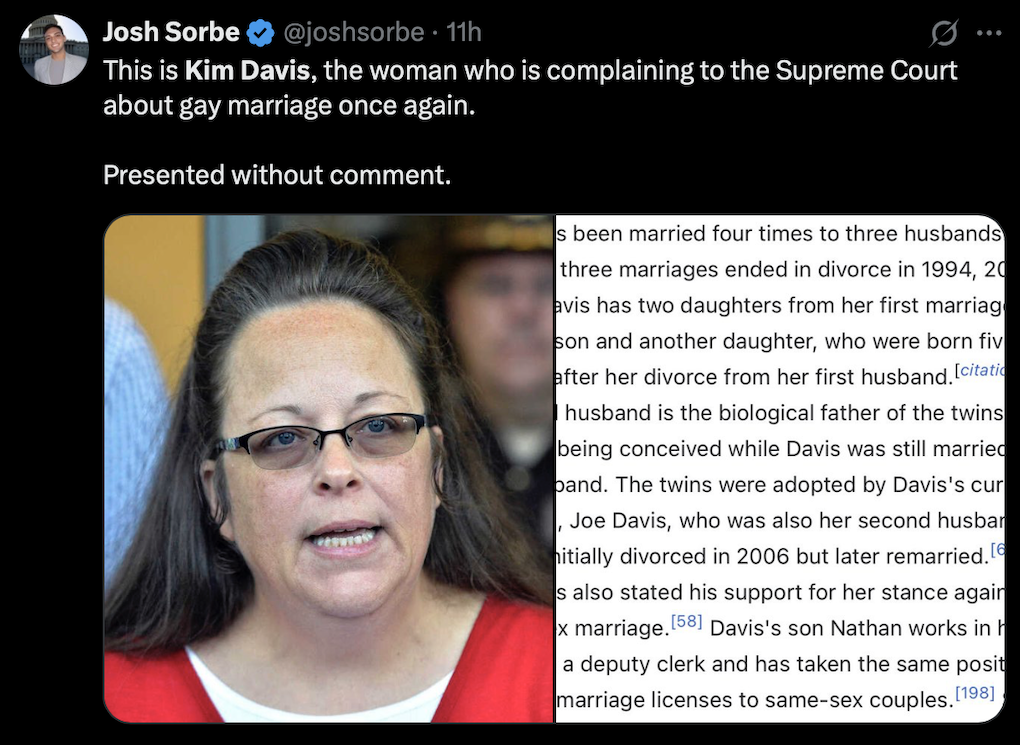
The couple she denied — David Ermold and David Moore — sued Davis for damages. Since then, the legal fight has worked its way through the courts, with Davis losing at every stage.
According to ABC News, Davis has filed a petition for writ of certiorari with the U.S. Supreme Court. In it, she argues that the First Amendment’s Free Exercise Clause should shield her from personal liability for refusing to issue the license. Her legal team contends that she acted based on her sincerely held religious beliefs and should therefore be protected.
The Legal Rejection So Far
A federal appeals court panel has already rejected Davis’s First Amendment defense. Their reasoning was that she is being held liable for state action, not personal action — and state action does not enjoy the same constitutional protections in this context.
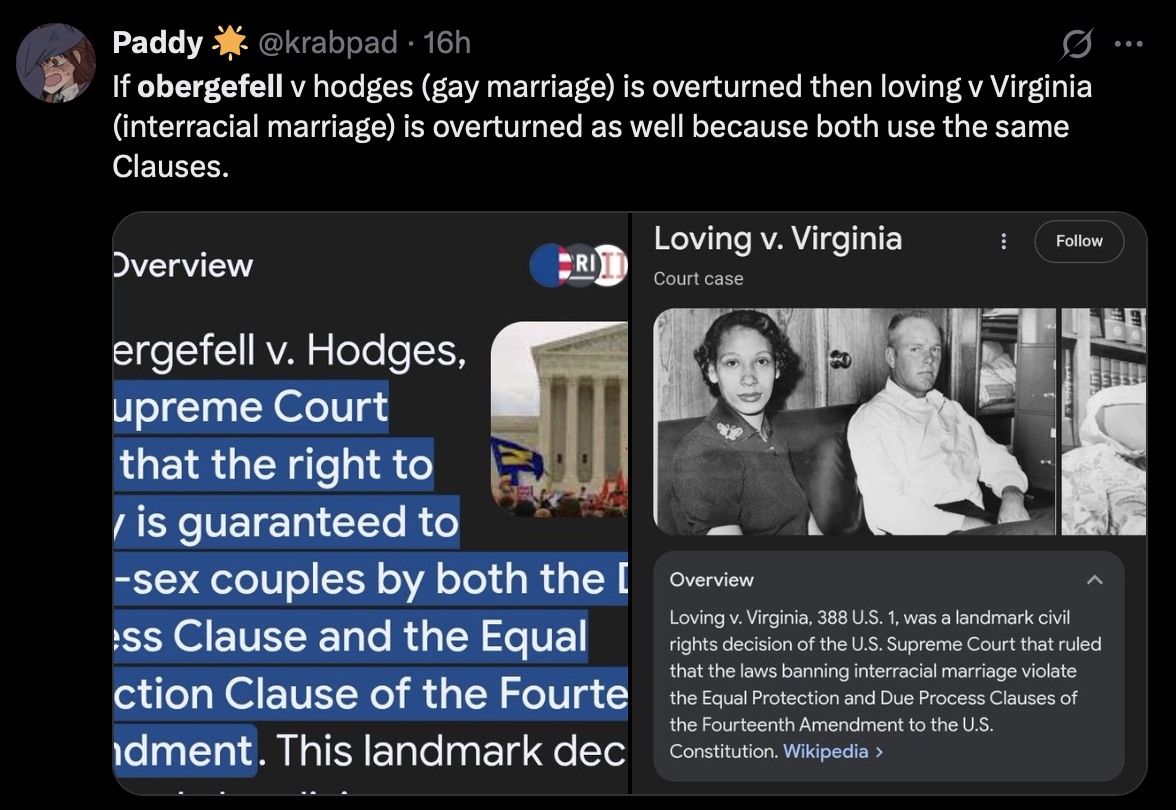
Her petition goes further, however. It doesn’t just argue for her personal defense. It questions the legitimacy of Obergefellitself.
In the petition, Davis and her attorney, Mathew Staver, describe the 2015 decision as “egregiously wrong” and call Justice Anthony Kennedy’s majority opinion “legal fiction.” Staver’s filing urges the Court to overturn the ruling entirely: “The mistake must be corrected.”
The Stakes
This is not simply a personal lawsuit about damages. According to Lambda Legal, Davis’s petition marks the first formal bid to overturn Obergefell v. Hodges since it was decided. The timing is not isolated, either. Lambda Legal reports that in 2025 alone, nine states have introduced bills seeking to block new same-sex marriage licenses or have passed resolutions urging the Supreme Court to reverse its marriage equality precedent.
@attorney_di #greenscreen Here is a summary ofvthe primary issues and holdings in the Obergefell case. The teo Acts mentioned are: The Defense of Marriage Act (DOMA) and The Respect for Marriage Act. #supremecourt #legalhistory #marriage #fyp #fypシ #foryoupage #attorneysoftiktok #educationalpurposes #learningontiktok #obergefell #constitutionalrights #fundamentalrights
For advocates of LGBTQ+ rights, the case represents not just a challenge to one ruling, but part of a broader political and legal movement to roll back established protections.
Responses from Both Sides
On behalf of Ermold and Moore, attorney William Powell expressed confidence that the Supreme Court will not entertain Davis’s arguments:
“Not a single judge on the U.S. Court of Appeals showed any interest in Davis’s rehearing petition, and we are confident the Supreme Court will likewise agree that Davis’s arguments do not merit further attention.”
But the petition’s very existence — and the possibility of the Court taking it up — has set off alarm among marriage equality supporters.
What Happens Next
The Supreme Court will consider Davis’s petition in a private conference this fall. Should the justices agree to hear the case, oral arguments could be scheduled for spring 2026, with a decision expected by June 2026.
@enby_therapist
The stakes of that decision would be monumental. Upholding Obergefell would reaffirm the constitutional protections for same-sex couples, potentially shutting down future challenges. But if the Court were to revisit or narrow the ruling — or overturn it entirely — it could undo a decade of progress and place marriage equality in the hands of individual states once again.
Why This Matters
The fight for marriage equality was long, hard-fought, and deeply personal for millions of LGBTQ+ Americans. For many, the 2015 ruling was not just a legal milestone but a validation of their relationships, families, and humanity.
The possibility of losing those rights — or having them placed on uncertain legal ground — is not abstract. It affects real couples, real families, and the stability of their lives. In 2015, Obergefell promised that marriage equality was a settled matter. In 2025, that promise is facing a test.
@usatoday Jim Obergefell never planned to sue the state of Ohio, but his love for his husband drove him to become a pioneer for LGBTQ+ rights. #Pride #SupremeCourt #Obergefell
Whether the Court declines to hear Davis’s case or agrees to review it, this moment is a reminder that rights can never be taken for granted. They require vigilance, advocacy, and the willingness to keep showing up — in courts, in legislatures, and in public life.
For now, the LGBTQ+ community and its allies are watching, waiting, and preparing. The next year could decide whether Obergefell remains a cornerstone of American civil rights — or becomes a chapter in a history still being written.
REFERENCE: ABC News
A sad day for USA and it will get worse