


Sports have become one of the biggest battlegrounds for transgender Americans, and this time the whistle came from the highest court in the United States. In a decision with consequences stretching far beyond a single track meet or basketball court, the U.S. Supreme Court has upheld state laws that bar transgender girls and women from competing on female school sports teams.
RELATED: Intersex Teacher Lost His Job After Being Mistaken for Transgender
For LGBTQ people, it’s another reminder that some of the biggest battles over identity aren’t happening on playing fields—they’re unfolding inside courtrooms.
Another Supreme Court ruling reshapes transgender rights
The Supreme Court ruled Tuesday that laws in Idaho and West Virginia prohibiting transgender girls and women from participating on female school athletic teams do not violate the U.S. Constitution or the federal anti-discrimination law known as Title IX.
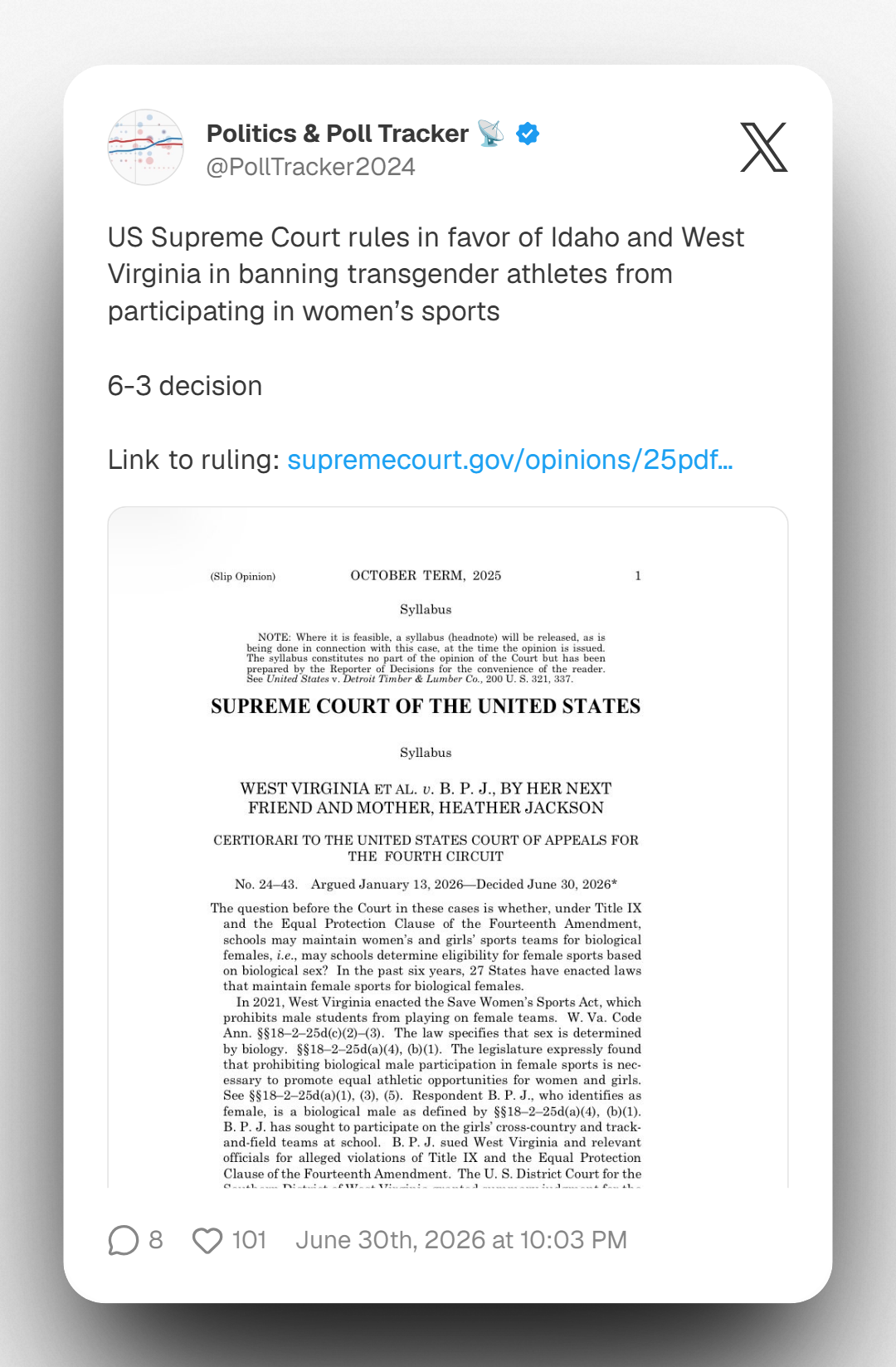
The ruling marks another significant legal setback for transgender Americans. Over the past year, the court’s conservative majority has repeatedly issued decisions narrowing legal protections for transgender people, including last year’s ruling that upheld state bans on gender-affirming care for transgender minors. With Tuesday’s decision, similar laws already passed in more than two dozen Republican-led states are now on much firmer legal ground.
RELATED: Two Court Cases: Refusing Gay Weddings Paid More Than Coming Out.
At the same time, lawsuits involving policies in Connecticut, California, and other states that allow transgender athletes to compete according to their gender identity remain unresolved, meaning the broader legal debate is far from over.
The athletes behind the cases
One of the cases centered on 16-year-old Becky Pepper-Jackson of Bridgeport, West Virginia. Pepper-Jackson has publicly identified as a girl since she was 8 years old, has taken puberty-blocking medication, and holds a West Virginia birth certificate recognizing her as female. She is also the only known transgender athlete to seek permission to compete in girls’ school sports in the state.
Her athletic career has steadily progressed. After finishing near the back of the pack in middle school cross-country races, she recently became West Virginia’s state champion in the shot put, winning last month’s championship by two feet.
The Idaho lawsuit involved Lindsay Hecox, who challenged the nation’s first statewide ban on transgender women participating in female school sports after hoping to try out for Boise State University’s women’s track and cross-country teams.
Lindsay Hecox, a runner based in Idaho, was set to represent the women’s team at Boise State University.
However, since the local authority passed the controversial Fairness in Women’s Sport Act, this is in jeopardy. pic.twitter.com/amJXpPnlDC
— VICE TV (UK) (@vicelanduk) September 16, 2020
She ultimately did not make either team because, as her attorney Kathleen Hartnett told the Supreme Court during January arguments, “she was too slow.” Hecox instead competed in club-level soccer and running.
A debate that extends far beyond sports
Supporters of the bans argue they are necessary to preserve competitive fairness in women’s athletics. Idaho Solicitor General Alan Hurst told the court the law is “necessary for fair competition because, where sports are concerned, men and women are obviously not the same.”
Lawyers representing Pepper-Jackson countered that while sex-based distinctions may generally serve a purpose, their client does not possess the athletic advantages often cited because she transitioned early and has undergone puberty-blocking treatment. The issue has also divided some of the biggest names in sports.
Former tennis champion Martina Navratilova, Olympic swimmers Summer Sanders and Donna de Varona, and beach volleyball star Kerri Walsh Jennings supported the state bans.
Meanwhile, soccer stars Megan Rapinoe and Becky Sauerbrunn, along with basketball legends Sue Bird and Breanna Stewart, backed transgender athletes’ right to compete according to their gender identity.
From workplace protections to Title IX
The ruling also highlights how differently the Supreme Court has interpreted federal anti-discrimination law in recent years. In 2020, the court ruled LGBTQ employees are protected under federal workplace discrimination law, concluding that “sex plays an unmistakable role” in employers’ decisions to punish transgender people for traits and behavior they otherwise tolerate.
The states defending the athletic bans argued there was no reason to extend that reasoning to Title IX, the federal law that prohibits sex discrimination in education. The court ultimately agreed.
A national conversation fueled by a very small number
Despite dominating political campaigns, legislative sessions, and endless social media arguments, transgender participation in school and college sports involves relatively few athletes.
NCAA president Charlie Baker told Congress in 2024 that he knew of only 10 transgender athletes among more than half a million students competing in NCAA sports. Even so, the issue has become one of the country’s most polarizing cultural flashpoints.
Following an executive order signed by President Donald Trump aimed at barring transgender women from women’s sports, the NCAA and the U.S. Olympic and Paralympic Committees changed their eligibility policies in ways that prohibit transgender women from competing in women’s categories.
Public opinion has largely favored restrictions. An Associated Press-NORC Center for Public Affairs Research poll conducted in October 2025 found that roughly six in ten U.S. adults supported requiring transgender children and teenagers to compete only on teams matching the sex assigned to them at birth. Around two in ten opposed those limits, while about one-quarter said they had no opinion.
According to the Williams Institute at the UCLA School of Law, approximately 2.1 million U.S. adults, or 0.8% of the population, identify as transgender, along with an estimated 724,000 teenagers between the ages of 13 and 17.
The legal fight isn’t over
For many LGBTQ advocates, Tuesday’s ruling feels less like the final lap than another checkpoint in a much longer race. The Supreme Court has clarified where it stands on the Idaho and West Virginia laws, but questions surrounding Title IX, transgender participation in sports, and equal protection remain active in courts across the country.

One thing is certain: the conversation has never really been just about scoreboards or medals. It has always been about who gets to belong, who gets to participate, and who gets to decide where the finish line should be.
Source: PBS