


Before Pride Month even has time to cool off, two court stories landed within days of each other that read like they were written by someone with a very dark sense of irony. In one, a Texas judge who refused to officiate same-sex weddings walked away with more than $640,000 after years of litigation. In the other, a gay student who says she was barred from graduating after coming out settled her case for just $10,000 and the diploma she should have received in the first place.
RELATED: LGBTQ+ Workers Feel Pride Support Is Disappearing From the Workplace

It’s the kind of legal whiplash that leaves LGBTQ+ people wondering whether they’re reading the same rulebook as everyone else.
One judge’s religious liberty comes with a six-figure court payday
Texas Justice of the Peace Judge Dianne Hensley has been awarded more than $640,000 after a court ruled that her religious freedom rights were violated when she was disciplined for refusing to officiate same-sex weddings because of her Christian beliefs.
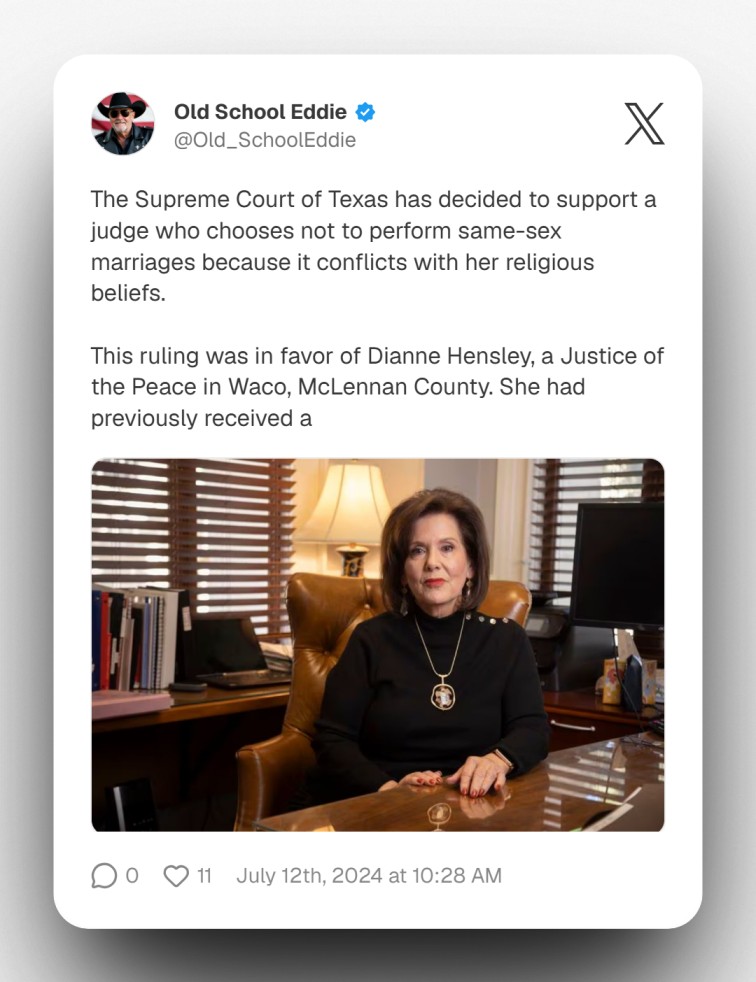
According to the court ruling, Hensley will receive $10,000 in damages, while the State Commission on Judicial Conduct has been ordered to pay roughly $630,000 in attorney’s fees accumulated during the eight-year legal battle. Her legal team at First Liberty Institute celebrated the decision as a major victory.
RELATED: Niger and Japan Take LGBTQ+ Rights in Opposite Directions
“It’s a great victory for people of faith. It’s important for people of faith to be able to decline to participate in things that they find that are incompatible with their religious faith,” Hiram Sasser, executive general counsel for First Liberty Institute, told Fox News Digital.
Supporters argued that Hensley wasn’t trying to prevent same-sex couples from getting married altogether. Instead, they said she created a referral system that directed couples to other officiants who could perform their weddings without extra cost or delay.
“I think one of the great things about how Judge Hensley handled things here is that she not only was exercising a religious faith to say, ‘Hey, look, I can do some marriages, but not others,’ but she was also being a good neighbor. She had a referral system in place for people whose weddings she could not perform,” Sasser said.
The court dispute dates back to 2018, when the State Commission on Judicial Conduct warned Hensley that continuing to perform opposite-sex marriages while declining same-sex ceremonies could result in escalating disciplinary action.

Sasser also pointed to changes made since then, saying the Texas Supreme Court updated its rules to allow religious accommodations and that the state legislature reformed the commission’s membership. After eight years in court, Hensley welcomed the court’s outcome.
“All I wanted to do was serve our community and maintain my faith commitments. I am thankful the law prevailed after eight long years, and we restored religious liberty to the land.”
Meanwhile, one gay student’s graduation came with a $10,000 settlement
While one courtroom celebrated a victory for religious freedom, another case highlighted what happened when a student says she paid the price for coming out.

Morgan Armstrong reached a settlement with Tennessee Christian Preparatory School after suing the school for banning her from graduation and withholding her diploma. Under the agreement, Armstrong received $10,000, her diploma, and protection from the school making disparaging remarks about her to colleges.
The dispute began after the standout basketball player posted photos with her girlfriend on social media alongside the caption, “cat’s out of the bag.”

She later encouraged friends to interact with the post, writing:
“Go and comment on my post, I have some ruthless Trump supporting ‘Jesus’ mfs on there.”
Soon afterward, Armstrong and her family were summoned to the school, where administrators presented a letter accusing her of making “a disparaging remark, reflecting the people at Tennessee Christian.”
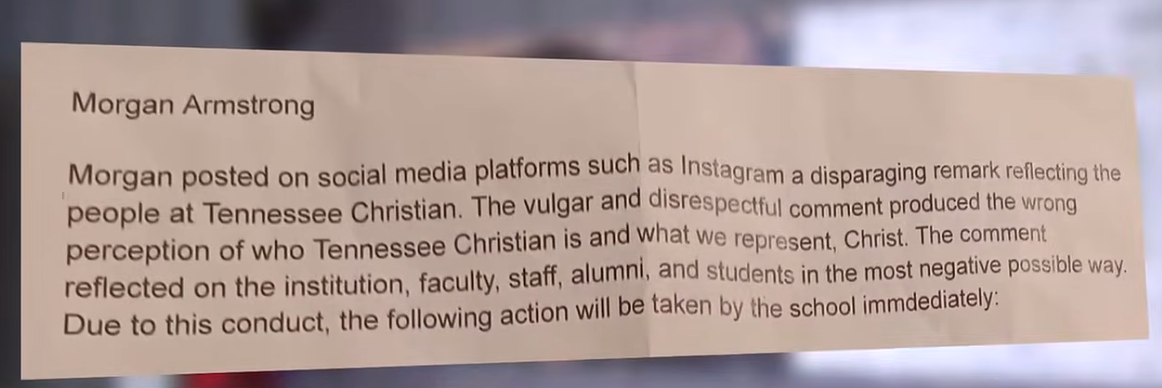
The school barred her from participating in graduation and allegedly threatened to send her social media posts to colleges.
A graduation stage she never got to walk across
Armstrong’s attorney, Daniel Horwitz, argued that she had never posted anything about the school itself and said administrators failed to follow their own disciplinary policy, which reportedly called for only a one-day suspension for a first social media violation. Instead of celebrating graduation with her classmates, Armstrong spent the day protesting across the street with her family.
“It was difficult having to stand across the street knowing that the people I’ve grown up with for the last four years were able to walk across the stage and I wasn’t allowed to,” she said.

At the time the lawsuit was filed, Head of School Jared Tilley said Tennessee Christian Preparatory School “firmly rejects the misleading allegations” while maintaining that it remained committed to delivering Armstrong’s diploma.
Two cases, two outcomes, one uncomfortable contrast
Placed side by side, these stories almost read like a legal version of “spot the difference.”
One case ended with hundreds of thousands of dollars awarded to a public official who declined to perform same-sex weddings because of her religious beliefs. The other ended with a gay student receiving a comparatively modest settlement after saying she was excluded from one of the biggest milestones of her young life because she came out.
The legal issues aren’t identical. One centered on religious liberty, the other on alleged discrimination and school discipline. But for many LGBTQ+ people, the contrast is difficult to ignore. One person’s refusal became a six-figure court victory. Another person’s exclusion ended with a diploma, $10,000, and a graduation ceremony she can never get back.
People of “Faith” have every right to do what they want EXCEPT when it involves voilating the law. She has the right to resign rather than stay a judge but she and everyone else MUST follow the rule of law in positions such as this. (something people of her ilk and I bet party) don’t seem to do. On the flip side, this gives us the right to discriminate against these people. It can’t go one way.
I am getting sick and tired of people using religion to get out of the duties of their jobs. If they don’t like all the responsibilities of their job due to their personal religion which should have no impact on others) then get a different job. No one should ever be able to use religion to discriminate against LGBTQ+ people. Especially with marriage – its been the law of the land for long enough.
So…Texas tax payers had to pay $630K for legal fees? 🤭🤪😎