


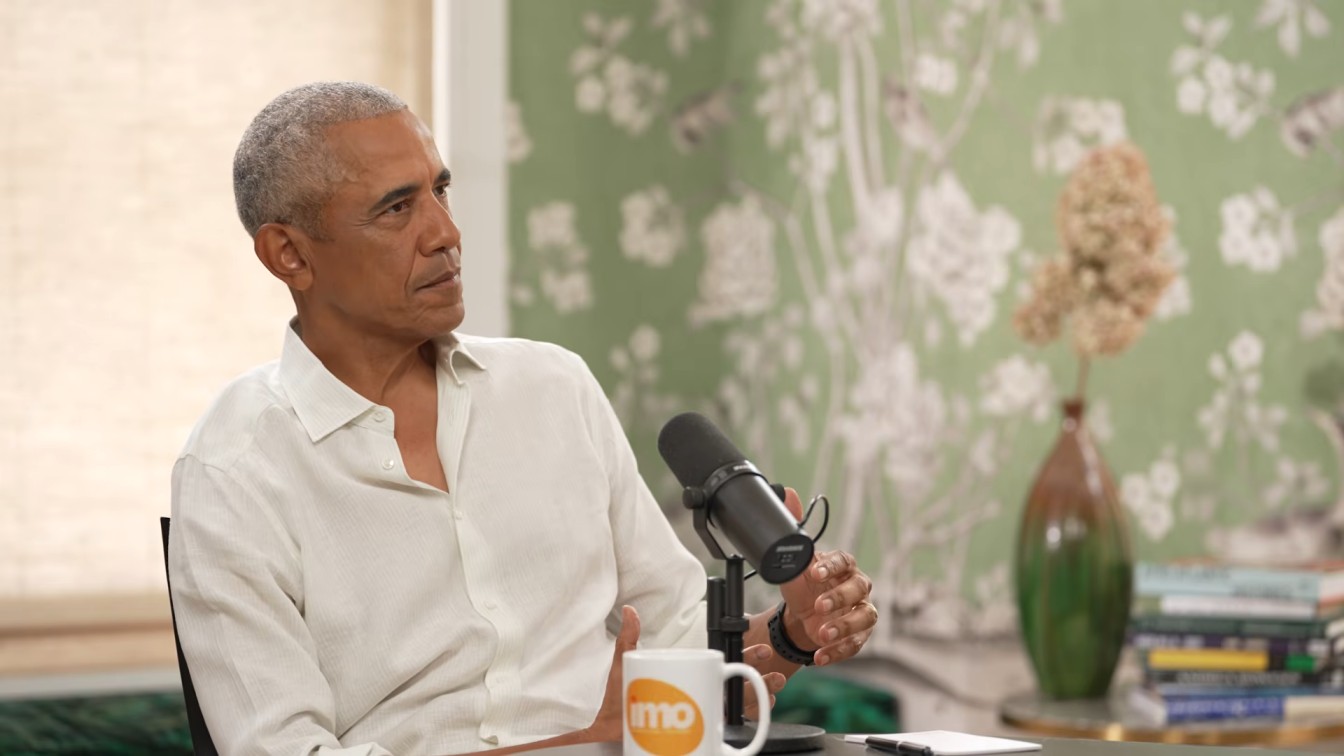
Barack Obama’s latest conversation on the IMO podcast with Michelle Obama and Craig Robinson wasn’t just another episode of presidential musings. No, this time, the former president offered a deeply personal reflection on the power of diverse role models in shaping emotionally intelligent men, and in particular, how gay men—both past and present—helped teach him the very values of empathy and kindness. If ever there was a moment that highlights just how far the LGBTQ+ community has impacted culture, this is it. And no, it’s not just about the glamorous, rainbow-hued speeches of acceptance we’re used to hearing in public forums—this is about real-world, down-to-earth transformation.
RELATED: 21-Year-Old Barack Obama Opens Up About Gay Sex Fantasies

Barack’s message, ever the subtle champion of change, urges us to rethink the blueprint for raising young men—especially those navigating the mess of toxic masculinity so often perpetuated in the online “manosphere.” His advice? “Look to the community.” But not just for inspiration from the usual suspects—sports stars or corporate titans. No, Obama’s message is to widen that scope to include the diversity of human experience, which has long been championed by LGBTQ+ folks, in order to raise men who value empathy as much as they value, well, anything else.
As he said on the podcast, “I do think as a society, we have to create more structures for boys and men to … be able to meet a wide range of role models so that whatever their inclinations, they can see a path to success that isn’t just sports or money, making a lot of money.” And thank goodness for that. Because let’s face it: If all we ever see in the media are billionaire bros and jockish superheroes, how would we ever know that emotional intelligence could be sexy?

But here’s where things take a personal turn for Obama. He recalls a moment in his own life that truly reshaped his understanding of the LGBTQ+ experience—a gay professor in college. He was a man of quiet power, a man who didn’t have to shout from the rooftops to make an impact on Obama’s own maturation process. “I had a gay professor in college at a time when openly gay folks still weren’t out a lot, who became one of my favorite professors and was a great guy and would call me out when I started saying stuff that was ignorant,” Obama shared. “You need that, to show empathy and kindness.”
The most telling part? It’s not just that this professor taught Obama about European politics, but that he demonstrated, through his very presence, how to be authentic in the face of societal pressures. In a world that often tries to force men—straight, gay, and everything in between—into rigid boxes, this gay professor didn’t just talk about LGBTQ+ rights. He lived with them. And that made all the difference.
In fact, Obama’s recollection brings us back to a time when his own views weren’t as evolved. He openly admits, in his 2020 memoir A Promised Land, that in the 1970s, he was guilty of using anti-LGBTQ+ slurs with his friends—behavior he now recognizes as “callow attempts to fortify our masculinity and hide our insecurities.” But here’s the kicker: As Obama reflected on those less enlightened days, he also came to realize the damage caused by that ignorance—and it was the openly gay people in his life who helped him see the bigger picture. In fact, the man he credits with reshaping his perspective is Dr. Lawrence Goldyn, his European Politics professor at Occidental College, who was “the first openly gay professor that I had ever come in contact with.” It’s funny how one encounter can transform a lifetime of learning, right?
Obama’s story is a great reminder that it’s never too late to learn or to grow—and that some of the best teachers come in forms we least expect. His relationship with Dr. Goldyn wasn’t about speeches or agendas. It was about friendship, mutual respect, and the quiet power of simply being who you are, unapologetically. Obama continues, “He wasn’t proselytizing all the time, but just his comfort in his own skin and the friendship we developed helped to educate me on a number of these issues.”
So, how does this play into the bigger picture of raising emotionally intelligent boys? Obama’s counsel is clear: Parents, especially cis-het parents, should cultivate a diverse circle of friends. “If you then have a boy who is gay or nonbinary or whatever, they have somebody that they can go, ‘Okay, I’m not alone in this,’ right?” It’s a quiet kind of activism, one that doesn’t rely on grand gestures but on consistent exposure to different perspectives.
And that, dear readers, is a true gift we can give the next generation. Not just raising boys who are capable of tying a tie or scoring a touchdown, but boys who understand the world is a little bigger, a little messier, and far more beautiful when they embrace it all.
So, if you’re looking for inspiration as a parent or a mentor, consider this: the role models that shape us don’t always wear capes or suit jackets. Sometimes they’re the ones who quietly show us how to live with kindness, authenticity, and a deep sense of empathy. And if that role model happens to be gay? Even better. They’ve already shown you that love, in all its forms, makes the world a far more colorful place.
Watch the full podcast here: