


The word trans has rarely felt as politically charged — or as dangerously misused — as it does right now. In late January, a Republican candidate for governor of Tennessee made remarks so extreme that LGBTQ+ advocates, civil rights groups, and medical professionals immediately sounded the alarm. The comments didn’t just echo familiar culture-war talking points; they escalated them to a place that many in the trans community recognize as rhetoric that openly threatens trans families.
RELATED: The Harm Behind Texas Schools Rejecting Trans Students’ Names
Who Said It — and Where
The comments came from Monty Fritts, a 62-year-old Republican running in Tennessee’s 2026 gubernatorial race. Fritts made the remarks during a guest appearance on a Christian Nationalist podcast, a clip of which later circulated widely on social media.
What Fritts said — and how directly he said it — is what has made this moment different.
 Source: fritts4tn.com
The Call That Sparked Outrage
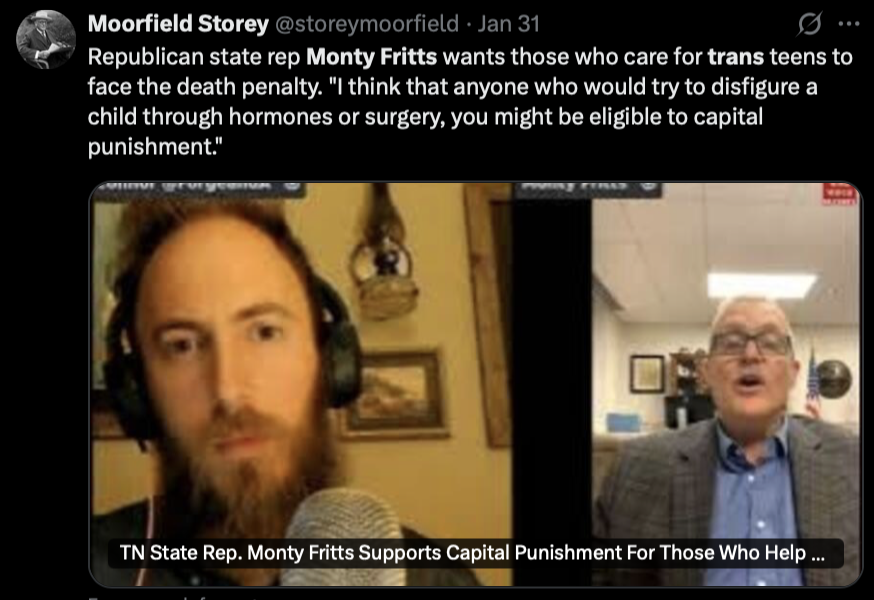
During the roughly 40-second podcast clip, Fritts advocated for capital punishment for parents, guardians, and medical professionals connected to trans and non-binary minors receiving gender-affirming care.
His words, kept intact and unedited, include:
“I think we need a law in Tennessee that would allow for capital punishment for those who commit an assault on the sanctity of life,”
Tennessee state Rep. Monty Fritts, who is running for governor, calls for a law that would allow for capital punishment for “anyone who would try to disfigure a child and change their sex through hormones or surgery”: “I think it aligns with scripture.” pic.twitter.com/gPbQqnFXpz
— Right Wing Watch (@RightWingWatch) January 29, 2026
“I think that anyone who would try to disfigure a child through hormones or surgery, you might be eligible to capital punishment.”
The reaction was immediate. LGBTQ+ advocacy organizations, activists, and political commentators described the remarks as a dangerous escalation — one that moves beyond policy disagreement into rhetoric that frames trans healthcare as a capital crime.
What Gender-Affirming Care for Trans Youth Actually Is
Much of the fear-based language around trans youth relies on a distorted picture of medical reality. In the United States, gender-affirming care for trans minors typically refers to puberty suppressant medication, commonly called puberty blockers.
These treatments are widely considered safe and are regarded by major medical institutions as life-saving in some cases, particularly for trans youth experiencing severe dysphoria
Despite frequent claims to the contrary, invasive gender-affirming surgeries for trans minors are extremely rare. Assertions that such procedures are common have been repeatedly disputed by medical experts.
Not an Isolated Statement
This is not the first time Fritts has publicly advocated for the death penalty in the name of “moral” governance. Earlier this month, he faced backlash over a leaked audio recording in which he called for capital punishment for people who had abortions and for those who provided abortion care.

That audio was recorded in August of the previous year at a Washington County Republican Party meeting titled “God, Guns, and Guts.” Reporting on that recording was credited to journalist Rachel Wells.
The repetition matters. For LGBTQ communities already navigating hostile legislation and social stigma, patterns like this signal intent, not rhetorical slip-ups.
Tennessee’s Political and Legal Reality
Tennessee remains a Republican stronghold, with the GOP holding the vast majority of the state’s Congressional seats. That dominance has shaped the state’s legal landscape for trans people.
In June 2025, the US Supreme Court upheld Tennessee’s ban on gender-affirming care for trans minors, a ruling widely described within the LGBTQ+ community as a truly difficult setback. Against that backdrop, calls for criminalization — let alone execution — feel less abstract and more chillingly plausible.
Why This Moment Matters for the Trans Community
For trans people and their families, language like this does real harm. It reframes care as violence, parents as criminals, and trans existence as something punishable by death. Even when such proposals have no immediate legal path forward, they contribute to an environment where harassment, threats, and violence feel increasingly justified.
This isn’t just about one candidate or one podcast appearance. It’s about how far anti-trans rhetoric has moved into the mainstream — and how openly some political figures are now willing to say the quiet part out loud.
For LGBTQ+ audiences, especially trans readers, the message is unmistakable: vigilance, community solidarity, and accurate information matter more than ever. Because when rhetoric escalates this far, silence is not neutral — and neither is misinformation.
I feel for Tenn. if they vote this fascist in!
I bet if someone were to go turn on his personal computer right now, and trace his website history, you would find tons of pictures that would not sit right with any christian organization or parent. The ones who raise the alarm are the ones we must worry about the most. There’s a word out there I believe its termed “Hypocrite”.
Just another reason why Republicans should be banned from society. So much being the party of “family values” and “peace”.