


If you’ve ever heard someone say, “You can’t make this stuff up,” the infamous “gay bomb” is probably Exhibit A.

It sounds like the plot of a forgotten camp comedy: a secret military weapon designed to make enemy soldiers irresistibly attracted to each other, causing chaos on the battlefield. The kind of premise that feels one rejected screenplay away from becoming a midnight cult classic. Except it was real. Well, sort of.
RELATED: Neo-Nazis Crash Pride Event With Swastikas and Slurs
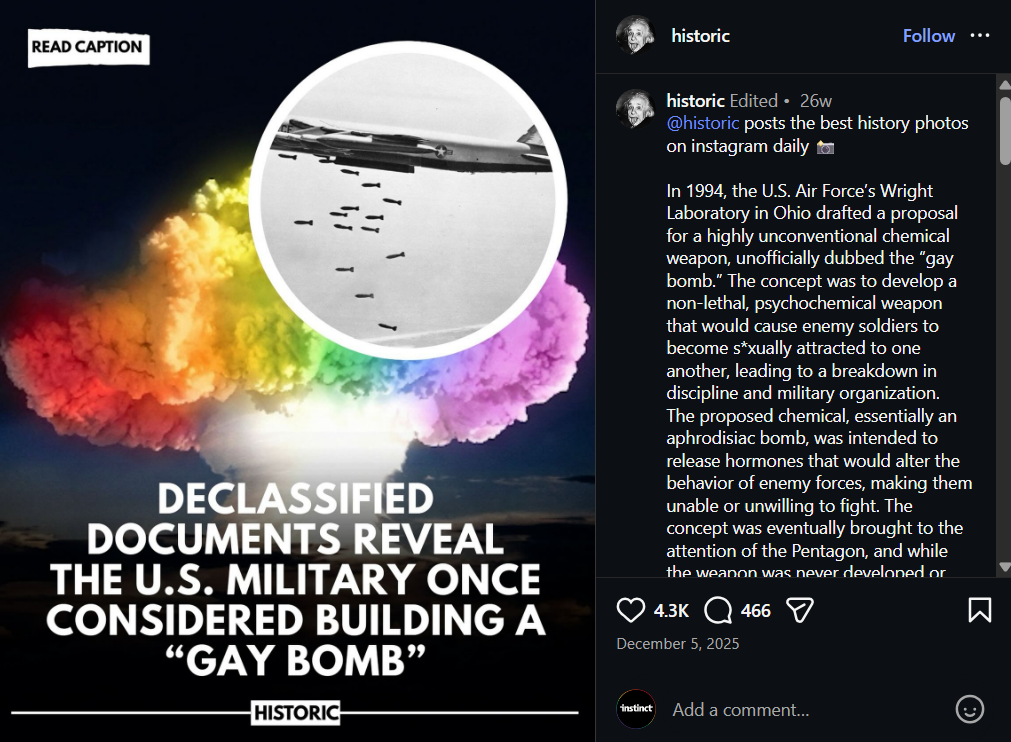
Back in 1994, researchers associated with the U.S. Air Force Wright Laboratory submitted a proposal seeking funding for a variety of nonlethal weapons concepts. Among them was the idea of a chemical aphrodisiac that could theoretically influence enemy behavior. The proposal never received funding, never moved beyond the concept stage, and never became an actual weapons program.
Still, more than three decades later, people continue talking about it—and not because anyone seriously thought a cloud of fabulousness was about to be deployed over enemy territory. The real story is what the proposal revealed about how many institutions viewed gay people at the time.
The Problem Was Never the Science
The most telling part of the proposal wasn’t whether the concept could work. It was the assumption that made someone think it was worth proposing in the first place. The theory suggested that soldiers who suddenly experienced same-sex attraction would become distracted, lose discipline, and cause military cohesion to collapse. Underneath the bizarre premise was a much more familiar idea: that homosexuality itself was inherently disruptive. Viewed through the lens of the early 1990s, that thinking wasn’t particularly unusual.
RELATED: Far-Right Pastor Thinks Nicotine Creates Men and Weed Creates Gays
This was an America where homosexuality remained heavily stigmatized. The military’s “Don’t Ask, Don’t Tell” policy would arrive the following year. Public debates frequently treated gay Americans less as citizens deserving equal rights and more as a social issue to be managed. In that context, the “gay bomb” wasn’t simply a strange military proposal. It was a snapshot of how deeply prejudice had become embedded within certain corners of American life.
History Had Other Plans
Fortunately, reality turned out to be a stubborn thing. Over the following decades, evidence repeatedly challenged claims that LGBTQ+ people would undermine institutions. Gay and lesbian service members served openly in armed forces around the world. Workplaces expanded protections. Universities, professional organizations, and government agencies adopted policies that would have seemed politically impossible when the proposal was written. Funny how civilization didn’t collapse.
The contrast is striking. The proposal treated same-sex attraction as a threat to military effectiveness. Yet many of the institutions once warned about inclusion became stronger, more representative, and more reflective of the societies they served. What once looked like a national security concern now reads more like an awkward historical artifact.
America Loves a Moral Panic
Of course, the “gay bomb” didn’t emerge from nowhere. American history is filled with moments when minority groups became convenient targets for broader social anxieties. During the Cold War, fears about communism became entangled with fears about homosexuality. Earlier generations directed suspicion toward immigrants, religious minorities, and racial groups.
The pattern rarely changes. Find a marginalized group. Portray it as a danger to established institutions. Present exclusion as protection. These campaigns tend to reveal more about the fears of a particular era than about the people being blamed for them. The details evolve. The headlines change. The underlying script remains surprisingly familiar.
From the “Gay Bomb” to the Culture Wars
As public acceptance of same-sex relationships grew and legal recognition expanded, the political battlefield shifted. Opposition movements increasingly focused on newer conflicts involving gender identity, education policy, public accommodations, and government recognition. These issues became central features of America’s modern culture wars, particularly during periods of intense political polarization. Within that environment, LGBTQ+ issues became valuable political currency.
Supporters of these debates argue they involve important questions about rights, values, and social norms. Critics argue they often serve as distractions from pressing challenges such as housing affordability, health care access, infrastructure, economic inequality, and long-term fiscal concerns. Regardless of where someone stands politically, one reality remains difficult to ignore: cultural conflict attracts attention. And attention is a finite resource.
The Real Threat to Cohesion
Here’s where the story takes an unexpectedly ironic turn. The original “gay bomb” proposal rested on the belief that gay people would somehow destroy unity and discipline. That prediction aged about as well as milk left on a dashboard. Military organizations, businesses, schools, and countless other institutions continued functioning while becoming more inclusive. The feared collapse never arrived. Yet concerns about social cohesion never disappeared. Instead, they migrated elsewhere.

Today, researchers studying trust, civic engagement, and democratic stability often focus on political polarization itself. The growing tendency to view fellow citizens as enemies rather than participants in a shared society presents challenges that are arguably far more significant than the imaginary scenarios proposed in 1994. The threat wasn’t people being gay. The threat was always the fear of people being gay.
A Historical Curiosity With a Serious Lesson
Today, the “gay bomb” survives mostly as an odd footnote in American history—a bizarre concept that sounds funnier every time you hear it. But beneath the absurdity sits a valuable reminder. Prejudice doesn’t always arrive wearing a villain’s cape. Sometimes it appears in policy discussions, research proposals, official reports, and institutional assumptions. Sometimes it sounds reasonable to the people living in that moment.
The passage of time has a way of exposing those assumptions for what they were. More than thirty years later, the “gay bomb” tells us far less about military technology than it does about how societies define threats, how fear becomes embedded in decision-making, and how future generations judge those choices. And if there’s one thing history repeatedly proves, it’s that panic ages poorly. The receipts, however, tend to last forever.
Source: Milwaukee Independent