


Hot priests in calendars was probably too good to be true.
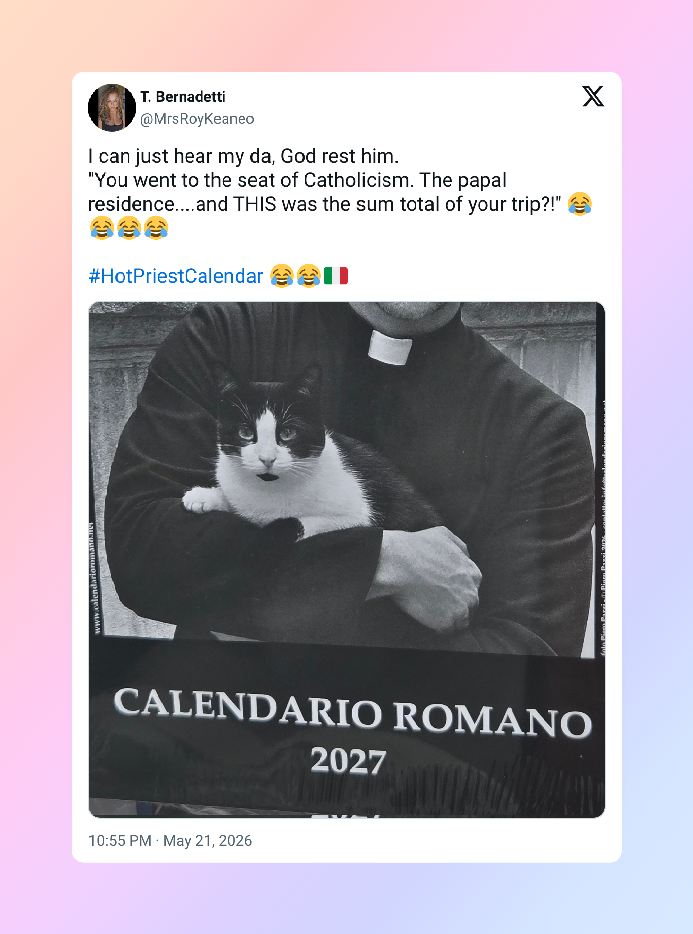
For years, the infamous Calendario Romano has quietly existed as one of Rome’s most unintentionally hilarious tourist souvenirs. Somewhere between rosaries, Vatican postcards, and tiny Colosseum replicas sits a calendar full of impossibly photogenic “priests” staring moodily into the distance like they just walked out of a prestige Italian drama.
Officially, the calendar presents itself as an informational tourism product connected to Vatican culture and life. Unofficially? It has absolutely become known online as the “hot priest calendar.”
And honestly, people were not exactly buying it for the liturgical holidays.
The Calendario Romano has been around since the early 2000s, featuring handsome men dressed in priestly attire for each month of the year. Over time, it became a novelty item, a collectible, and for some people, a slightly confusing spiritual experience.
A quick internet search long convinced many fans that the men featured were actual priests.
Well. About that.
RELATED: He Loved God — But Couldn’t Live Without Sex: An Italian Priest Speaks Out
One of the Calendar’s Most Famous Faces Was Never a Priest
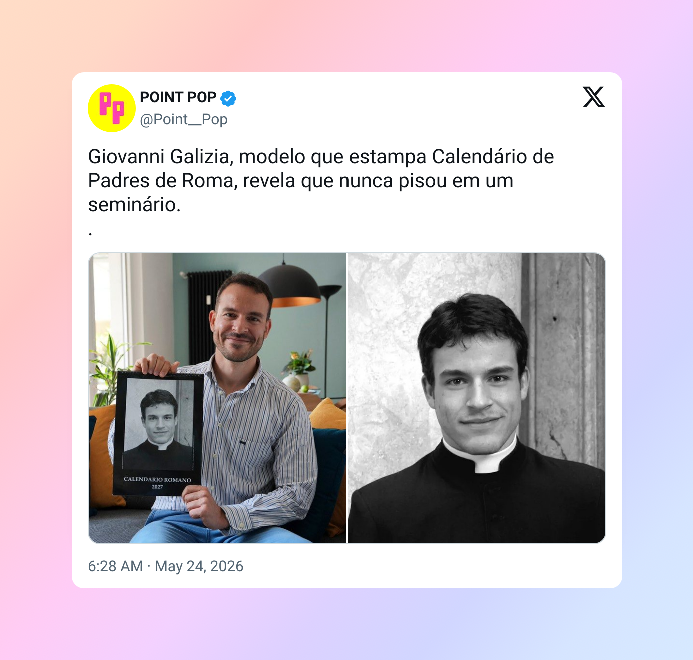
One of the calendar’s most recognizable cover stars, Giovanni Galizia, has now revealed that he was never a priest at all. In reality, the now 39-year-old works as a flight attendant instructor.
Recentemente Giovanni Galizia revelou que nunca foi padre e nem chegou a pisar num seminário. Quando tinha 17 anos trabalhava como modelo e foi convidado pra fazer umas fotos vestido de padre que acabaram estrelando o famoso calendário romano. Atualmente Giovanni possui 40 anos e… pic.twitter.com/VCvYkQYxrC
— Dan Pimpão (@DanPimpao) May 24, 2026
Honestly, somewhere out there, thousands of tourists are probably reevaluating several emotional decisions.
Speaking to Italian newspaper Repubblica, Galizia explained that the now-famous photo was taken when he was only 17-years-old after a photographer invited him to pose wearing priest garments.
“At one point he asked me if I wanted to participate. It was a game, he had everything ready,” Galizia explained, including the outfit itself.
The photograph was reportedly taken in Palermo, and according to Galizia, he never earned money from the shoot. He also made it very clear that despite years of appearing across souvenir shops in Rome as one of the calendar’s signature “priests,” he was never actually ordained.
“What I can assure you is that I was never a priest,” he said.
And suddenly the Calendario Romano cinematic universe got much more complicated.
The Vatican Never Exactly Stopped It Either
What makes the entire story funnier is how openly available these calendars have remained for years around Vatican-adjacent tourist areas. While the Vatican has never exactly promoted the calendar as official religious material, it also never seemed especially bothered by tourists purchasing copies by the thousands.
To be fair, the calendar’s official description sounds extremely innocent. According to its website, it exists as “an information tool aimed at the tourist public” that provides general information about Vatican City.
Information tool is certainly one way to describe it.
In reality, the Calendario Romano became something much bigger online thanks to decades of people reacting the exact same way: “Wait… why are these priests kind of hot?”
The combination of dramatic lighting, flowing robes, soft smiles, and suspiciously model-like bone structure turned the calendar into a full-on novelty sensation.
RELATED: The Priest Calendar Serving Body-ody-ody…of Christ
Wait… Were Any of Them Real Priests?
Perhaps the funniest part of Galizia’s interview was his suggestion that other men featured throughout the calendar may not have been real priests either. Which honestly feels like finding out professional wrestling might be scripted or that Santa isn’t real (of course he is).
For years, people assumed the appeal came from the accidental attractiveness of actual clergy members being photographed in glamorous ways. But if several of the models were simply photogenic Italian men borrowing cassocks for a photoshoot, then the entire mythology surrounding the calendar changes completely.
Not necessarily in a bad way, though.
If anything, the revelation somehow makes the Calendario Romano even campier and more iconic. The idea that tourists across the world have been buying a “hot priest calendar” fronted by a teenage future flight attendant pretending to be clergy is objectively incredible pop culture lore.
A Holy Novelty With Lasting Appeal
At the end of the day, the Calendario Romano endures because it occupies a very strange and very entertaining corner of pop culture. It is equal parts religious souvenir, internet curiosity, camp collectible, and accidental thirst trap.
And despite Galizia insisting there was “nothing sensual” about the photo, the internet may continue disagreeing with him for the foreseeable future.
Time may have passed, as he joked in his interview, but the calendar’s bizarre charm clearly has not.
Because whether the men inside were priests, models, or random teenagers agreeing to spontaneous photoshoots in Palermo, the Calendario Romano still remains one of the funniest and most unexpectedly iconic tourist items Rome has ever produced.