

Two gay men who escaped Iran after being detained for alleged same-sex activity are now confronting the possibility of removal from the United States—an outcome advocates warn could put their lives in immediate danger.
The couple, who are partners and are believed to be in their late 30s and early 40s, were taken into custody by Iran’s morality police in 2021. In Iran, same-sex relationships are criminalized, with penalties that can include corporal punishment or execution. After being released while awaiting sentencing, the men fled the country before a final punishment was imposed.

Their journey eventually led them to the United States, where they crossed the southern border in January 2025 and formally requested asylum. Despite those claims, they have remained in immigration detention for more than a year as U.S. authorities move forward with plans to deport them back to Iran, according to their legal counsel.
While a federal judge has stepped in to temporarily halt at least one deportation order, immigration advocates caution that the risk facing the men has not passed and could escalate quickly.
RELATED: A Gay D.C. Marriage Put on Pause After ICE Detention
Advocates Say the Case Fits the Definition of Asylum
Rebekah Wolf, a staff attorney with the American Immigration Council, represents the men and argues that their situation aligns squarely with the intent of U.S. asylum law.
“They are textbook asylum cases,” Wolf said in an interview with The Advocate. “People from a country where who they are is criminalized and punishable by torture or death — that is literally the definition of an asylum seeker.”
Wolf explained that the men fled Iran specifically to avoid prosecution for charges that could have led to their execution. She says the current deportation effort would return them to the same legal system they escaped, despite the dangers it poses.
The Reality of Being LGBTQ+ in Iran
For LGBTQ+ people, being forced to return to Iran carries severe and potentially fatal consequences.
The Human Dignity Trust reports that:
“Iran criminalises same-sex sexual activity between men and between women. Sentences include a maximum penalty of death. There is evidence of the law being enforced in recent years, and LGBT people are regularly subjected to discrimination and violence.”
Under Iran’s 2013 Penal Code, same-sex intimacy is outlawed through provisions targeting acts referred to as livat, tafkhiz, and musaheqeh. These laws apply to both men and women and are rooted in interpretations of Islamic law.
Human rights organizations stress that these statutes are actively enforced today, not relics of the past.
pic.twitter.com/s9oRYoraRv
Watch: Iran’s former president, Muhammad Khatami, says executing gay people is not violence, but a religious obligation and an act of worship.Since the Islamic revolution, more than ten thousand gay people have been executed in Iran, for violating the…
— Liza Rosen (@LizaRosen0000) November 3, 2023
A Documented History of Executions
The dangers facing the men are not theoretical.
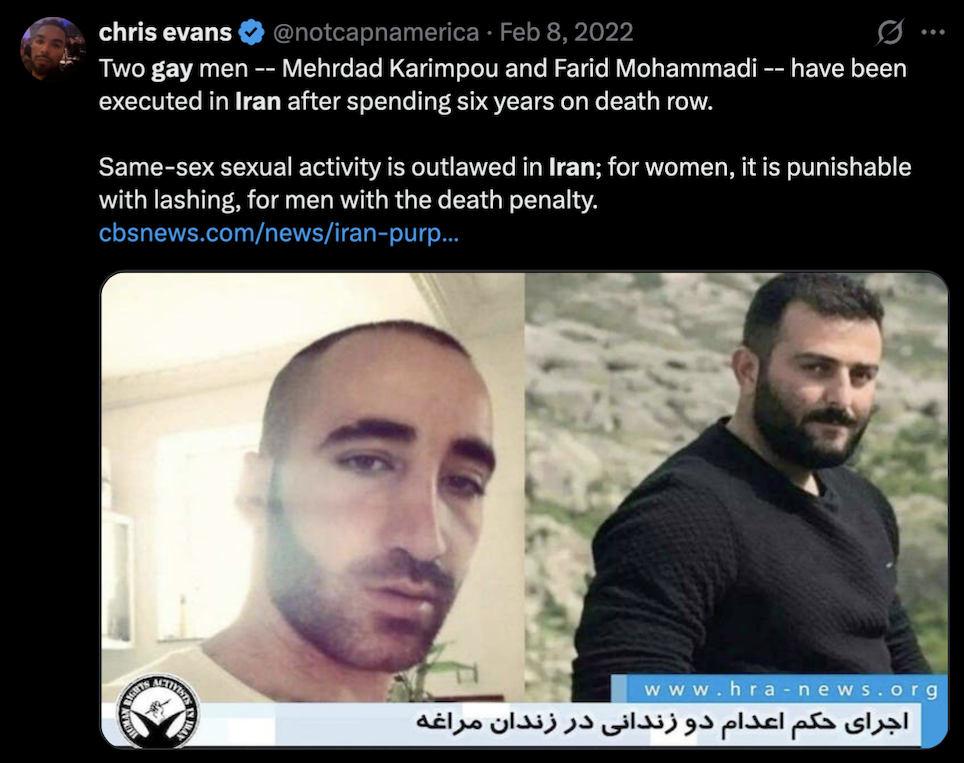
In 2022, AP News reported that Iranian authorities executed two gay men who had been convicted on sodomy charges after spending six years on death row.
According to the report,
“They were sentenced to death for ‘forced sexual intercourse between two men’ and hanged in a prison in the northwestern city of Maragheh.”
Advocacy groups argue that deporting LGBTQ+ asylum seekers to Iran knowingly exposes them to the risk of imprisonment, torture, or execution.
A Stark Disparity in Legal Outcomes
Wolf also raised concerns about procedural fairness, stating that the two men did not have legal representation during their asylum hearings, which took place in late April and early May. She said the proceedings were affected by bias and fundamental due process failures.
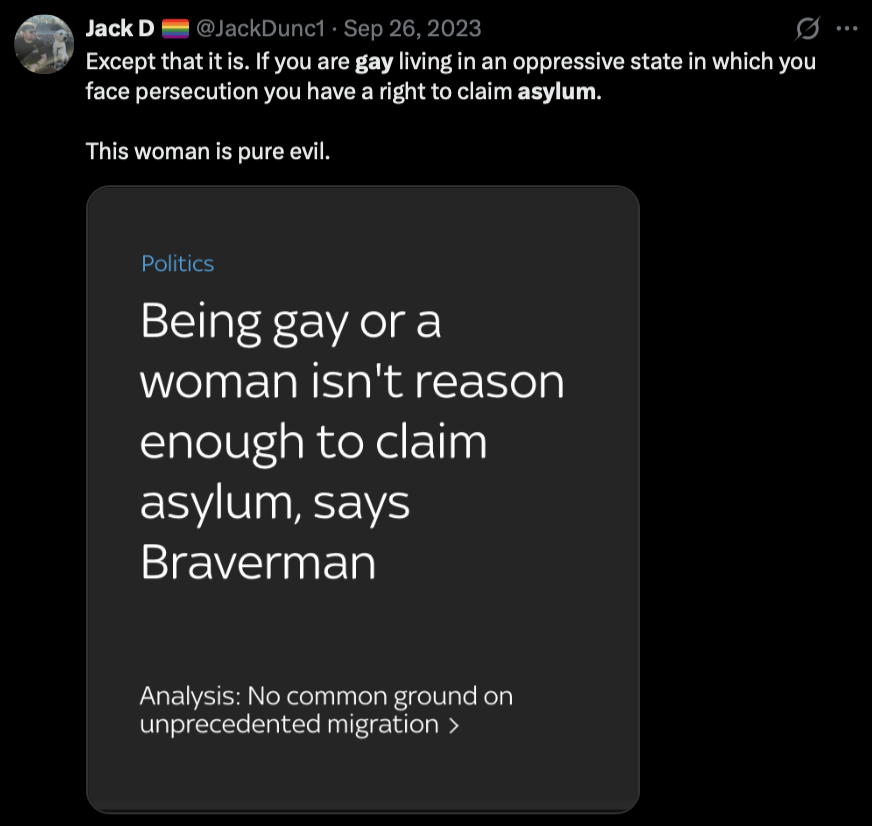
The men arrived in the U.S. alongside another LGBTQ+ asylum seeker, a woman who was also detained by Immigration and Customs Enforcement. Wolf represented her during her case.
The woman was granted asylum following a brief 45-minute hearing, and the government chose not to appeal the decision. She was released from detention.
The men, however, remain detained and face deportation.
Deportation With Deadly Consequences
Advocates say sending the men back to Iran would effectively return them to a country where their sexual orientation is criminalized and punishable by extreme violence.
“You need to be trans, you can’t be a homosexual” 💔
An unexpected and impromptu conversation with a gay man who took drastic steps to escape persecution in Iran
Filmed by / with @judge148
Vid goes live this eve 9 Sept at 9PM (Terf Island o’clock)
Link below… pic.twitter.com/Eg6Q9LG9fb
— MrMenno 🇳🇱🏳️🌈🎶 (@MrMennoTweets) September 9, 2025
Human rights groups have repeatedly documented cases of LGBTQ+ people in Iran being arrested, assaulted, denied basic rights, and, in some instances, executed.
For LGBTQ+ communities and allies, the case raises urgent concerns about whether the United States will honor its obligation not to deport individuals to countries where they face persecution or death.
An Uncertain and Urgent Future
Although a court order has temporarily delayed one removal, the men remain in custody, and advocates warn that deportation could still occur with little warning if permanent relief is not secured.
 Source: Kira Yan | Canva.com
As Wolf and others have emphasized, the outcome of this case is not merely procedural—it may determine whether two people survive.
For LGBTQ+ individuals fleeing countries like Iran, asylum is meant to offer protection. This case suggests that protection may be increasingly fragile.
REFERENCE: The Advocate, AP News, Human Dignity Trust