

In Moscow, the battle over who gets to exist on screen has entered a new phase. Several executives tied to Russia’s largest streaming platforms are now facing administrative charges connected to the country’s sweeping laws against LGBTQ+ representation. While officials have not publicly named specific films or shows at the center of the accusations, the message is unmistakable: queer visibility itself remains the target.
The cases, reported by The Moscow Times and Mediazona, arrive at a moment when digital entertainment has become one of the last remaining spaces for subtle LGBTQ+ storytelling in Russia. For many viewers, streaming platforms were once a rare window into narratives that reflected lives outside officially sanctioned norms. That window appears to be narrowing.
RELATED: Was ‘Heated Rivalry’ Created For Straight Women? It Depends. Let’s Talk About It
Streaming Platforms Under Pressure
According to court filings, executives from services including Kinopoisk, Ivi, Amediteka, Wink, and others are being held personally accountable for alleged violations of Russia’s LGBTQ+ “propaganda” regulations. These laws, expanded significantly in 2022, prohibit any public portrayal of what authorities describe as “non-traditional” relationships — a term broadly applied to nearly all LGBTQ+ identities.
Russian police raid several gay bars and nightclubs in Moscow under laws banning LGBT propaganda. What do you think? pic.twitter.com/Lkuv9Gv9XA
— RadioGenoa (@RadioGenoa) December 2, 2024
Several of the named executives have faced penalties before, suggesting a sustained campaign rather than isolated enforcement. Others are encountering these accusations for the first time, including charges that specifically reference content allegedly accessible to minors.
What’s striking is not only who is being charged, but what remains unnamed. Officials have declined to identify the exact programs or films under scrutiny, creating an atmosphere of uncertainty that critics say encourages preemptive censorship across the industry.
The Cost of Ambiguity
For creators and platforms alike, the lack of clarity has consequences. Without knowing what crosses the legal line, services may choose to quietly remove LGBTQ+ characters, themes, or even entire genres from their catalogs. The result isn’t just fewer queer stories — it’s a chilling effect that reshapes entertainment from the inside out.
This legal pressure extends beyond Russia’s borders. International studios and distributors working with Russian platforms must now weigh whether content that is celebrated globally could expose local partners to fines or legal action in Moscow.
Why Representation Still Matters
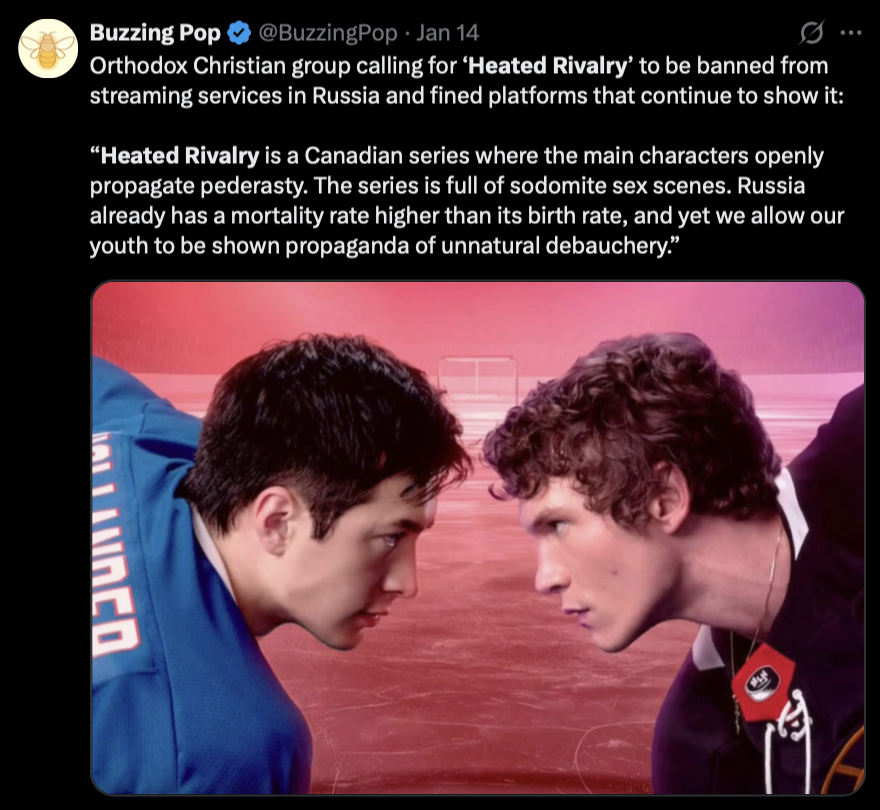
Globally, LGBTQ+ audiences have watched as inclusive storytelling has expanded across film and television. Series like Heated Rivalry — praised worldwide for its sharp writing, compelling performances, and emotionally layered characters — highlight just how powerful representation can be. Viewers don’t just connect with stories; they connect with the people who bring them to life. The irony of this situation? One of the show’s characters, Ilya, is from Moscow.

Part of Heated Rivalry’s success comes from its cast, including Hudson Williams, Connor Storrie, Robbie G.K., and Francois Arnaud, whose performances have resonated far beyond their home markets. Shows like this demonstrate that LGBTQ+ stories are not niche — they’re universal, commercially viable, and deeply human.
That contrast makes Moscow’s current crackdown feel especially stark. While global audiences celebrate queer-led narratives, Russian authorities continue to frame them as threats rather than reflections of real lives.
A Broader Cultural Shift in Moscow
The charges against streaming executives follow years of escalating restrictions. In 2023, Russia’s Supreme Court went even further by labeling the so-called “international LGBT movement” as extremist — despite no such organization formally existing. The designation effectively expanded the state’s power to suppress activism, media, and community spaces.
Within this environment, entertainment becomes political by default. A romantic subplot, a same-sex kiss, or even a character’s identity can trigger legal consequences. For LGBTQ+ Russians, the disappearance of these stories isn’t symbolic — it directly affects visibility, connection, and mental health.
What Comes Next
As Moscow’s legislative session continues and courts review these cases, the future of streaming in Russia remains uncertain. Platforms may adapt by editing catalogs, geo-blocking content, or avoiding LGBTQ+ themes altogether. Others could challenge the rulings, though past outcomes suggest limited room for success.
For LGBTQ+ audiences watching from abroad, the situation is a reminder that progress is uneven — and often fragile. While queer stories thrive in many parts of the world, they remain contested ground elsewhere.
Visibility as Resistance
Even amid tightening restrictions, queer storytelling continues to find ways to exist. Whether through international streaming, underground distribution, or global fan communities, representation persists — sometimes quietly, sometimes defiantly.
Moscow’s latest charges underscore a harsh reality: visibility is still political. And for many LGBTQ+ viewers, simply seeing themselves on screen remains an act of resistance.
REFERENCES: The Moscow Times and Mediazona