


The numbers may look like they belong in a dry polling report, but they land with a familiar sting. For many LGBTQ+ people, gay jokes followed by the excuse “it’s just a joke” have long been the world’s least original punchline. Now, fresh polling suggests more people in Britain are comfortable treating gay people as fair game for comedy—and that’s no laughing matter.

Have you noticed it yourself? Maybe you’ve heard more people brushing off gay jokes as “just banter,” or acting like they’re suddenly fair game again. This latest survey suggests you might not be imagining it.
RELATED: The STI Everyone’s Ignoring Is Becoming Harder to Treat
The punchline keeps changing
A new YouGov study has revealed a gradual but notable shift in how British people view jokes about gay people, with more respondents saying such jokes are acceptable regardless of who is telling them.
The biannual tracker, which spans from August 2019 to January 2026, surveyed between 1,963 and 2,048 British adults during each wave of data collection. The poll asked a straightforward question: “Which, if any, of the following identity groups do you think it is acceptable to make jokes about? Please select all that apply.”
RELATED: Gay Christians Under Fire as Southern Baptists Reject LGBTQ Identity
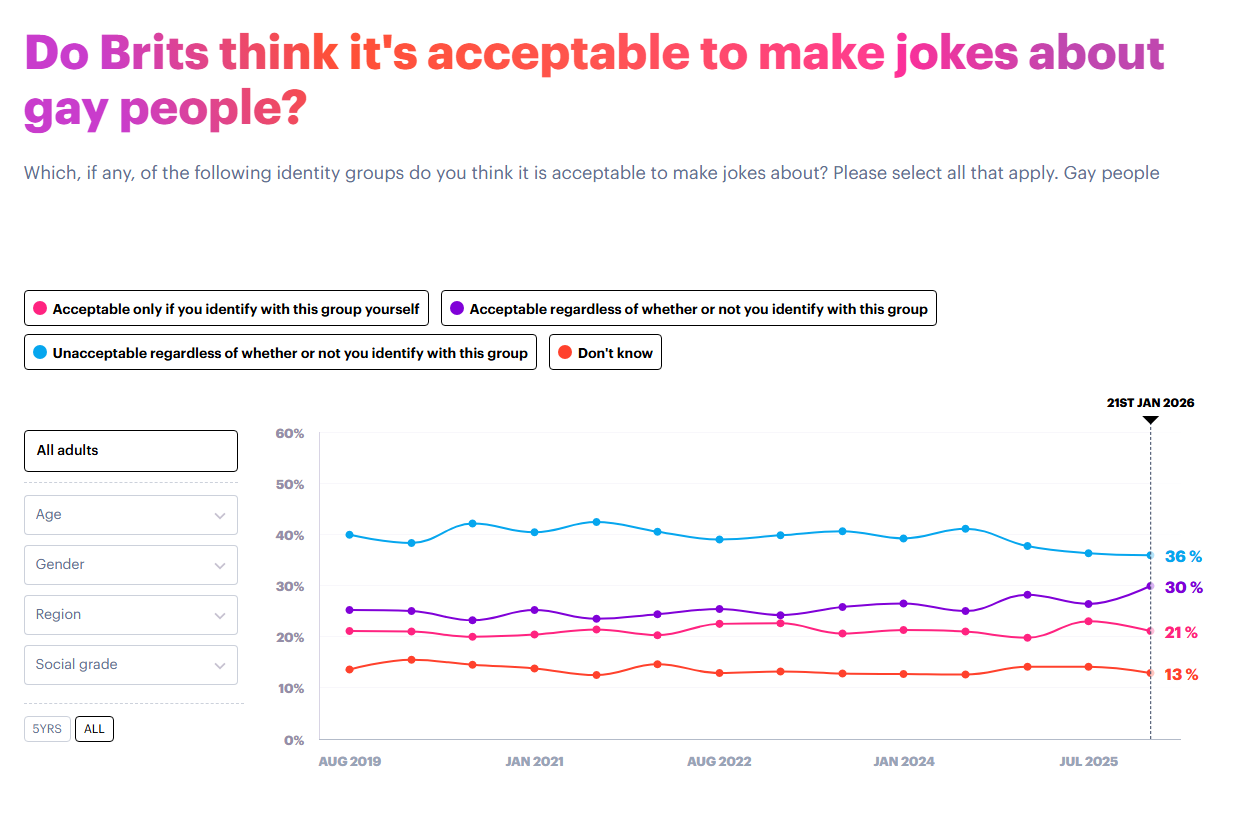
When it came to gay people, respondents could choose from four answers: “Acceptable only if you identify with this group yourself”, “Acceptable regardless of whether or not you identify with this group”, “Unacceptable regardless of whether or not you identify with this group” and “Don’t know.”
Back in 2019, 25% of respondents said it was “acceptable regardless of whether or not you identify with this group.” By 2026, that figure had climbed to 30%. Five percentage points might not sound seismic, but the data points to a gradual shift in public attitudes. For LGBTQ+ people, that’s worth paying attention to because the line between “banter” and bias has never been as clear-cut as some would like to pretend.
Gay jokes, old excuses
The findings arrive alongside growing concerns about anti-LGBTQ+ hostility elsewhere in British society, raising fresh questions about where gay jokes end and prejudice begins. British schools have recently reported a sharp rise in suspensions linked to homophobic and transphobic abuse, adding wider context to the survey’s results. The trend is also reflected in attitudes toward what respondents considered unacceptable.
In 2019, 40% of participants said gay jokes were “unacceptable regardless of whether or not you identify with this group.” By 2026, that number had fallen to 36%—the lowest level recorded since the survey began. The highest level of opposition was 42%, reached in both 2020 and 2021. Taken together, the results suggest more Britons are becoming comfortable with the idea that jokes about gay people are acceptable, whether or not the person making them belongs to the LGBTQ+ community.
Comedy has always pushed boundaries, and queer people have mastered the art of laughing through life’s absurdities. The difference, of course, is whether the joke is shared with the community—or aimed squarely at it.
The gender gap is hard to miss
The survey also found that this shift is happening among both men and women, although not at the same pace. Among men, 38% said in 2019 that gay jokes were “acceptable regardless of whether or not you identify with this group.” By 2026, that number had risen to 43%, the highest level recorded during the study.

Women were consistently less likely to agree. The figure increased from 14% in 2019 to 18% in 2026, showing a similar upward trend but remaining considerably lower than among male respondents. Those contrasting numbers suggest attitudes are changing across the population, though men appear substantially more willing than women to give the green light to jokes targeting gay people.
Younger Brits aren’t buying the bit
One of the survey’s more surprising findings is that younger people showed the strongest resistance to gay jokes. Among respondents aged 18 to 24, 25% said such jokes were “unacceptable regardless of whether or not you identify with this group.” That compares with 33% among those aged 25 to 49, 36% among people aged 50 to 64, and 45% among those aged 65 and older.
The survey doesn’t explore why attitudes differ across age groups, but the figures highlight clear generational differences in how respondents viewed gay jokes.
For queer people, the issue isn’t that humor is off-limits. LGBTQ+ culture practically runs on impeccable timing, razor-sharp wit, and the ability to turn hardship into comedy gold. The question has always been who gets to tell the joke—and whether everyone is still laughing by the end.