


Trump has put forward a new nominee for one of the most visible public health roles in the United States—and the choice is already prompting discussion, particularly among LGBTQ+ advocates.
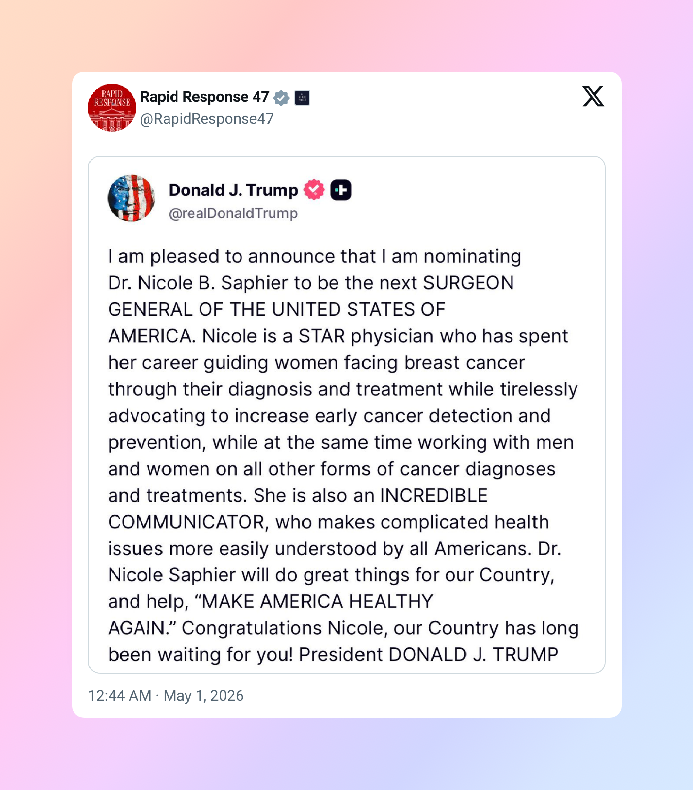
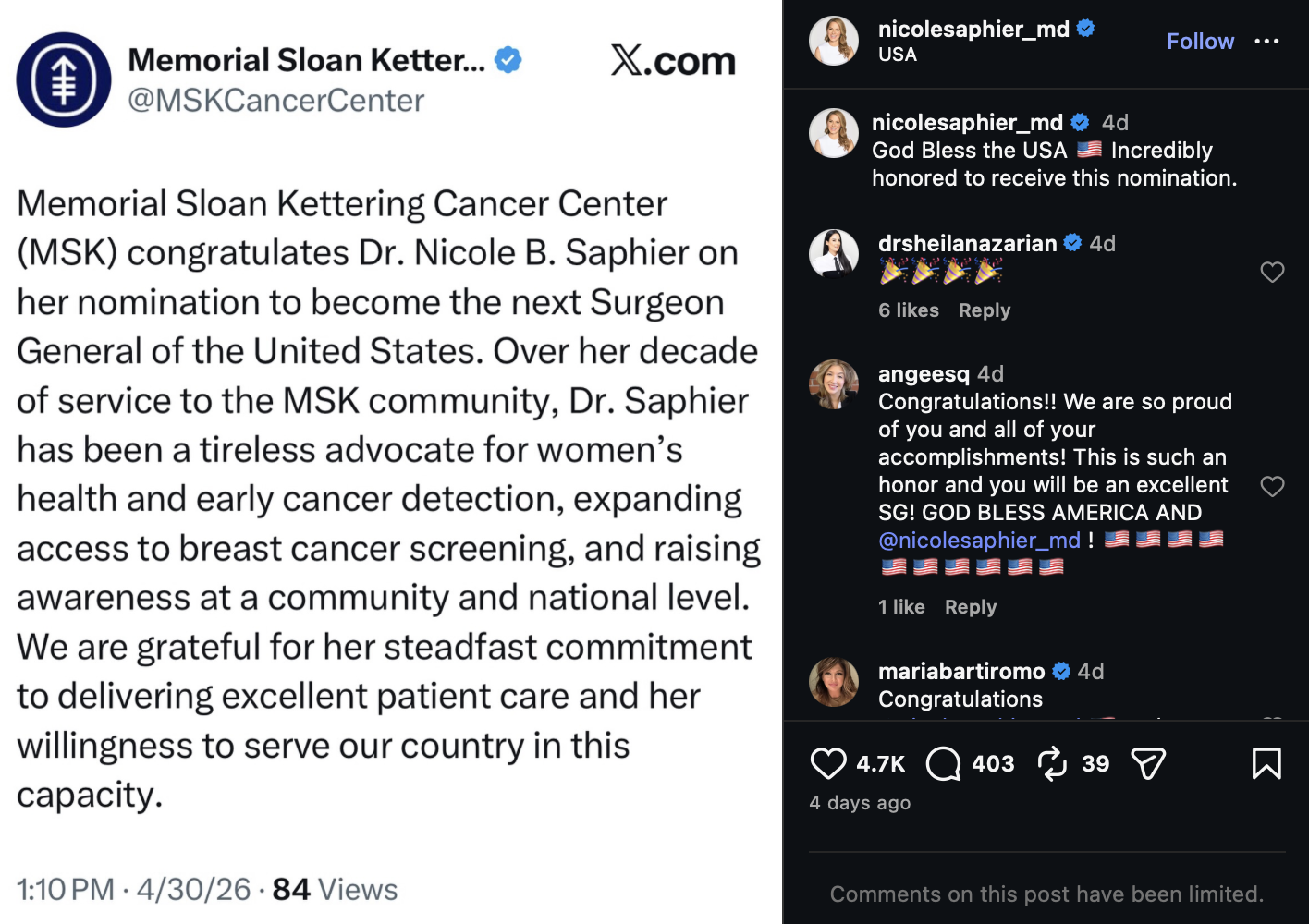
Donald Trump announced that Dr. Nicole Saphier is his latest nominee for U.S. surgeon general. Saphier, a Fox News contributor, podcast host, and owner of the nutraceutical company DropRx, would be the third nominee for the role following Janette Nesheiwat and Casey Means.

In a post on Truth Social, Trump praised Saphier’s credentials and communication style:
“I am pleased to announce that I am nominating Dr. Nicole B. Saphier to be the next SURGEON GENERAL OF THE UNITED STATES OF AMERICA. Nicole is a STAR physician… She is also an INCREDIBLE COMMUNICATOR, who makes complicated health issues more easily understood by all Americans… Dr. Nicole Saphier will do great things for our Country, and help, ‘MAKE AMERICA HEALTHY AGAIN.’”
Past Comments on Transgender Care
Saphier’s nomination is drawing particular attention because of her past public comments about transgender healthcare.
In a podcast discussion, she described gender-affirming care in critical terms, stating:
“A lot of these transgender medical interventions are the exact same way. It’s just another pathway of promoting body dysmorphic disorder.”
She has also referred to transitioning as a “fad” and a “trend,” language that has been widely debated in medical and advocacy circles.
These statements stand in contrast to positions held by major medical organizations, which generally support gender-affirming care as evidence-based treatment for individuals experiencing gender dysphoria.
The Role of the Surgeon General
The surgeon general is often referred to as the “nation’s doctor,” serving as a leading voice on public health issues. According to the National Institutes of Health:
“The Surgeon General oversees the Commissioned Corps of the U.S. Public Health Service (USPHS) and is viewed as the ‘Nation’s Doctor,’ responsible for providing the public with information on living healthier and safer lives.”
Because the position shapes national health messaging, any nominee’s views on science, medicine, and public health policy tend to be closely examined.
Broader Health Policy Questions
Beyond LGBTQ+ issues, Saphier has also expressed skepticism toward certain established public health practices. She has been noted for criticism of the American Academy of Pediatrics immunization schedule, which is based on extensive research and widely followed across the U.S.
This has raised additional questions about how her approach might align with federal health agencies such as the CDC, particularly at a time when vaccine policy remains a sensitive and highly scrutinized topic.
.@NBSaphierMD: Mental Health Crisis Is A National Emergency
“In my 2020 book Make America Healthy Again, I warned about the rising mental health crisis, 5 years later we are much worse off, especially children.”https://t.co/blmlBu5Zsc pic.twitter.com/Gx83HRKvG3
— Mr Producer (@RichSementa) August 29, 2025
LGBTQ+ Rights in the Current Policy Landscape

Saphier’s nomination by Trump comes amid a broader policy context where LGBTQ+ rights and religious liberty debates are increasingly intersecting.
The Trump administration recently issued a report tied to Executive Order 14202, titled Eradicating Anti-Christian Bias, which examined claims of discrimination against Christians. The report includes criticism of policies under the Biden administration that expanded LGBTQ+ protections, particularly in areas like foster care and healthcare guidance.
According to the report’s executive summary, some religious groups argued they were disadvantaged when required to affirm LGBTQ+ identities in certain settings.
RELATED: Is Trump Using ‘Anti-Christian Bias’ to Roll Back LGBTQ Protections?
What Happens Next
A confirmation hearing for Saphier has not yet been scheduled. The timeline will depend on the US Senate Health Committee, which will review her nomination before any final decision.
As Trump’s nomination process moves forward, attention is likely to remain focused on how Saphier’s views align with established medical guidance—and what her leadership could mean for public health messaging.
For LGBTQ+ communities in particular, the discussion reflects a broader question: how national health leadership approaches issues of identity, care, and access in an evolving medical and political landscape.
make america healthy again?
so should we start eating mcdonalds everyday to be healthy?