

The American debate over faith and power is stirring conversation and controversy because of a recent speech made by William Wolfe who serves as the executive director of the Center for Baptist Leadership and who previously worked as Deputy Assistant Secretary of Defense and Director of Legislative Affairs at the State Department during Trump’s term.
Former Trump administration official William Wolfe admits that he and his fellow Christian nationalists intend to gain power and impose their morality upon everyone: “Frankly, yes, we are going to impose it upon you. If you don’t like it, I’m sorry.” https://t.co/aVTXKOlZWd pic.twitter.com/BNqw8ADlE8
— Right Wing Watch (@RightWingWatch) March 17, 2026
The former government official spoke at Bethel Church in Petersburg, West Virginia, where he laid out a vision of governance rooted firmly in biblical teachings. His remarks soon gained widespread attention after video excerpts were shared by Right Wing Watch, a nonprofit watchdog organization that tracks statements and activities from far-right political and religious figures.
The comments have fueled a broader discussion about how religion should influence public policy—and whether certain interpretations of Christianity are increasingly shaping American political life.
RELATED: Not the Love Story Anyone Asked For: The Trump-Epstein Statue Doing the Titanic
A Speech That Quickly Went Viral
Clips of Wolfe’s address began circulating online shortly after Right Wing Watch published footage from the event. The video sparked debate across social media platforms, with supporters praising his defense of religious values while critics warned about the implications for a diverse American society.
During his speech, Wolfe encouraged believers to closely examine their faith and align their political actions with their understanding of religious teachings.
“You should always check yourselves,” Wolfe said. “Do I believe what God believes? Am I defending what God says is good?”
He went on to argue that communities should feel confident shaping public life according to those beliefs.
“And if it is, then you should have the courage to say, ‘This is how we’re going to run our town, this is how we’re going to run our county, this is how we’re going to run our state, and this is how we should run the United States of America by legislating the morality that we can find in the Bible.’”
The remarks quickly became a flashpoint in ongoing debates about faith, governance, and the limits of religious influence in American politics.
The Idea of “Republican Jesus”
For many LGBTQ advocates and progressive commentators, speeches like Wolfe’s highlight what they describe as the rise of a political version of Christianity sometimes referred to as “Republican Jesus.”
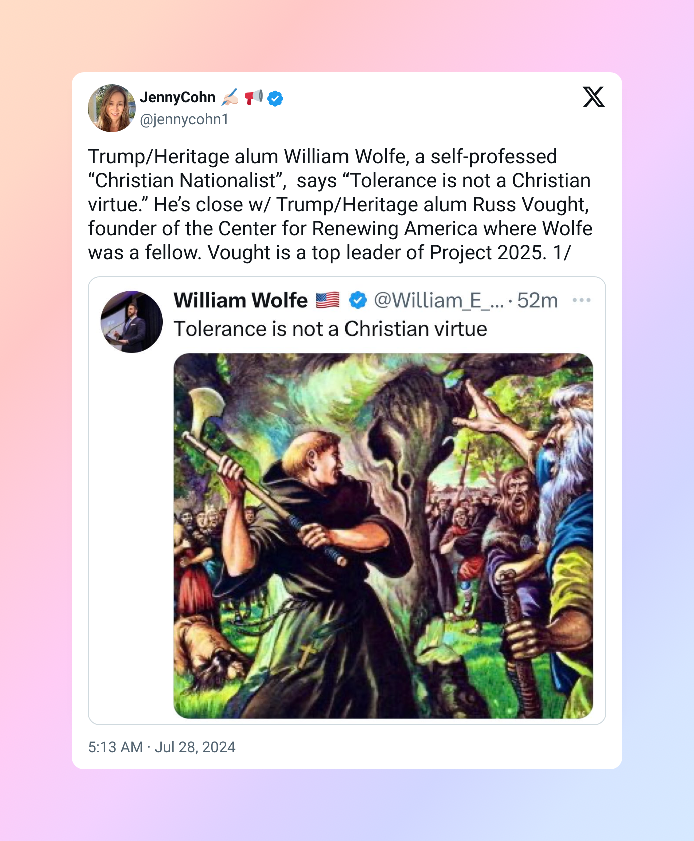
The phrase is often used critically to describe how some political movements emphasize specific biblical interpretations—particularly those tied to social issues—while downplaying other teachings centered on compassion, humility, and care for marginalized communities.
This isn’t entirely surprising to observers who have watched the cultural battles of the past decade. Critics argue that segments of the far-right have increasingly promoted selective “Christian values” as a framework for shaping laws that affect the American public.
Those debates often center on LGBTQ equality, reproductive rights, and education policy—issues that frequently place religious beliefs and civil rights protections on a collision course.
Christian Nationalism and the American Political Landscape
Wolfe’s comments also arrive during heightened discussion about Christian nationalism, a political ideology asserting that the American government should reflect Christian religious principles.
Radical Christian nationalist former Trump administration official William Wolfe backs ICE’s brutal deportation operations: “I don’t care how much they scream. I don’t care how much they cry.”https://t.co/RYNymF0ym2 pic.twitter.com/eET5qJ2WzR
— Right Wing Watch (@RightWingWatch) January 23, 2026
Scholars studying the movement say its influence has grown in recent years, especially within certain political circles. Civil rights advocates warn that blending religion and government authority could undermine long-standing constitutional protections.
Supporters, however, argue that Christianity has historically shaped American culture and that expressing those values through public policy is simply part of democratic participation.
Why Civil Rights Advocates Are Paying Attention
For LGBTQ organizations and civil liberties groups, rhetoric about legislating biblical morality raises concerns about the future of equal protections.
Trump/Heritage alum William Wolfe, a self-professed “Christian Nationalist,” says that “what we need is … smash-mouth fundamentalism…” 1/ pic.twitter.com/1sF7CpaJTi
— JennyCohn ✍🏻 📢 (@jennycohn1) May 1, 2024
Many point to the United States Constitution, particularly the Establishment Clause, which prohibits the government from establishing an official religion. That principle has long served as a safeguard ensuring that no single faith dictates public law in the American system.
Advocates say maintaining that separation is essential in a nation where citizens represent a wide range of beliefs, identities, and traditions.
A Conversation That Will Continue
As the political climate intensifies ahead of upcoming elections, debates about religion’s role in public life are unlikely to fade anytime soon. Wolfe’s speech has become part of a much larger conversation about how faith intersects with democracy in the American experience.
For LGBTQ communities and allies, the issue goes beyond politics—it touches on fundamental questions about belonging, equality, and whether the promise of freedom applies equally to everyone.
In the end, the tension between “Republican Jesus” and broader human values reflects an ongoing struggle over who gets to define the moral direction of the American nation—and whose voices will be heard along the way.