

It’s almost the end of 2025, and yet here we are—still reporting, dissecting, and grieving over homophobic incidents in the world of football. A sport that claims to be evolving, modernizing, and becoming more inclusive continues to stumble over its own entrenched prejudices. And the latest example comes from Brazil, where 73-year-old head coach Abel Braga sparked international outrage during his presentation as the SC Internacional manager.
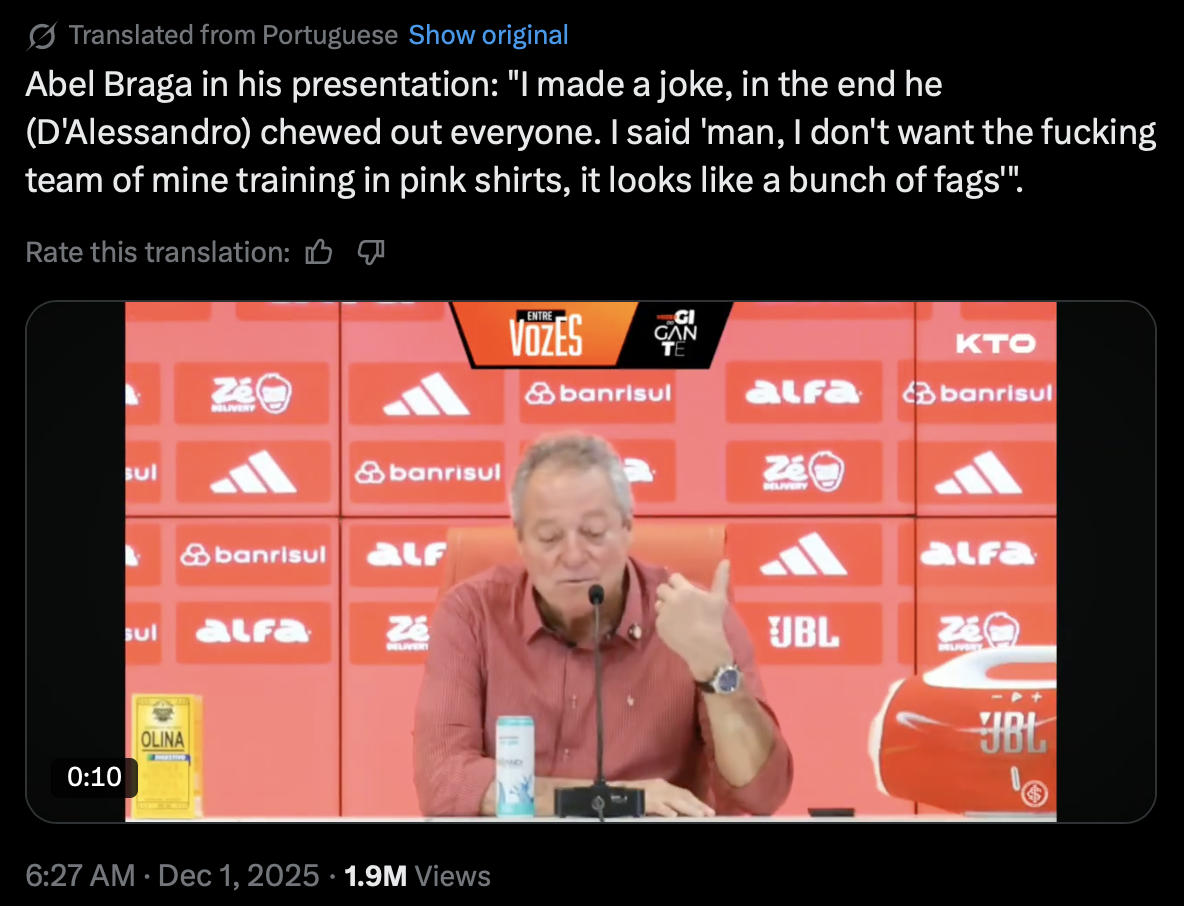
Braga, in full view of cameras and press, recounted a conversation in which he told the club’s sporting director, Andrés D’Alessandro, to change the team’s pink training shirts. His exact words:
“I said, ‘I don’t want my freaking team training in pink shirts, it looks like a team of fgots.’”
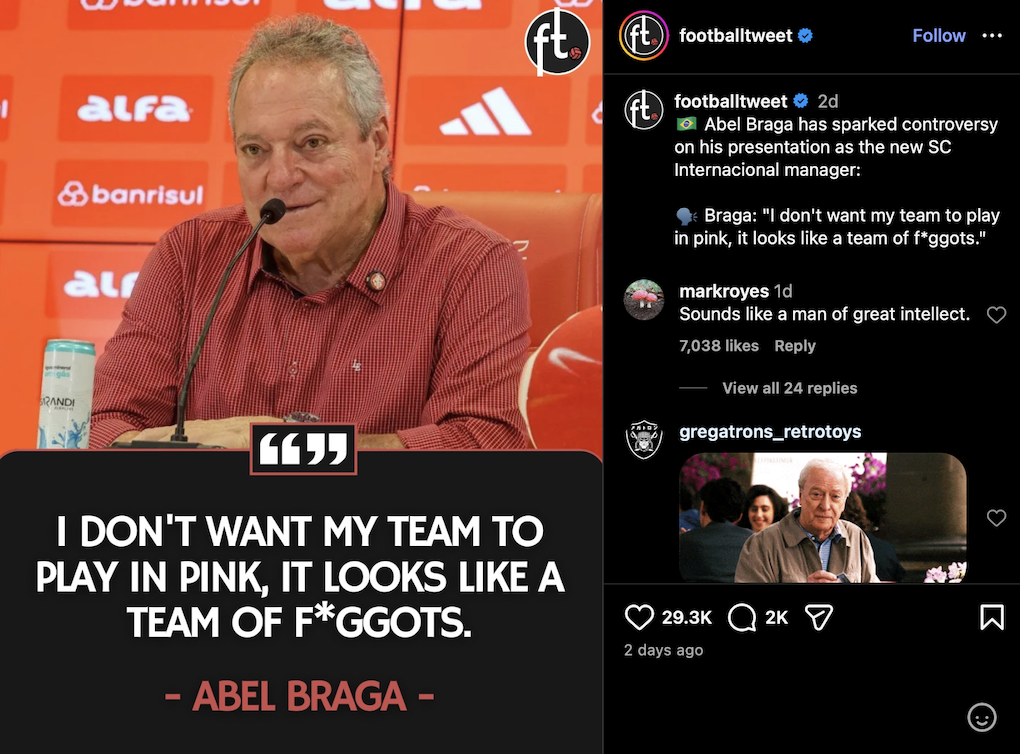
It was a moment that felt ripped from a bygone era—the kind of ugly casual homophobia many assumed had no place in professional sports anymore. But the truth is, football still has a long, uncomfortable relationship with masculinity, gender norms, and the policing of what men should look like.
Braga later posted a public apology on Instagram, writing:
“I acknowledge that I didn’t make a good statement about the color pink… Colors don’t define genders. What defines is character.”
He urged fans to focus on “peace” and “hard work.”
The apology read clear enough—but the wound was already open. Because forgiveness is easy. Unlearning prejudice isn’t.
“We Can’t Keep Normalizing This”: Journalists and Fans Fight Back
ESPN Brazil journalist Ricardo Spinelli, who is openly gay, immediately called Braga out on Instagram, stressing that these remarks cannot continue to be brushed aside as “jokes” or “slips.”
“We can’t keep normalizing these go-around hate comments in football,” he wrote.
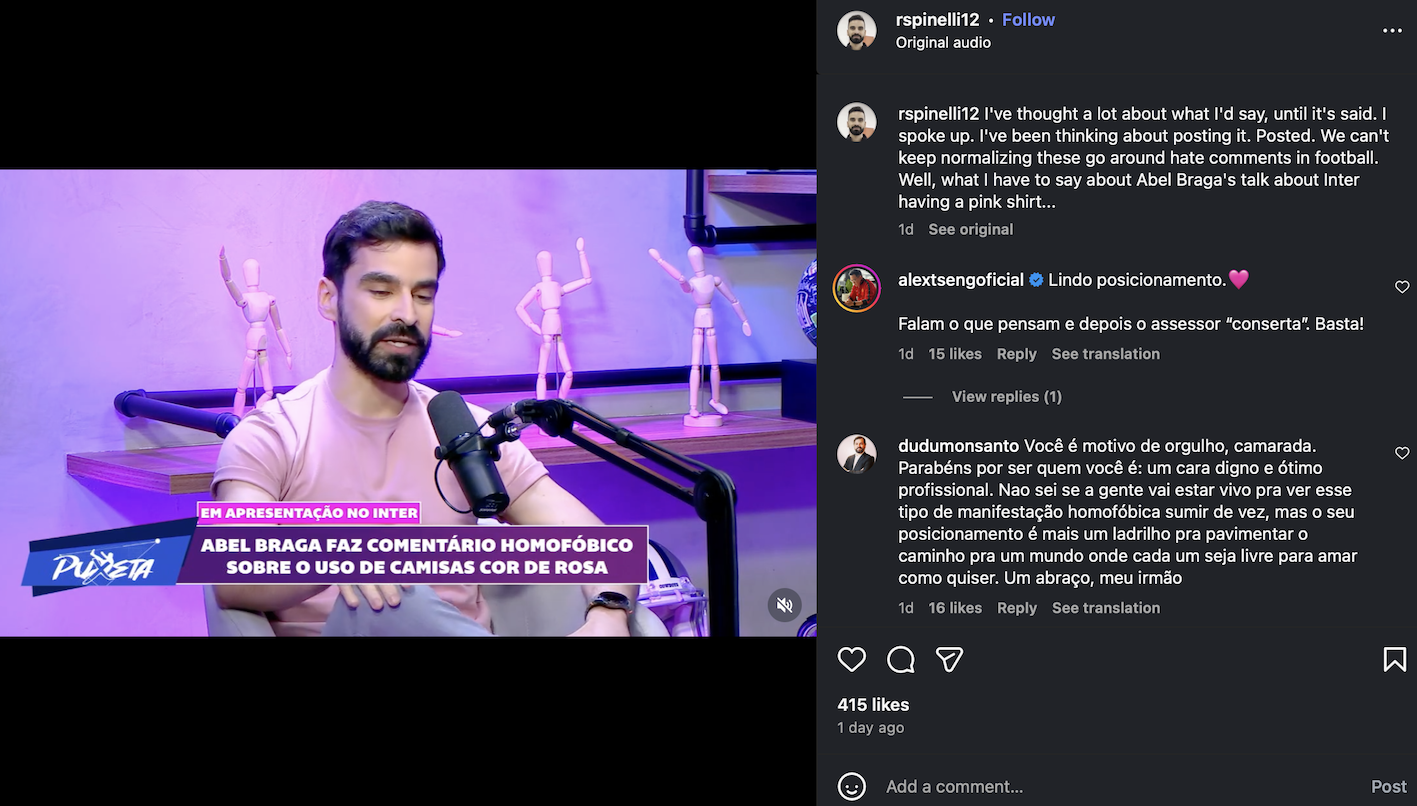
Spinelli’s statement was powerful not just because it condemned the slur, but because it came from within the football community itself. His reminder—that he is gay, visible, and present—punctures the myth that homophobia only harms some distant “other.” LGBTQ+ people are everywhere in football: on the pitch, behind the cameras, in the stands, and in the staff rooms. Comments like Braga’s reinforce a culture that tells queer players, explicitly or implicitly: You don’t belong here.
Football’s Masculinity Crisis—From Dyed Hair to Slurs
Hypermasculinity has been football’s shadow for decades. Even today, players like right-back Yan Couto have been criticized simply for dyeing their hair pink—an act that apparently still triggers outdated ideas about gender. Football tries to reassure fans and players that the sport is evolving, but incidents like Braga’s expose how shallow those reassurances can be.
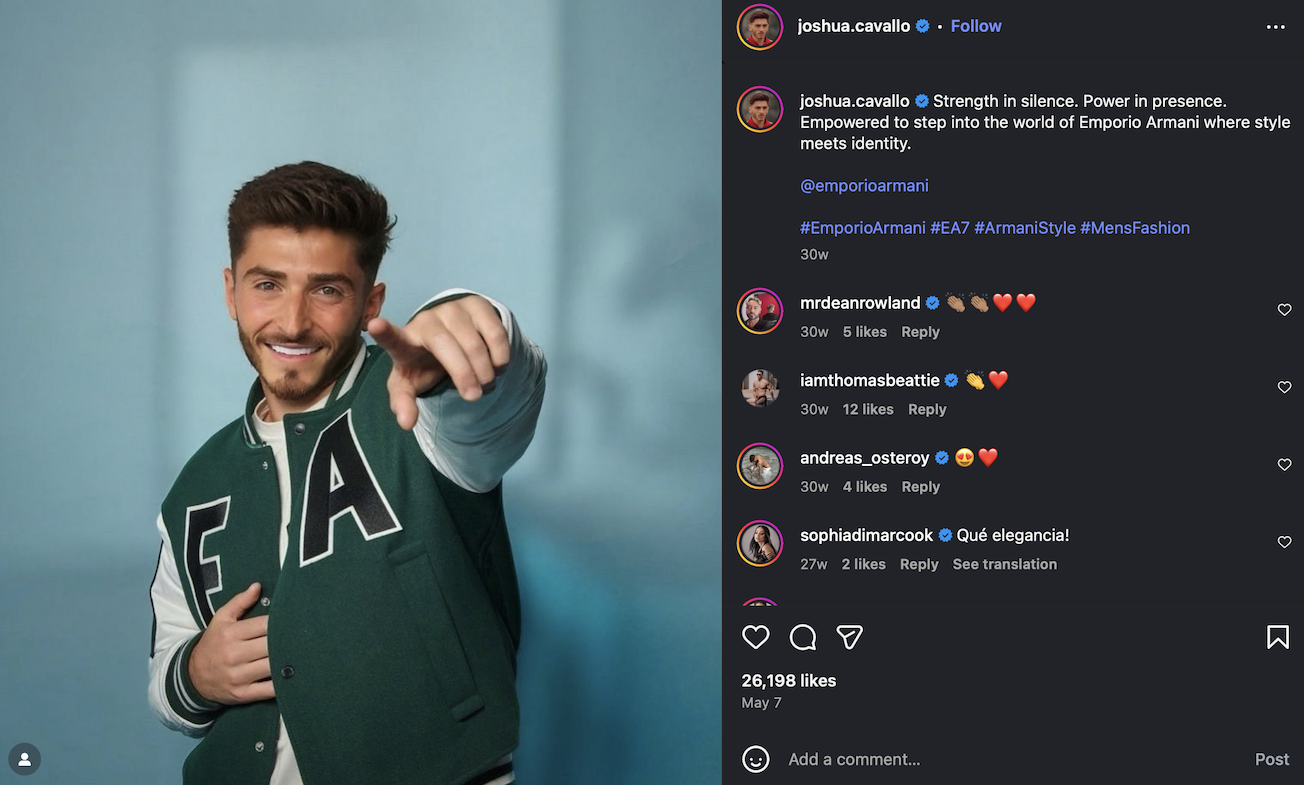
This contradiction is exactly why openly gay male professional footballers remain so rare—Josh Cavallo and just a few others are out in the world’s top leagues, even in 2025.
What does that say about the environment players are walking into?
Josh Cavallo: The Lone Trailblazer Still Carrying the Weight
Cavallo’s bravery in coming out in 2021 was monumental, but instead of ushering in a wave of openly queer athletes, he became the quiet mentor behind the scenes. And as he revealed on Paul C Brunson’s We Need To Talk podcast, he’s been guiding closeted athletes for years:
“I helped mentor a lot of closeted athletes… football players that aren’t out and don’t want to be out.”
He respects their timelines, their fears, their choices.
“They’re happy to come out next year or in 10 years… or they just don’t want to come out at all.”
What he offers them isn’t publicity or pressure—it’s safety.
“To have that safe space with me… is incredible. Because I couldn’t do that.”
Reflecting on his own journey, Cavallo told Joe Hart on Footballers Unfiltered:
“I got to a point in my life where I wanted to live authentically… It affected my mental health quite a lot… There’s still a long way to go.”

He’s become the role model he himself never had.
“There was no one to look up to,” Cavallo admits.
Now he stands as proof that being gay and being a top athlete are not mutually exclusive.
“It’s possible no matter what you do… it’s about your talent.”
RELATED: Footballer Josh Cavallo Reveals Homophobic Verbal Abuse & Death Threats
Where Do We Go From Here?
Every time football takes a step forward—promoting Pride Nights, partnering with LGBTQ+ organizations, celebrating diversity—incidents like Braga’s yank it two steps back. And it leaves us all asking the same exhausted question:
Why say it in the first place?
Why, in a sport that relies so heavily on teamwork, unity, passion, and discipline, does homophobia still slip through so easily? Why must LGBTQ+ fans and athletes rely on apologies rather than prevention?
Safe spaces don’t happen by accident. They’re built. They’re maintained. They’re defended.
Football can evolve. It is evolving. But only if players, fans, journalists, and clubs refuse to let homophobia hide behind “jokes” and “mistakes.”
It’s nearly 2026. We deserve a sport that celebrates every person who loves the game—not just the ones who fit someone else’s definition of masculinity.