


A study of gay and heterosexual men suggests that relationship stability may help explain differences in romantic attachment. The real question isn’t who catches feelings harder, but who feels confident enough to trust them.

Romance comes with a particularly annoying catch: falling for someone and believing you have a future together are two very different things. You can have chemistry, affection, and all the ingredients for a promising relationship, yet still wonder whether it will last. For gay men, that uncertainty may have a bigger role in romantic security than we tend to acknowledge.
RELATED: Locktober: A Gay Guy’s Guide to Chastity and Oct’s Kinkiest Challenge
A study published online September 16, 2026, in BMC Psychology examined differences in romantic attachment between gay and heterosexual men. The researchers found that gay men reported higher attachment anxiety and avoidance, as well as lower perceived relationship stability. The findings offer a different way to think about dating struggles: perhaps the question isn’t simply how people handle intimacy, but how secure they feel about building a future with someone.
The Future Can Change How We Feel in the Present
Researchers Fan Yang of Waseda University in Japan and Zichen Zhai of Nagoya University in Japan investigated whether perceived relationship stability could help explain differences in attachment between gay and heterosexual men.
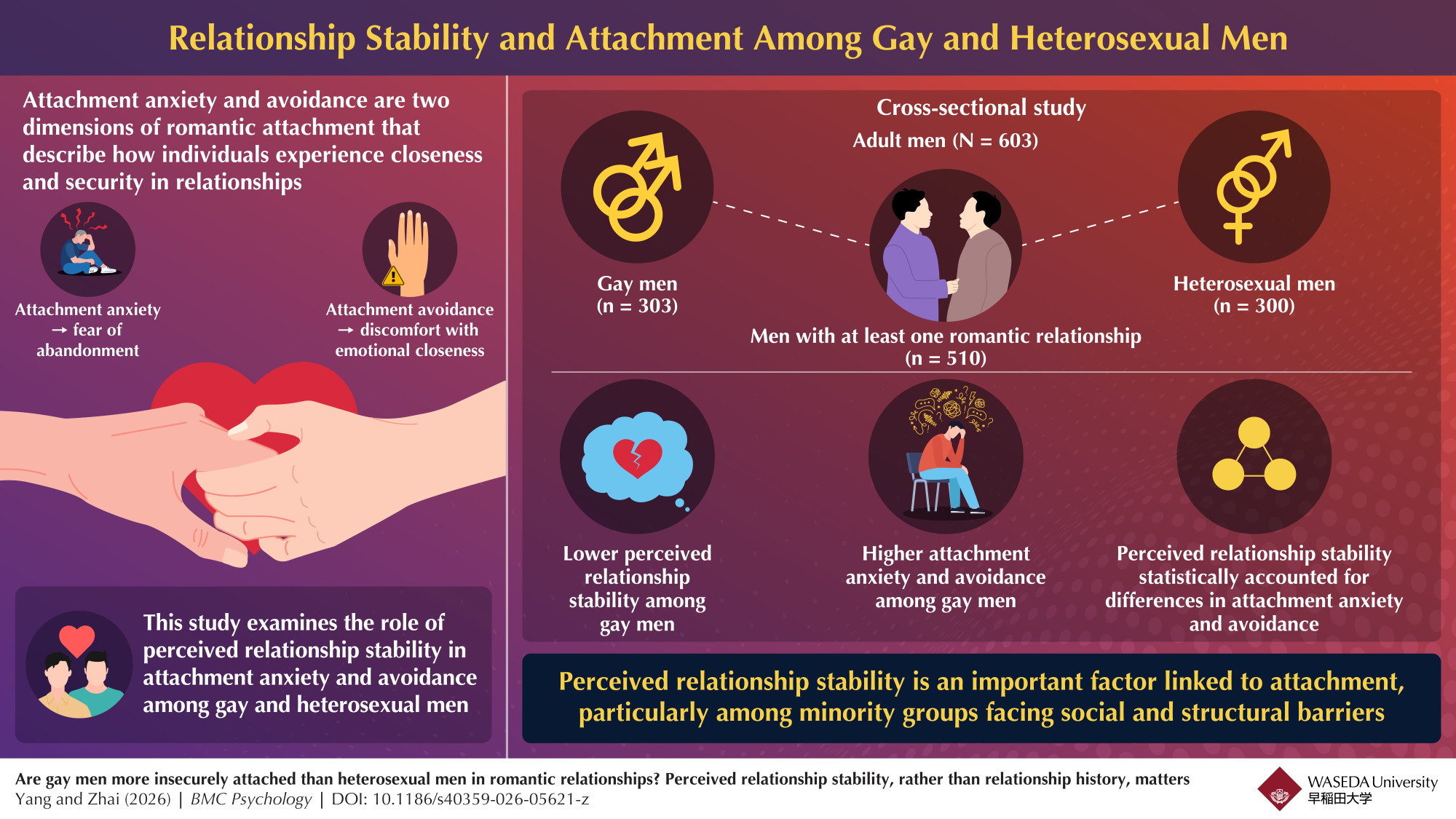
Their study focused on two dimensions of attachment. Attachment anxiety involves concerns about abandonment or uncertainty about a partner’s feelings. Attachment avoidance refers to discomfort with emotional closeness or depending on another person.
Both can complicate romance. One person might need reassurance that a partner isn’t about to leave, while another might struggle when a relationship becomes emotionally intimate. Neither response tells the whole story of a person, but both can affect how relationships develop.
RELATED: Contact With an Ex? Here’s What LGBTQ+ Daters Should Know
The researchers surveyed 603 men aged 20 to 29 living in Shanghai, China, including 303 gay men and 300 heterosexual men. Participants answered questions about their attachment patterns, relationship histories, and perceptions of relationship stability.

Among the 510 men who had experienced at least one romantic relationship, gay men reported lower perceived relationship stability than heterosexual men. They also reported higher attachment anxiety and avoidance, even after the researchers accounted for economic and occupational status.
The difference wasn’t simply about how often the men had dated. The two groups reported similar numbers of romantic relationships and similar durations for their shortest relationships. Their perceptions of stability, however, showed a clearer distinction.
As Yang explained, “The feeling that ‘this relationship has a future’ may be an important part of romantic security.”
That idea gets at something dating advice often overlooks. People don’t experience relationships solely through what happens between them and their partners today. Their expectations about what comes next can also shape how safe they feel getting attached.
When Love Comes With Extra Uncertainty
For gay men, imagining a shared future can sometimes involve considerations beyond whether a partner is committed. Family acceptance, social support, and the broader environment can all influence whether a relationship feels sustainable.

A couple might be happy together but still face questions about how their relationship will be received by relatives, whether they can count on support from the people around them, or how freely they can build a life together. Those concerns do not apply to every gay relationship, and heterosexual couples can experience uncertainty of their own. But social acceptance may add another dimension to relationship security for sexual minorities.
This is one reason the study’s findings deserve more than a quick comparison of who is more anxious or emotionally guarded. Higher attachment anxiety and avoidance should not automatically be treated as personal shortcomings. The researchers’ findings suggest that perceived stability may help account for the differences they observed.
In other words, understanding someone’s attachment patterns may require looking beyond their behavior during an argument or their reluctance to talk about feelings. It may also mean considering how confident they feel about the relationship’s future.
The Problem Isn’t Necessarily Commitment
It would be easy to read the results and conclude that gay men are less secure in relationships. But the study does not establish that gay men are worse at commitment, less capable of intimacy, or destined for more complicated love lives.
Instead, the researchers found a statistical relationship between perceived stability and differences in attachment anxiety and avoidance. Their results suggest that how stable participants believed their relationships to be helped explain the differences between the groups. The study does not prove that perceived instability directly causes those attachment patterns.
Its scope also matters. The participants were men aged 20 to 29 living in Shanghai, China, so the findings cannot automatically represent gay and heterosexual men across all countries, generations, and social circumstances.

Still, the research raises an important point about the way we talk about romantic security. We often focus on individual behavior: who gets attached too quickly, who struggles to open up, and who keeps one foot out the door. Yet feeling secure with another person may also depend on whether a lasting relationship seems possible in the first place.
The researchers suggest that relationship counseling and mental health support for sexual minority individuals may benefit from considering both communication between partners and concerns about whether a relationship can be accepted, supported, and maintained over time.
Because the goal isn’t just to find someone who makes you feel something. It’s to feel that what you’re building together has a future.
And if dating has taught us anything, it’s that catching feelings can happen in an instant. Trusting that those feelings have somewhere to go is a much bigger undertaking.
Source: News Medical Life Sciences and Science 2.0