


Dating someone who still has contact with an ex can trigger a very specific kind of queer detective work. Suddenly, a perfectly innocent “Happy birthday!” text looks like evidence in a courtroom, and liking an ex’s Instagram post somehow becomes a federal case.

And honestly, the panic makes sense. An ex is an ex for a reason, right? If your partner is still talking to one, it can be tempting to wonder whether the relationship is really over — or whether you’ve unknowingly wandered into a romantic sequel nobody asked for.
RELATED: Sexual Roles by ZIP Code: Where You Live Matters
But a new Taimi survey suggests the situation is considerably less dramatic than our suspicious little brains might assume.

Among 1,404 LGBTQ+ respondents, only 32% said they believe the stereotype that queer people always stay friends with their exes. Yet 60% said they actually have communicated with more than one of their exes.
RELATED: Homonormativity: The Gay “Rulebook” Nobody Asked You to Follow
So maybe the interesting question isn’t why LGBTQ+ people keep their exes around. Maybe it’s why we assume they shouldn’t.
The Ex Is Not Automatically the Problem
An ex can occupy a surprisingly boring place in someone’s life. They can be a former partner who became a friend. Someone still connected to the same social circle. A person who gets a birthday message once a year. Someone you genuinely stay in contact with without secretly wanting to recreate the relationship. That distinction matters because contact and intimacy aren’t necessarily the same thing.

Angelika Koch, a relationship and dating expert at Taimi, told me that staying in contact with an ex is often labeled “red flag behavior” because it “normally indicates trouble letting go of the relationship after it ends.” And sometimes it does.
The problem is that we can start treating the existence of an ex as the evidence, rather than looking at what the relationship actually looks like now.
A partner saying “I still talk to my ex” tells you remarkably little by itself. A partner saying “I still talk to my ex every day about everything happening in my life” tells you considerably more. Same ex. Very different situation.
Maybe Queer Dating Makes This Even Trickier
For LGBTQ+ daters, completely erasing an ex from your social universe isn’t always particularly realistic.

Dating pools can overlap. Friends date friends. Friend groups become intertwined. People run into each other at the same parties, events and hangouts. An ex can remain part of the wider social landscape long after the romantic relationship has ended. That doesn’t mean everyone needs to maintain a friendship with an ex.
It does mean the old heterosexual-rom-com formula of “break up and never speak again” isn’t necessarily a universal rule. Koch made it clear that boundaries become especially important when former partners share friends.
“This can look like inviting people from that group out for dinner or hosting them at their place,” she explained. “Doing this allows them to have their own social circle within that circle, free from their ex.”
In other words, sometimes keeping an ex in your life isn’t about keeping the romance alive. It’s about figuring out how to stay in contact and exist in the same world without making everyone else choose sides.
The Question Isn’t “Do You Still Talk?”
This might be the part worth remembering before interrogating a new partner about their entire romantic history.
“Are you still in touch with your ex?” sounds like an important question, but it doesn’t actually tell you whether there’s a problem. Ask what the contact looks like instead.
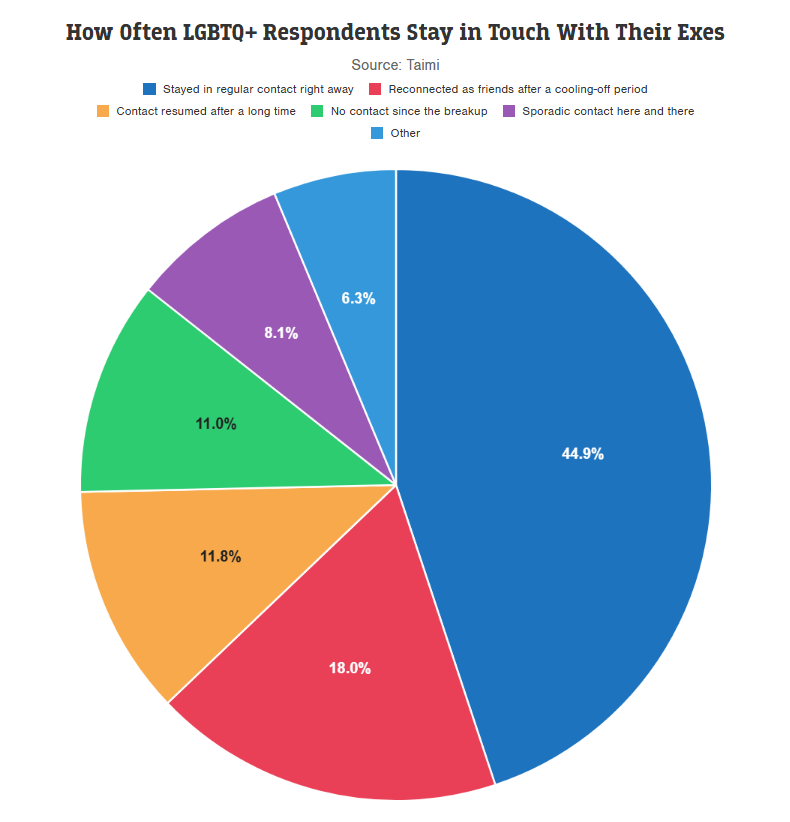
Do they occasionally exchange memes? Are they still part of the same friend group? Do they have lengthy conversations about their personal lives? Does your partner openly tell you when they’re communicating with an ex?
Or are they turning to their ex whenever something emotionally important happens? That last one can tell you considerably more than whether an ex still has their number.
“Ask for the reason behind the communication and how long it has been since the relationship ended,” Koch advised. “If someone just broke up with their ex and now they are friends, without having any ties to them, that’s problematic.”
Time can matter, too.
“If they broke up with this person a decade ago and decided to become friends years later … I wouldn’t worry too much because so much time has passed.”
Which is fair. A person who became friends with an ex after years of moving on is in a very different position from someone who declared themselves “totally over it” five minutes after the breakup.
When the Ex Starts Getting the Good News First
Here’s where things get more interesting. Occasional contact isn’t necessarily concerning. Emotional priority is another matter.
“If they speak to this person all day through text, that’s a red flag. If it’s on the rare occasion, I wouldn’t worry too much about it,” Koch told me.

And contact frequency is only part of the equation. Imagine your partner gets a promotion. They have exciting news, and instead of telling you, they immediately message their ex.
That’s not necessarily proof of anything romantic. But it does raise a more useful question: Why does this person still occupy such an important emotional position?
Sharing good news can be intimate. It gives another person access to your ambitions, hopes and the little victories that make up your life. The issue isn’t that an ex knows about the promotion. It’s whether the ex consistently gets access to the parts of your life that you reasonably expect a current partner to share.
Sometimes an Ex Is Just an Ex
Taimi respondents also gave a pretty uncomplicated reason for staying in contact with former partners: They cared about them. That word can mean plenty of things.
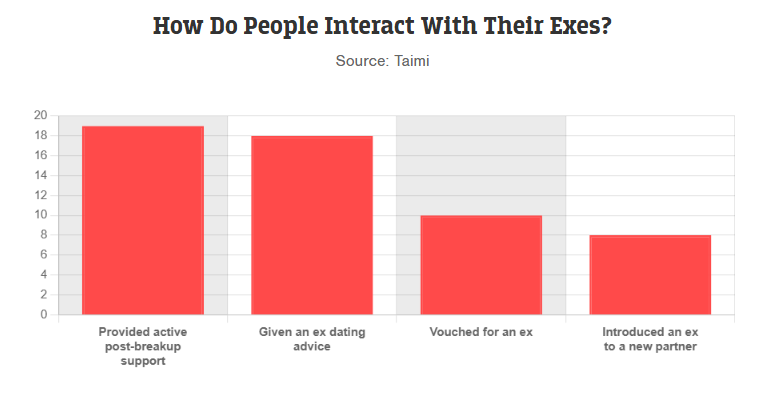
It can mean friendship. It can mean wanting to remain civil. It can mean sharing a social circle. It can mean that the relationship mattered even though the romance didn’t work. And sometimes, people simply discover that they’re better friends than partners.
“I often see people hang onto their ex as either a backup or as someone they still long for, but are trying to move forward with their life,” Koch said. In this case, it’s in a client’s best interest for their matchmaker or dating coach to point out the behavior.
That’s the version of ex contact worth paying attention to: not necessarily the person who occasionally says hello, but the person who seems unable to move forward while keeping their former relationship within reach.
There Can Be a Green Flag Hiding in the Ex Files
We tend to talk about exes as if every former relationship is a ticking time bomb. But sometimes staying friends simply means two people managed to end a relationship without deciding they needed to hate each other afterward.
Maybe the breakup was amicable. Maybe the relationship was never particularly serious. Maybe both people genuinely moved on and discovered that friendship worked better. Those aren’t automatically warning signs.
Taimi also found that trans respondents were most likely to say they had turned a relationship into a platonic friendship. That finding adds another interesting dimension to the survey because it shows that ending a romance doesn’t necessarily mean ending every form of connection.

Ultimately, the survey doesn’t say that staying in contact with an ex is always healthy. Koch’s advice makes clear that there are situations where it can signal unresolved feelings or poor boundaries. But the existence of an ex isn’t the whole story.
The better question is whether the past relationship is still taking up space that belongs to the present one. Because your partner having an ex isn’t exactly breaking news. Everyone has a history. The real plot twist is finding out whether that history is still getting top billing.
Source: DatingNews