


Gerry Studds is a name younger LGBTQ+ people may not immediately recognize, but his role in queer political history is impossible to ignore.
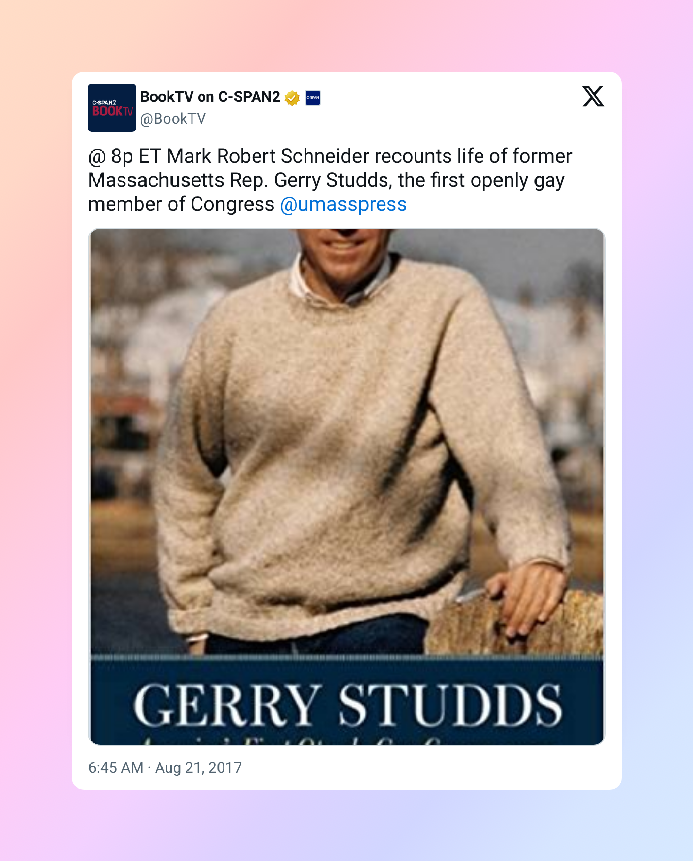
Long before rainbow campaign logos became common and before openly LGBTQ+ politicians were elected across the country, former Massachusetts Representative Gerry Studds became the first openly gay member of the United States Congress in 1983. A few years later in 1987, fellow Massachusetts Congressman Barney Frank would become the second openly gay member of Congress and one of the most recognizable LGBTQ+ political figures in American history. But it was Studds who crossed that line first, during a time when doing so could instantly end a career and there was the additional sex scandal that came with it.
RELATED: Barney Frank Has Left the Room—And Left a Legacy Too Big to Ignore
The 1983 Congressional Page Scandal
Studds had served in Congress since 1973, but in 1983 his name became tied to a congressional page scandal involving relationships between members of Congress and teenage congressional pages.
At the center of the controversy were allegations involving 17-year-old male pages. While the age of consent in Washington, D.C. at the time was 16, the issue quickly escalated because of the power imbalance between elected officials and the young pages working under them. Studds and congressman Dan Crane were formally censured by the House of Representatives.
The scandal dominated headlines and forced conversations about sexuality, power, and public morality into the national spotlight during the Reagan era, a time when anti-LGBTQ+ sentiment was still deeply embedded in American politics and culture.
Related Post: He had sex in the Capitol, vanished to Australia—and doesn’t regret a thing.
In Studds’ case, the former page later stated he would have preferred maintaining the friendship without the sexual aspect of the relationship, even describing Studds as “intelligent” and “fun,” adding that he did not harbor ill will toward the congressman.
The 17-year-old male page who had a homosexual relationship — his first — with Rep. Gerry Studds, D-Mass., told the investigators he found the congressman ‘an intelligent, witty, gentle man.’
Studds himself acknowledged that the relationship had been consensual while also admitting it was inappropriate because of the subordinate dynamic.
The Speech That Made History
Rather than deny his sexuality or attempt to quietly disappear from public life, Studds made a decision that was almost unheard of for a politician in the early 1980s. He publicly acknowledged that he was gay.
On July 14, 1983, he addressed the House floor in a speech that would permanently place him in LGBTQ+ political history. His speech was noted by Time in 1983:
“It is not a simple task for any of us to meet adequately the obligations of either public or private life, let alone both, but these challenges are made substantially more complex when one is, as I am, both an elected public official and gay.”
At a time when openly gay public officials were virtually nonexistent, the statement was groundbreaking.
The AIDS crisis was devastating LGBTQ+ communities across the country. Homophobia was openly used as a political weapon. Careers, families, and reputations were often destroyed simply because someone was queer. Against that backdrop, Studds choosing openness instead of denial became historically significant, even as controversy surrounded him.
Re-Elected Again and Again
What surprised many political observers was what happened next.
Instead of disappearing from Congress after the scandal, Studds won re-election in 1984 from a relatively conservative district in Massachusetts, and continued winning elections for another 13 years until retiring in 1997.
That political survival was notable for the era. In the 1980s, openly gay politicians were still considered unelectable in many parts of the country. Yet voters continued sending Studds back to Washington.
Outside LGBTQ+ visibility, he was also known as a strong advocate for environmental protections and issues connected to the fishing industry, which was particularly important to many constituents in coastal Massachusetts.
Love, Marriage, and an Unequal System
Studds also became part of another major LGBTQ+ milestone decades later.
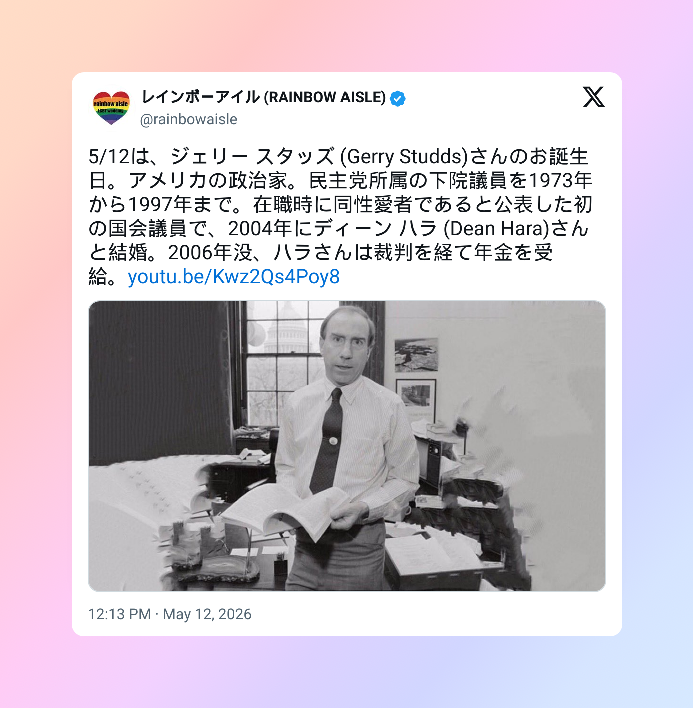
In 2004, he married his longtime partner Dean T. Hara in Boston, just one week after Massachusetts became the first U.S. state to legalize same sex marriage, according to The Washington Post.
The moment symbolized how dramatically the country had shifted since Studds first came out in Congress two decades earlier. But legal inequality still remained.
When Studds died in 2006 at age 69 due to a pulmonary embolism, federal law still did not recognize same sex marriages because of the Defense of Marriage Act. As a result, Hara was denied access to congressional survivor pension benefits that heterosexual spouses automatically received.
According to The Boston Herald, Hara later joined the landmark federal lawsuit Gill v. Office of Personnel Management, which successfully challenged part of DOMA and helped pave the way for broader marriage equality protections in the United States.
A Legacy That Remains Complicated but Important
Gerry Studds’ legacy remains layered and complicated.
His relationship with a congressional page rightfully sparked criticism and accountability. Even Studds himself admitted it represented a serious lapse in judgment. At the same time, his public acknowledgment of being gay marked a critical and landmark moment for LGBTQ+ visibility in American politics.
History rarely arrives in perfect packaging. Sometimes progress comes through flawed people making choices that still shift culture forward.
Without Studds, it becomes harder to imagine later openly LGBTQ+ politicians like Barney Frank, Tammy Baldwin, Pete Buttigieg, or the growing number of queer elected officials serving openly today.
For many LGBTQ+ Americans, visibility in politics once felt impossible. Gerry Studds helped crack that door open, even amid controversy, and American political history has never looked the same since.
So maybe Barney Frank was first to be out by choice. Studds seemed to have been forced to come out as part of a sex scandal, but he was still the first to be out.
I’m almost 67 years old and remember Gerry Studds pretty well. It’s unfortunate that his political career was tainted by an indiscretion, nevertheless we should be proud of his place in LGBTQ+ history. And I consider myself fortunate to see marriage equality become a reality in my lifetime, as well as the election of Sarah McBridge, the first trans congresswoman. Things have changed quite a bit since I was a teen.