


Gloria Steinem spent a lifetime making powerful people uncomfortable, giving women room to speak, and reminding society that equality was never supposed to come with a membership limit. The legendary feminist journalist and activist died Wednesday, September 2, at her home in New York City. She was 92.
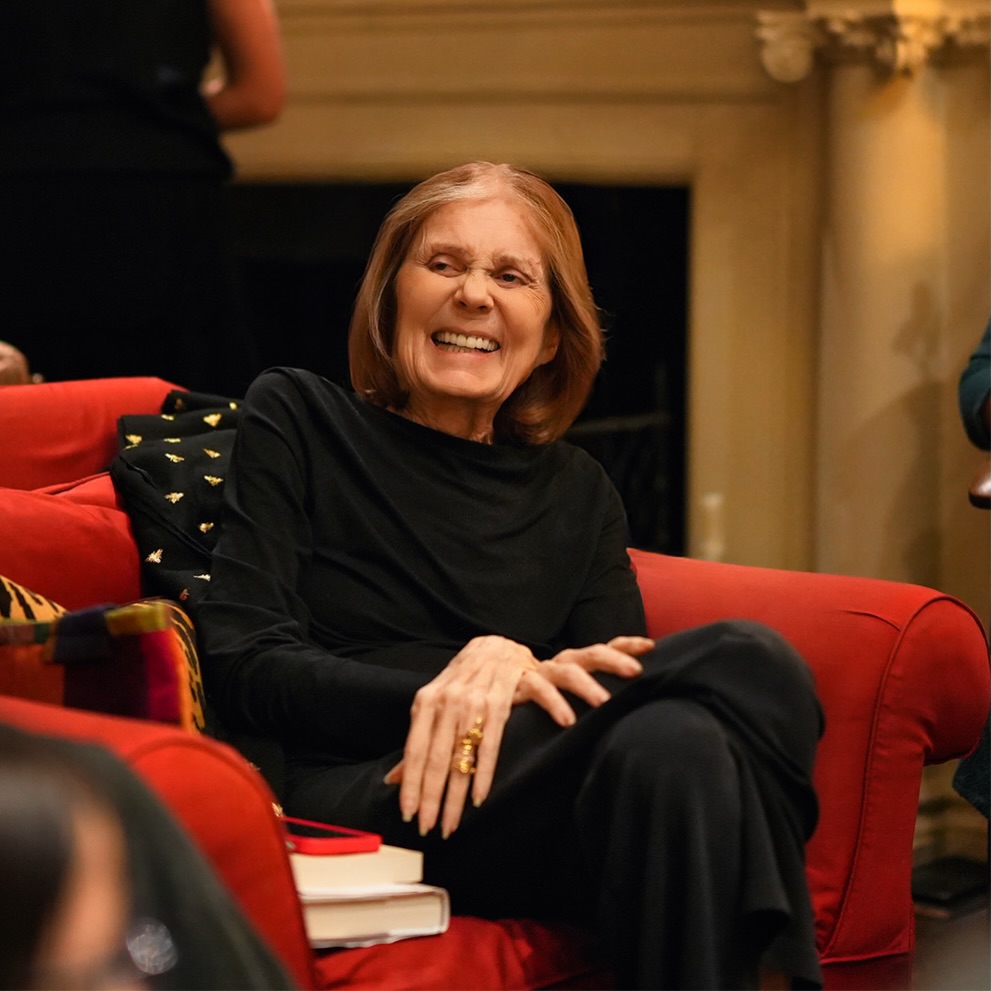
According to a statement posted to Steinem’s Instagram, she “passed away peacefully at her home in New York City, surrounded by some of the many who loved her.” No cause of death was announced.
RELATED: Dolly Parton Had a Trans Chauffeur—and a 30-Year Friendship
For generations of women, Steinem became almost synonymous with feminism. But for LGBTQ+ people, her legacy carries another important thread: she was an early and outspoken supporter of gay and lesbian rights, later becoming a vocal advocate for transgender equality as well.
In other words, Steinem understood something that queer people have been explaining to everyone else for decades: equality gets a lot less convincing when there are asterisks attached.
Gloria Steinem showed up for gay rights early
Steinem’s support for gay and lesbian people was already visible during the early years of the modern LGBTQ+ rights movement.
RELATED: Tim Curry Dies at 80: A Tribute to the Rocky Horror Legend
In 1977, gay activists persuaded her to travel to Miami as they fought Anita Bryant’s campaign to repeal Dade County’s ordinance prohibiting discrimination against gay people. Later that year, while speaking at an American Association of University Women convention, Steinem called lesbians “the most vulnerable group of women” and argued that the word lesbian had to become “as honorable as any other.” That was not exactly the sort of thing feminism’s mainstream establishment was always eager to hear.
Steinem also pushed back when feminism itself was being framed as somehow incompatible with lesbian inclusion. In 1992, she rebuked columnist Sally Quinn for arguing that feminism had alienated women by including lesbians. Steinem said Quinn had “disqualified herself” from serious consideration as a commentator on women’s issues.
For queer women in particular, that distinction mattered. Steinem was making the case that lesbian equality was not some optional side quest in the fight for women’s rights. It was part of the fight.
Her record on trans rights had a complicated chapter
Steinem’s relationship with transgender issues was more complicated, and that history is worth acknowledging rather than airbrushing away. In 2013, she addressed the subject directly in an essay for The Advocate, looking back at a controversial 1977 essay whose meaning, she said, had become separated from its original context.
Steinem recalled that Ms. had published an excerpt from writer Jan Morris’ autobiography about her transition in 1974, which she described as a courageous pursuit of an authentic life.
But Steinem also remembered hearing from gay men and lesbians experiencing such intense homophobia that some had considered transition for reasons unrelated to their gender identity. Those experiences helped inform her earlier concerns about whether society could sometimes pressure people to change themselves rather than confront prejudice. Decades later, she made clear that her position was not opposition to transition.
Transgender people, she wrote, were living authentic lives, and decisions about their health care belonged to them alone. She acknowledged that understandings of gender had changed considerably since the 1970s and apologized for earlier words that suggested anything less than support. She went further, arguing that transgender people and women faced overlapping struggles involving healthcare, harassment and workplace discrimination.
Steinem called transgender legal equality one of the LGBTQ+ movement’s most neglected priorities and urged lawmakers to prohibit workplace discrimination based on sexual orientation and gender identity. For a figure whose career stretched across so many political eras, that evolution is part of the story too: Steinem did not pretend the conversation had stood still since the 1970s.
Before the speeches, there was a Playboy Bunny
Of course, no Gloria Steinem retrospective can escape the Playboy Bunny story. In 1963, she spent 11 days undercover as a Playboy Bunny for Show magazine. Her two-part investigation, “A Bunny’s Tale,” documented poor pay and sexist treatment, challenging the glossy image of Playboy as a supposed sexual revolution for everyone.
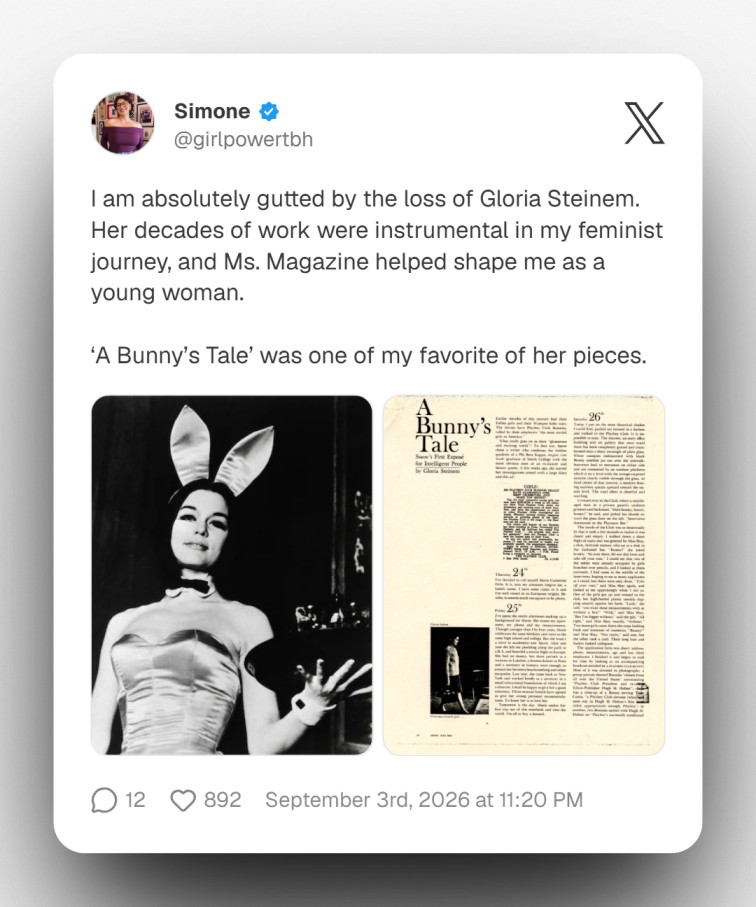
The story helped propel Steinem into the national spotlight. She later became a founding editor and writer at New York magazine and co-founded Ms., which debuted as an insert in New York in 1971 before becoming a standalone magazine in 1972.
The publication tackled subjects that mainstream women’s magazines often preferred to keep politely behind the curtain: abortion, lesbianism, domestic abuse, sexual harassment and gender roles.
For Steinem, journalism was never merely about reporting what was happening. It was about asking why people had been told they were supposed to put up with it. And apparently, she had no interest in accepting the answer, “Because that’s just how things are.”
The woman behind the icon
Steinem was born March 25, 1934, in Toledo, Ohio, and graduated from Smith College in 1956 with a degree in government studies. She later spent two years in India on a fellowship, an experience that influenced her activism after she returned to the United States. Her political awakening was also deeply personal.
Steinem later described attending an abortion speak-out in a church basement in 1969. She had gone there as a reporter, but the stories women told affected her profoundly. She eventually shared her own experience of having an illegal abortion at 22.
In her 2015 memoir, My Life on the Road, she dedicated the book to the doctor who had helped her.

Her dedication ended with the words:
“Dear Dr. Sharpe, I believe you, who knew the law was unjust, would not mind if I say this so long after your death:”
“I’ve done the best I could with my life.”
“This book is for you.”
That personal connection was a recurring feature of Steinem’s activism. She had a knack for turning enormous political questions into things people could recognize in their own lives.
She believed change came from the bottom
Steinem helped establish the National Women’s Political Caucus in 1971, pushing for more women to participate in politics rather than simply doing the campaign grunt work.
“Women have been running the political campaigns in this country for generations. But by running means that they’ve been doing all the menial work, you know, addressing envelopes and driving cars and having fundraisings,” she told NPR in 1971. “We’re not going to do that anymore. Let the male candidates do their own typing.”
That line still has the energy of someone who had finally looked at the political system and decided, essentially, absolutely not. Her philosophy extended beyond elections and legislation. Speaking about reproductive rights in 2022, shortly before the Supreme Court overturned Roe v. Wade, Steinem said:
“It will not change the basic fact that we either have decision-making power over our own bodies — women and men — or there is no democracy.”
She also compared social change to a tree.
“Too often we think the tree grows from the top, from Congress. Trees grow from the bottom,” she said.
That idea feels particularly relevant to LGBTQ+ movements, which have so often depended on ordinary people organizing, speaking up, showing up and refusing to disappear.
A feminist icon who never seemed interested in acting like one
Steinem became the face of second-wave feminism, complete with the aviator glasses, signature hair and an apparently endless supply of invitations to talk about changing the world. But she also cultivated something more intimate: community.
She was known for hosting “talking circles” at her New York home, bringing women together for conversations that were less corporate networking event and more “everyone sit down and figure out what we’re doing here.”
She once imagined owning a diner when she got older, describing it as having “blue gingham curtains” and being “by the side of the road.”
“Diners are the most democratic places. Everyone goes—truck drivers go, people from the neighborhood, people in their tuxes after parties go… And in the back room,” she said, “we could have a little revolutionary meeting from time to time.”
Steinem never opened that diner. But in a way, she spent her life running one. Her work brought people together, gave marginalized voices a microphone and created spaces where conversations that were once considered impolite, radical or downright scandalous could become part of everyday political life.
And for someone who spent decades fighting for equality, perhaps there is something fitting about the fact that she imagined the revolution happening in the back room.
Her legacy reaches far beyond feminism
President Barack Obama awarded Steinem the Presidential Medal of Freedom in 2013, recognizing a lifetime of activism.
Barack Obama awards Gloria Steinem the Presidential Medal of Freedom in 2013:
“As a writer, a speaker, an activist, she awakened a vast and often skeptical public to problems like domestic violence, the lack of affordable child care, unfair hiring practices. And because of her… pic.twitter.com/1KUDzPRNdn
— FactPost (@factpostnews) September 3, 2026
“Because of her work, across America and around the world, more women are afforded the respect and opportunities that they deserve,” Obama said at the time. “She also changed how women thought about themselves.”
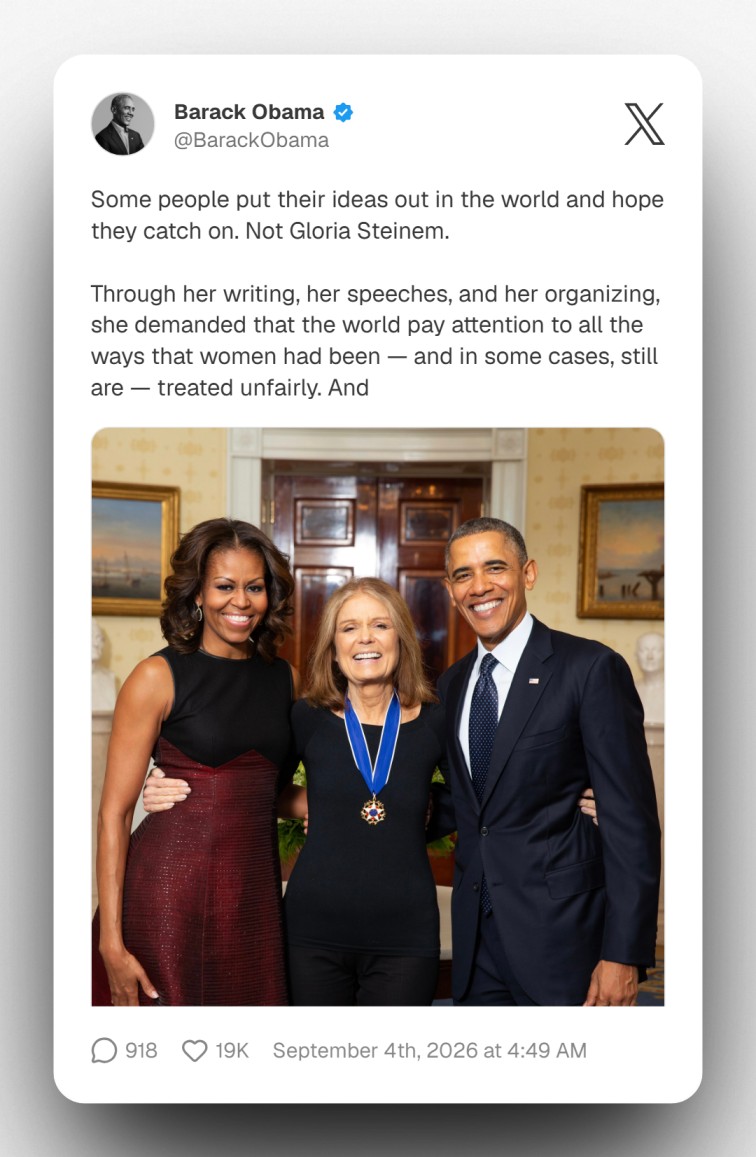
That change did not stop at women’s rights. Steinem’s work intersected with LGBTQ+ equality, reproductive freedom, workplace discrimination and the broader fight against systems that tell certain people they should simply know their place.
Her legacy is not perfectly simple. It does not need to be. What matters is that she kept evolving, kept organizing and kept making space for people who had been told there was no room for them.
For queer people, especially queer women, that history matters. Lesbian equality was not an afterthought in Steinem’s feminism. And when transgender people were pushed to the margins of political debate, she eventually used her platform to explicitly affirm their right to live authentically and make decisions about their own lives.
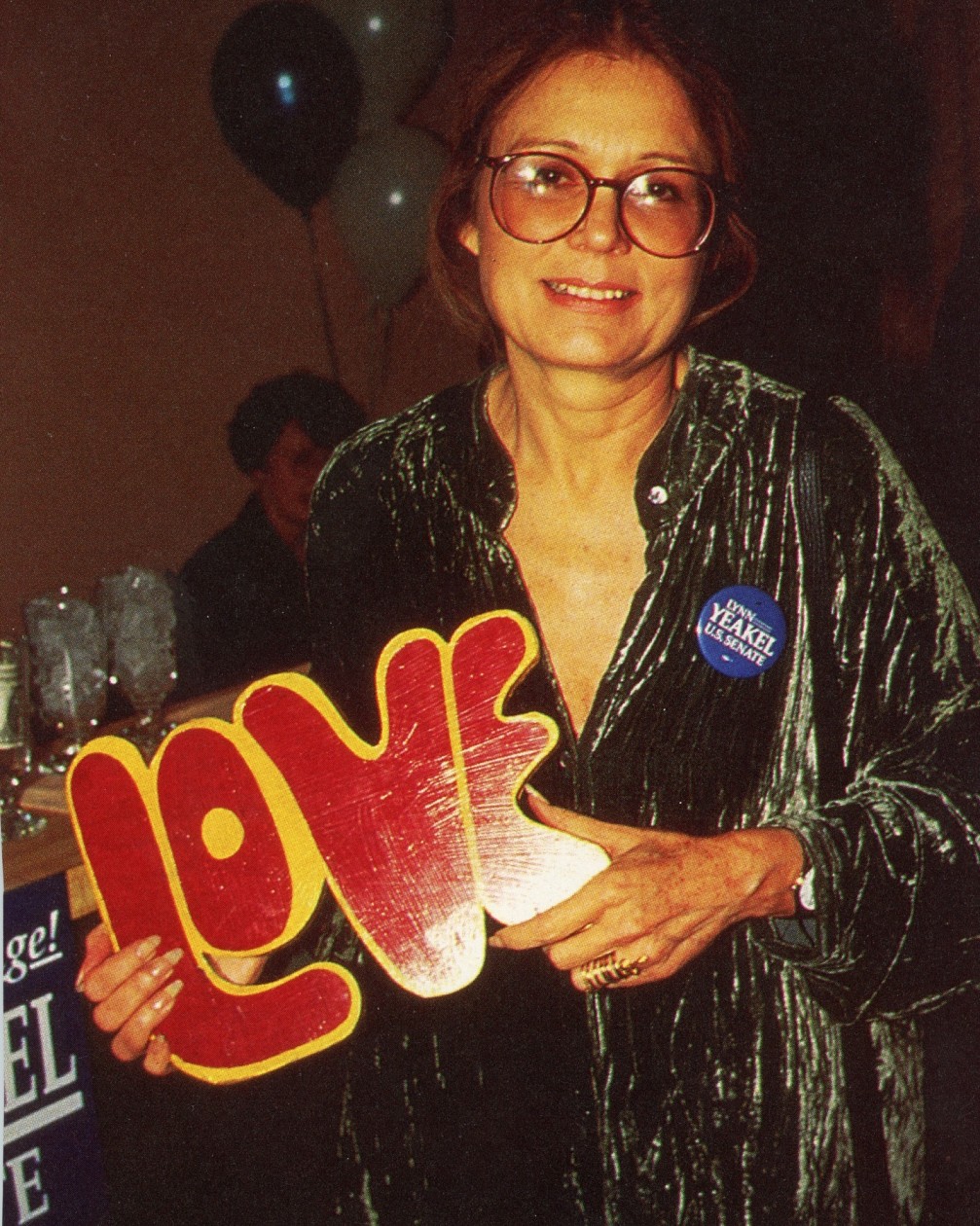
Gloria Steinem spent 92 years refusing to accept the world exactly as she found it. She challenged the rules, questioned the assumptions and, occasionally, told the men to do their own typing. Not a bad way to spend a lifetime.
92 years of badassery from Ms. Steinem. She paved the way for women. She was definitely a trailblazing woman.