


It takes years to build a life—and a single viral moment to unravel it.
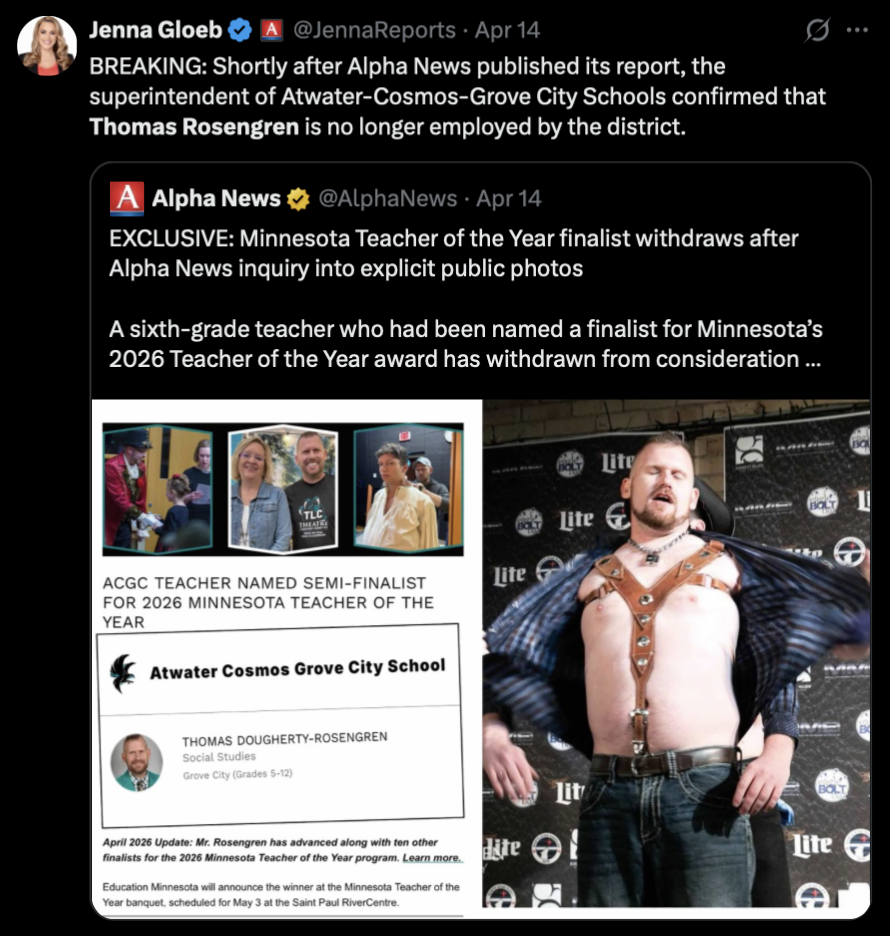
That’s the reality facing Thomas Rosengren, a Minnesota educator who recently withdrew from the state’s 2026 Teacher of the Year race after explicit images from his past resurfaced online. Within days, the narrative shifted from celebration to scrutiny. Not long after, he was no longer employed by his school district.
The speed of it all is what makes the story linger.

From Recognition to Resignation

Before the controversy, Rosengren was one of 11 finalists recognized by Education Minnesota for excellence in teaching. At Atwater Cosmos Grove City School District, he wasn’t just a classroom fixture—he also served as a theater director and junior high baseball coach.
His path into education had been steady: joining the district in 2016, transitioning into a full-time teaching role by 2021, and building a reputation strong enough to earn statewide recognition.
Then came the resurfaced images.
RELATED: D.C. Gets Kinky: Where to Strut, Sip, and Slay at Mid-Atlantic Leather
What Surfaced—and Where

According to reporting by Alpha News, photos from the 2019 “Mr. Minneapolis Eagle” contest began circulating online. The event, part of a leather community tradition, featured adult participants in staged, sexually suggestive performances.
In the images, Rosengren appears wearing bondage-style attire and participating in choreographed acts with other adults. The photos, which were publicly accessible, quickly spread beyond their original context—reframed not as part of a subcultural event, but as a viral controversy tied to his role as a teacher.
Within days of the report, Rosengren withdrew from the Teacher of the Year competition. Soon after, the district confirmed he was no longer employed, though specific details surrounding his departure remain unclear.
The Facts—and the Feelings
Here’s what we know:
Rosengren’s participation in the event was legal. It involved consenting adults. There has been no public allegation of misconduct within his professional role as a teacher. And yet, the outcome was decisive. This is where the story stops being simple.
Because while the facts are straightforward, the reaction to them is layered—shaped by expectations, discomfort, and the often unspoken rules about who is allowed to exist fully in both their personal and professional lives.
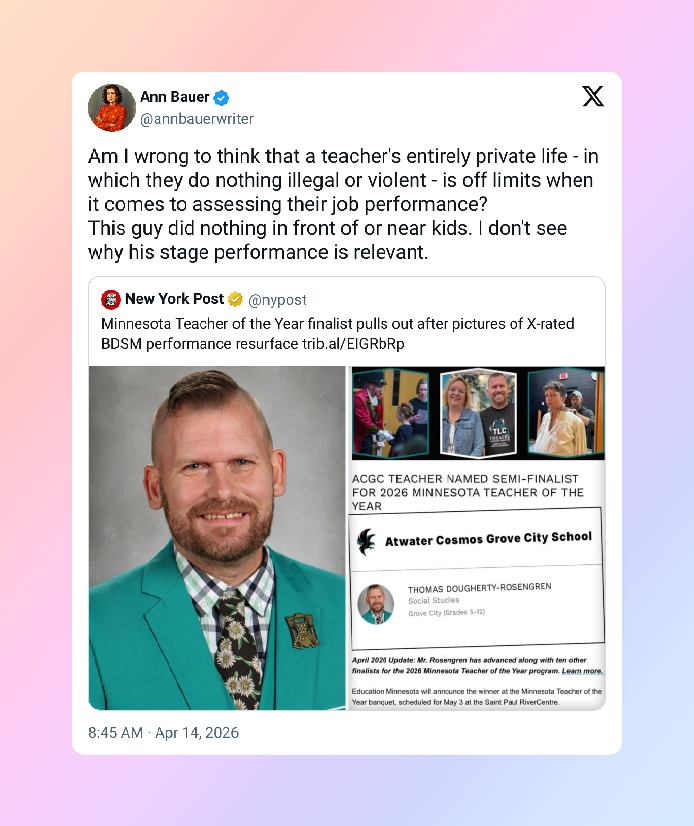
Essayist and novelist Anne Bauer even pointed out:
“Am I wrong to think that a teacher’s entirely private life – in which they do nothing illegal or violent – is off limits when it comes to assessing their job performance? This guy did nothing in front of or near kids. I don’t see why his stage performance is relevant.”
RELATED: Brownsburg Case Highlights Clash Between Teacher and Trans Students’ Rights
A Question Without Easy Answers
Should a teacher’s private life matter?
It’s a question that resurfaces whenever personal history collides with public responsibility. Educators are often held to high moral standards, particularly because they work with children. For some, that standard extends beyond the classroom—into what they do, who they are, and how they express themselves outside of work.
But there’s another perspective worth considering: if those actions are legal, consensual, and separate from their professional conduct, should they outweigh years of service and impact?
There isn’t a single answer. But there is a tension—one that becomes impossible to ignore in cases like this.
The LGBTQ+ Lens
For LGBTQ+ audiences, this story may feel particularly familiar.
Communities connected to queer identity—especially those involving kink or alternative expressions—have long existed on the margins, often misunderstood or judged more harshly when brought into mainstream view. What might be contextual within one space can be perceived very differently when removed from it.
That shift in perception can carry real consequences.
And while this situation is ultimately about one individual, it echoes broader patterns about visibility, acceptance, and the limits of both.
Beyond the Headline
It’s easy to reduce this story to a single line: teacher loses job after explicit photos resurface.
But that framing leaves out the human element—the years of work, the recognition, the complexity of living a life that doesn’t fit neatly into one category.
Empathy doesn’t require agreement. It simply asks us to look at the full picture.
Because behind every viral controversy is a person navigating the aftermath—and a society deciding, in real time, what it values more: context or reaction.