


Rome Pride has never exactly been known for subtlety. It’s a parade built on visibility, volume, and the occasional logistical miracle involving cobblestones and crowds. But this year, the conversation around Rome Pride has drifted away from route maps and stage lineups and landed squarely on a more complicated question: who gets to be included, and on what terms.
RELATED: Quakers Said Gay Love Wasn’t a Sin in 1963
The flashpoint in Rome is Keshet Italia, the only Italian Jewish LGBTQ organization, which has been banned from participating in the June 20 Rome Pride parade after refusing to condemn Israeli actions in Gaza as genocide. Roma Pride says participation is conditional on accepting its political manifesto, which includes a defined position on the conflict.
The rulebook behind the rainbow
Roma Pride confirmed that after meetings with Keshet Italia and Keshet Europe failed to reach agreement, both groups would not be allowed a float in the parade. The reasoning, in their own framing, is consistency: if you join the parade, you sign up to its politics.
RELATED: Far-Right Australian MP Jason Virgo Reveals He’s Gay
And those politics are not background noise. Roma Pride stated: “In particular, we strongly condemn the ongoing genocide and violence in Gaza by the State of Israel, which, in arrogant disregard for international law, targets the Palestinian civilian population.”
The organization also tried to draw a line between identity and government policy, saying: “We clearly distinguish the difference between the Israeli government and the LGBTQIA+ Jewish community, and we could never hold the latter responsible for war criminal acts committed by a genocidal government.” But it added a further condition: “We hold Keshet Italia responsible, however, for not having distanced itself and not intending to distance itself from the ongoing genocide in Gaza.”
That’s where things stopped being just another Pride disagreement and turned into something more fundamental: is Pride a broad umbrella, or a gated coalition with a manifesto check at the entrance?
“There is no pride if minorities are excluded”
Keshet Italia did not take the decision lightly—or quietly. In a press release, it called the move the “unprecedented exclusion” of the only Italian Jewish LGBTQ organization and said it exposed something deeper about the direction of the event.
“There is no pride if minorities are excluded,” Keshet Italia said. “We do not accept lessons in rights from those who practice identity-based exclusion. Antisemitism disguised as political positioning remains antisemitism.”
Keshet Europe backed that concern, warning that the issue wasn’t just disagreement but institutional exclusion. “Critique within our movements is legitimate. But using institutional power and public platforms to delegitimize Jewish LGBTQIA+ voices crosses a demarcation line that cannot be ignored,” it said.
It added a line that sounds almost like a reminder of what Pride is supposed to be about in the first place: “At the heart of it all lies a simple, fundamental aspiration, one that should require no justification in a democratic Europe: the freedom to march at Pride as we are. Visibly Jewish. Visibly Queer. Without condition, without compromise, and without fear.”
The politics of participation
The Union of Italian Jewish Communities also entered the debate, warning against the idea that participation in public events can be turned into an ideological screening process.
“No one should be called upon to pass an ideological test to be able to participate in a space born to include and guarantee dignity and rights to people, regardless of their identity, affiliation, or background,” it said.
Italian politician and European Parliament Vice President Pina Picierno echoed that concern on X/Twitter, arguing that democratic participation cannot depend on ideological conformity. While stressing that governments are absolutely open to criticism, she warned that exclusion based on disagreement risks drawing lines that are hard to walk back.
Roma Pride’s manifesto problem
Roma Pride, for its part, says this is not about exclusion but alignment. Its manifesto—required reading for participants—covers a wide range of political positions, including the conflict in Gaza.
It states: “In particular, we strongly condemn the ongoing genocide and violence in Gaza by the State of Israel, which, in arrogant disregard for international law, targets the Palestinian civilian population.”
It also calls for an end to occupation, settlement expansion, recognition of a Palestinian state, and refers to broader regional violence affecting Lebanon. It even frames resistance in historical terms, arguing that it was part of Italy’s own national formation, and that denying Palestinians a “right to resist” would be inconsistent with that history.
If all of this feels like Pride has turned into a policy conference with a marching permit, that tension is exactly what’s now playing out on the streets of Rome, where this year’s Pride debate has expanded far beyond the parade route itself.
Where belonging becomes conditional
Keshet Italia argues the stakes are not abstract. It points to past incidents at the 2025 Rome Pride parade, where participants carrying a rainbow flag with a Star of David were reportedly met with jeers and chants of “murderers.”
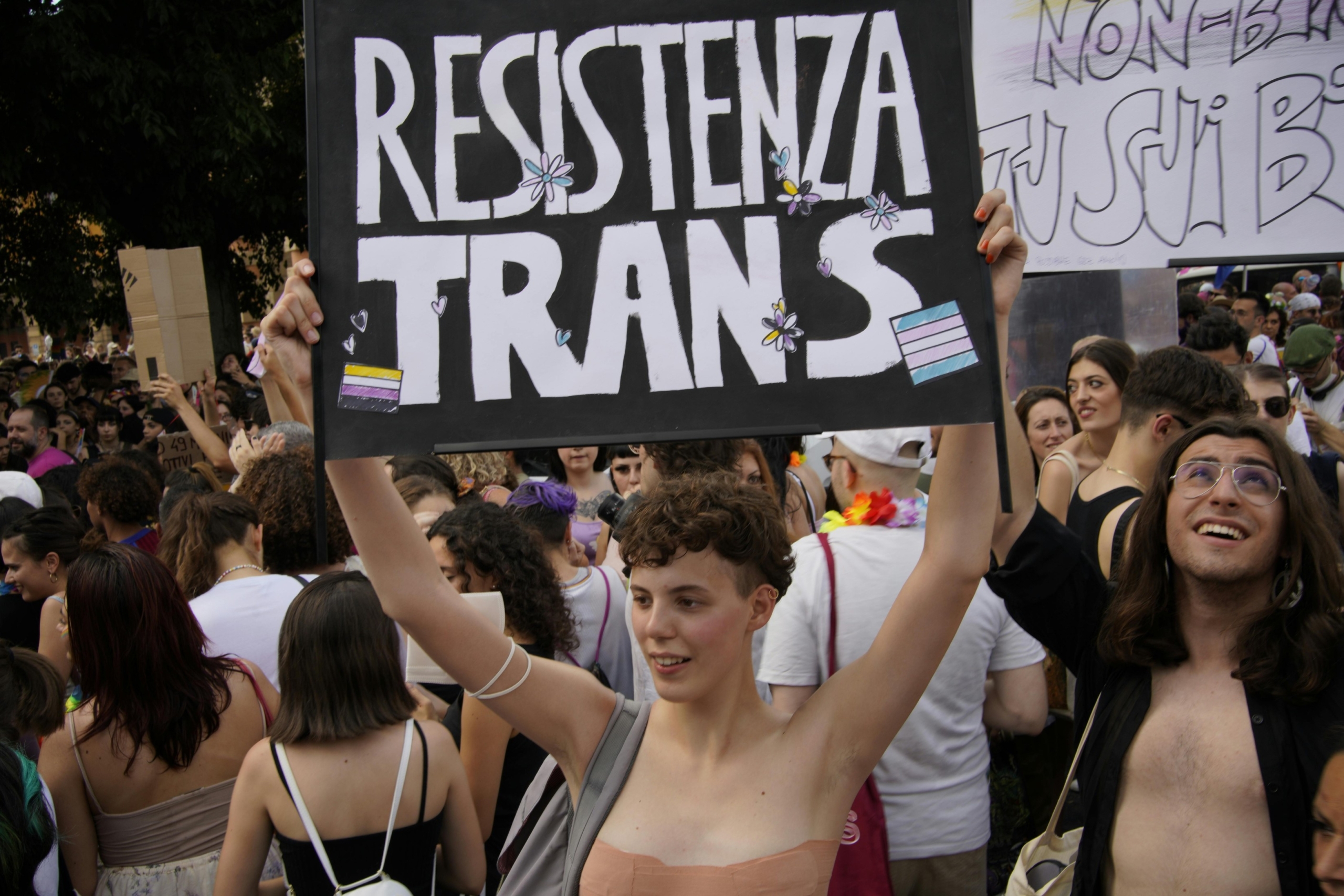
The group also says the fallout didn’t end there. It was reportedly asked not to join Toscana Pride due to security concerns and later skipped Milan and Bologna Pride events after experiencing harassment and feeling unsafe.
So what was once a parade in Rome about visibility and collective presence has become a test of how far that visibility extends when politics gets written into the entry requirements. Pride has always been a negotiation between celebration and protest—but in Rome this year, the negotiation has turned into a question with no easy exit: who is allowed to belong when belonging itself comes with conditions attached.
Source: The Jerusalem Post