


There is apparently a new way to say “we see you” to LGBTQ+ students at a Catholic high school in Oakland — and it involves a very colorful letter O.
RELATED: Poland Rejects Recognition of Foreign Same-Sex Marriages
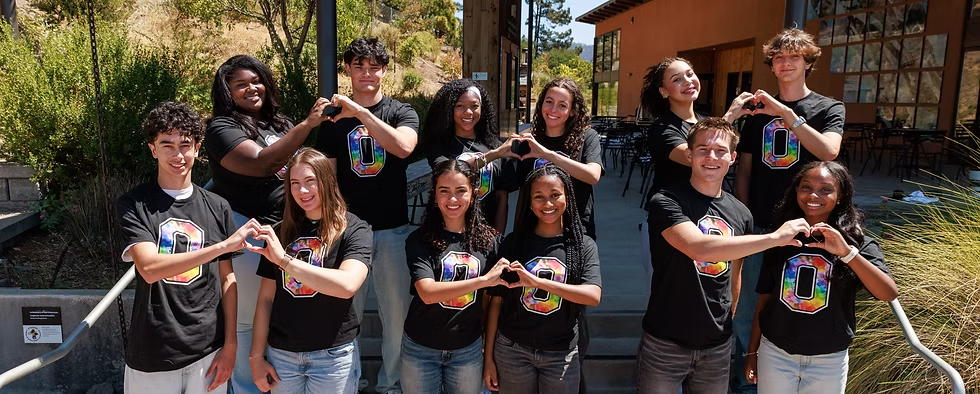
Bishop O’Dowd Catholic High School is heading into the new school year without the Pride and Progress flags that had appeared on campus. In their place is the Inclusive O, a rainbow-colored version of the school’s official logo designed to signal that LGBTQ+ students belong, too. Yes, it is technically a logo. Yes, it is also rainbow.
And yes, the whole thing has prompted exactly the sort of debate you might expect when a Pride flag meets a Catholic school, a bishop and a community trying very hard to agree on what inclusion should look like.
RELATED: Fresno Church’s Rainbow Doors Smashed for a Second Time This Summer
The rainbow is staying. Just in a different font, basically.
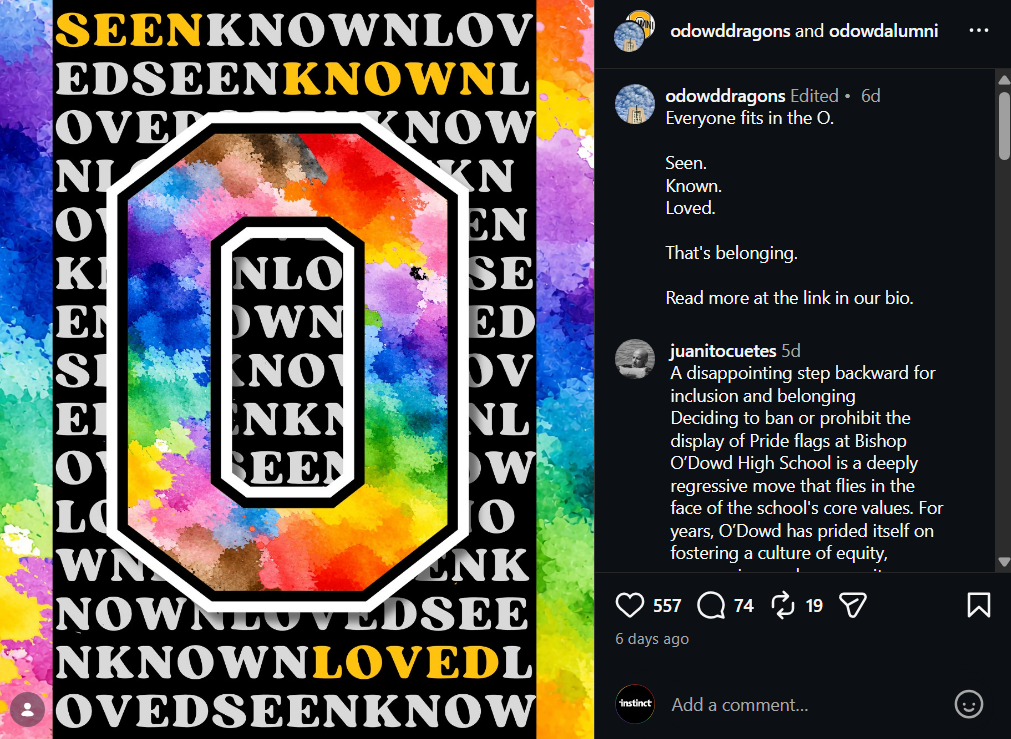
The Inclusive O takes the school’s familiar angular letter and fills it with watercolor-like rainbow shades. KRON-4 described the design this way:
“The symbol, an angular, oblong capital ‘O,’ features a smudge of colors, some of which — red, orange, yellow, green, violet, and blue — are also found in the Pride flag. However, rather than the neat, delineated lines of the Pride flag, the colors in the O look more like an impressionist watercolor of leaves.”
The school’s own explanation is considerably more direct:
“Our Inclusive O was created by and for the O’Dowd community. Using rainbow watercolor in our official O logo, it is underscored by words seen. known. loved.”
So, if you were hoping the rainbow itself had been banished from campus, surprise: it has simply been given a school-branded rebrand. The school says the Inclusive O is now displayed campus-wide, replacing the Pride and Progress flags that had previously appeared in some classrooms.
What happened to the Pride flags?
This is where things get considerably less cute than a watercolor O.
In a letter to the school community, president Kim Walsh explained that Pride and Progress flags had become part of a much larger conversation surrounding Catholic schools and LGBTQ+ inclusion.
“Many of you know that over the last few years, questions about Pride and Progress flags have become part of a much larger conversation taking place throughout the Catholic Church and in the United States.
“Across the country, Catholic schools have been working to navigate these tensions while remaining united as communities, caring for students, and living their catholic values. Last year, this became a lightning rod within our community. We did not want a symbol to become the source of division that diminished our ability to care for students.
“Our Inclusive O now appears in lieu of the Pride and Progress flags that had previously been displayed in some classrooms, and is now displayed campus-wide.”
Walsh did not identify the specific incident in that letter. Reporting from KQED said the Diocese of Oakland asked the school to remove the Pride flags after someone in the community saw a Progress flag on campus and reported it to Bishop Michael Barber.
The school did not immediately comply. Before summer break, however, the flags were removed and featured in a ceremony at the school chapel, while the Inclusive O began appearing on posters and shirts. In other words, the argument over a flag did not exactly disappear. It evolved into a discussion about what should replace it.
A year of figuring out what “belonging” looks like
The school says the Inclusive O was not dreamed up as a quick compromise after everyone got tired of arguing. Walsh said the school spent months involving faculty, staff, counselors, parents, students, LGBTQ+ community members and others in the process.
“Over many months, we engaged faculty and staff, counselors, parents, the Board of Regents, LGBTQ+ community members, and student leaders in prayer, discernment, and dialogue. Together, we asked a simple but important question: How do we continue to visibly communicate that every student belongs?”
That question produced a symbol that is unmistakably tied to O’Dowd itself rather than the broader LGBTQ+ movement. And therein lies the interesting part.
A Pride flag comes with decades of history and an instantly recognizable message. The Inclusive O comes with a school logo, a rainbow palette and a sentence explaining what it means. For some people, that distinction is the entire point. For others, it is the problem.
LGBTQ+ support goes beyond one piece of fabric
O’Dowd insists that changing the symbols on the walls does not mean changing its broader support for LGBTQ+ students. Walsh pointed to programs including the school’s Counseling Department, Health & Wellness team, Unity Club, Pride Arts Club and Inclusive Family Day. She also said the school was expanding its efforts this year.
“Our Counseling Department, Health & Wellness team, Unity Club, Pride Arts Club, Inclusive Family Day, and the many ways we accompany LGBTQ+ students and families remain in place. This year, we are also expanding that work through a community art workshop, an LGBTQ+ family retreat, and the formation of an Inclusive Advisory Council to help guide our ongoing efforts around belonging and student support.”
That is important context because the controversy isn’t simply about whether a rainbow exists somewhere on campus. It is about representation — and whether a school-created symbol can carry the same emotional and cultural weight as the Pride flag it replaces.
Some alumni aren’t exactly sending the O a standing ovation
Not everyone thinks the new symbol is an adequate substitute.
Some alumni have argued that the Inclusive O does not carry the same significance as the Pride flag, which has long been associated with LGBTQ+ visibility. The concern is fairly straightforward: a Pride flag doesn’t need a user manual.
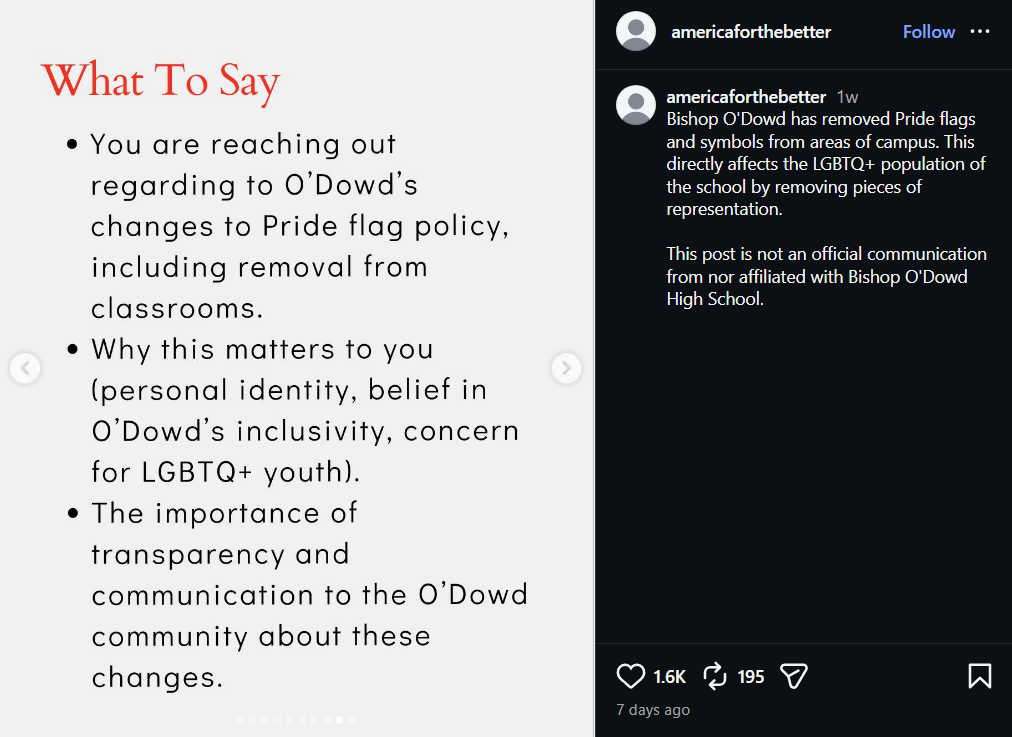
One social media post discussed on Reddit said the decision:
“‘directly affects the LGBTQ+ population of the school by removing pieces of representation.’”
That criticism has become one of the central questions surrounding the change: if the goal is to make LGBTQ+ students feel seen, does replacing a universally recognizable LGBTQ+ symbol with an institution-specific one make that visibility stronger — or harder to recognize? There is no universally agreed answer.
One LGBTQ+ advocate thinks the O is a win
Francis DeBernardo, executive director of New Ways Ministry, takes a more favorable view.
“The new symbol is a positive way to solve a dilemma that many Catholic schools face in regard to Pride flags,” he said. “It is a creative solution that sends a message of support to LGBTQ+ students, and that is the most important feature of it.”
And that may be the most charitable way to read what O’Dowd is attempting. The school isn’t pretending the controversy never happened. Instead, it has chosen a symbol it can control, define and put everywhere — one that the administration says communicates belonging without turning the campus into another battleground over the Pride flag.
Whether students and alumni ultimately see the Inclusive O as meaningful representation or as a conspicuously school-approved substitute is another question.
Because sometimes the symbol is the whole conversation
There is something almost perfectly modern about the situation: a community spends a year debating how to communicate inclusion, removes one symbol, creates another, and then finds itself debating the new symbol. But the argument matters because symbols matter.
For LGBTQ+ students, seeing a rainbow flag can mean more than decoration. It can be a small but unmistakable signal that someone thought about them before they walked through the door. At the same time, O’Dowd says it wants to avoid allowing that symbol to become a source of division that overshadows its ability to support students.
The Inclusive O is therefore doing a lot of work for one letter. It has to be a logo, a compromise, a rainbow, a reassurance and, apparently, a diplomatic envoy. Whether it succeeds may depend less on how pretty the O looks and more on what LGBTQ+ students actually experience once they are inside it.
For now, Bishop O’Dowd’s message is clear: the Pride flags are gone, but the school wants its LGBTQ+ students to know that “seen. known. loved.” is still very much the assignment.
Source: New Ways Ministry