


Are LGBTQ+ young people going back into the closet?
It is an unsettling question, especially after years of LGBTQ+ visibility among younger generations appeared to be moving in the opposite direction. New data analyzed by psychologist Jean M. Twenge suggests that the story may be changing, but the numbers need a little more unpacking before we start declaring the end of queer Gen Z because it really is that complicated.
In a September 2026 analysis, Twenge examined newly available 2025 data from the CDC’s Youth Risk Behavior Survey, which tracks U.S. high school students. The findings show a noticeable decline in students identifying as lesbian, gay, or bisexual, particularly among the youngest students.
READ: Coming Out, Staying Closeted and Surviving Hollywood
The youngest students show the biggest shift
The change isn’t evenly distributed across high school.
Among 12th graders, the share identifying as LGB slipped from 18% in 2023 to 16% in 2025. The decline becomes larger among younger grades, however, with the most striking change appearing among ninth graders. Their LGB identification fell from 17% to 11% over the same period.
Girls account for much of the movement. Among high-school girls overall, LGB identification decreased from 27% in 2023 to 22% in 2025, compared with a change from 9% to 7% among boys. Twenge’s analysis also found the sharpest long-term change among ninth-grade girls, whose LGB identification fell from 30% in 2021 to 17% in 2025.
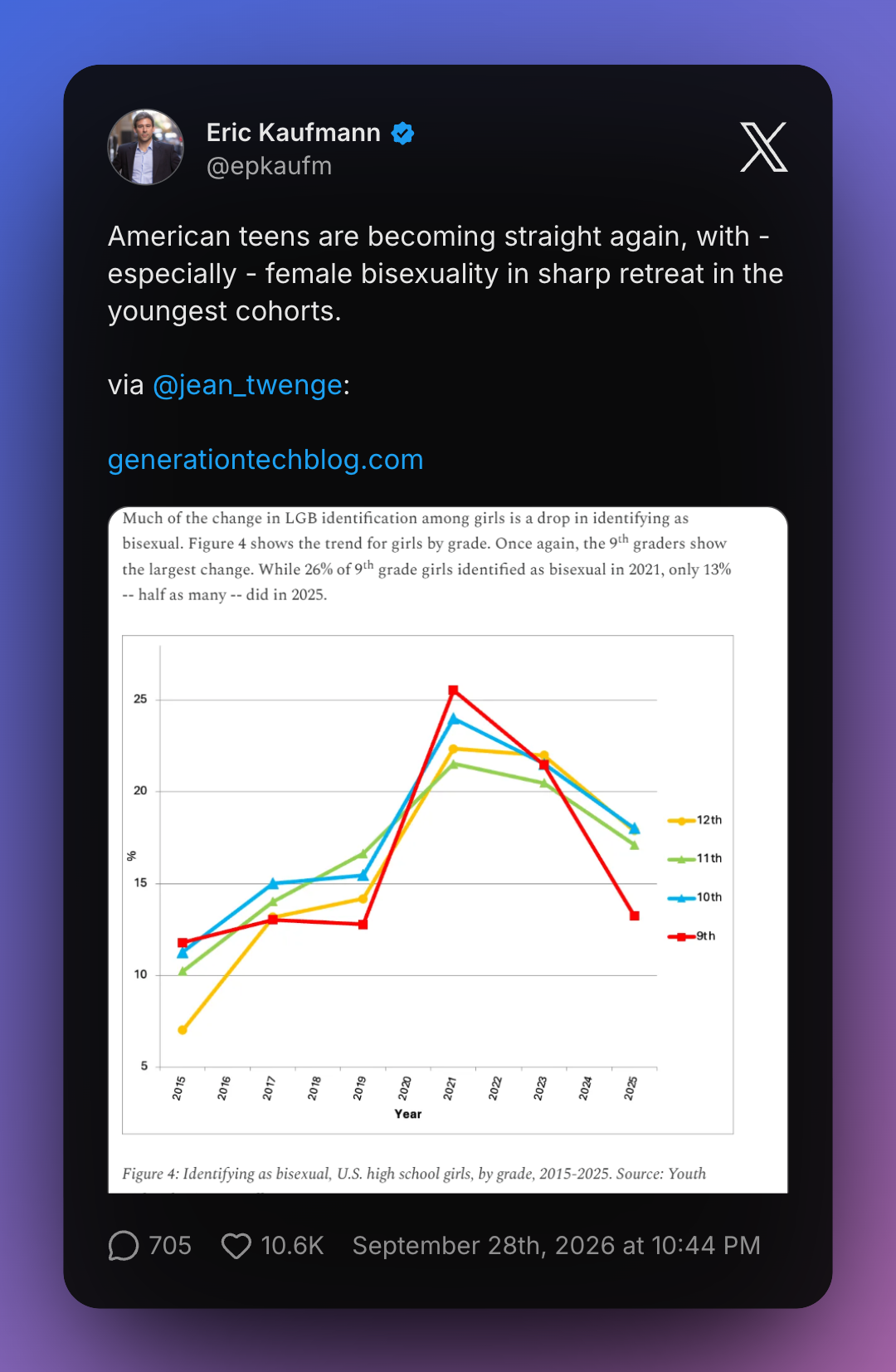
Much of that shift appears connected to bisexual identification. Among ninth-grade girls, bisexual identification dropped from 26% in 2021 to 13% in 2025.
But does this mean young people are “less LGBTQ+”?
Not necessarily.
First, these surveys measure how students describe their sexual identity at a particular moment. A change in the label someone selects does not automatically tell us that their underlying attractions have changed, or that they have stopped experiencing same-sex attraction.
It is also worth remembering that “LGB” does not capture every identity within the LGBTQ+ umbrella. A young person might describe themselves as pansexual, queer, fluid, or another identity rather than lesbian, gay, or bisexual.
There is another important wrinkle. Twenge initially reported a decline among U.S. 18- to 24-year-olds using early 2025 data, but later noted that the apparent decline disappeared once the full-year data became available. The newer evidence therefore points much more strongly toward a shift among younger high-school students than a universal retreat from LGBTQ+ identification among young adults.
The closet question is complicated
Could fear, stigma, or a changing political climate influence whether teenagers feel comfortable choosing an LGBTQ+ label? It is possible, but the data cannot establish that as the cause.
The CDC has previously documented the impact that stigma, discrimination, rejection, and violence can have on LGBTQ+ youth. That makes the surrounding social environment important, but it would be premature to turn these statistics into a single explanation.
What the numbers really tell us is that LGBTQ+ identification among younger teens is changing, and we need to understand why before deciding what it means. For LGBTQ+ youth, that distinction matters. A label can change. A person can take their time. Someone can be out, questioning, private, or simply still figuring themselves out.
And none of those journeys should be treated as a failure simply because the numbers don’t add up.
The goal isn’t to make every young person choose an LGBTQ+ label. It is to make sure that, whatever label they choose, they feel safe enough to choose it for themselves.