

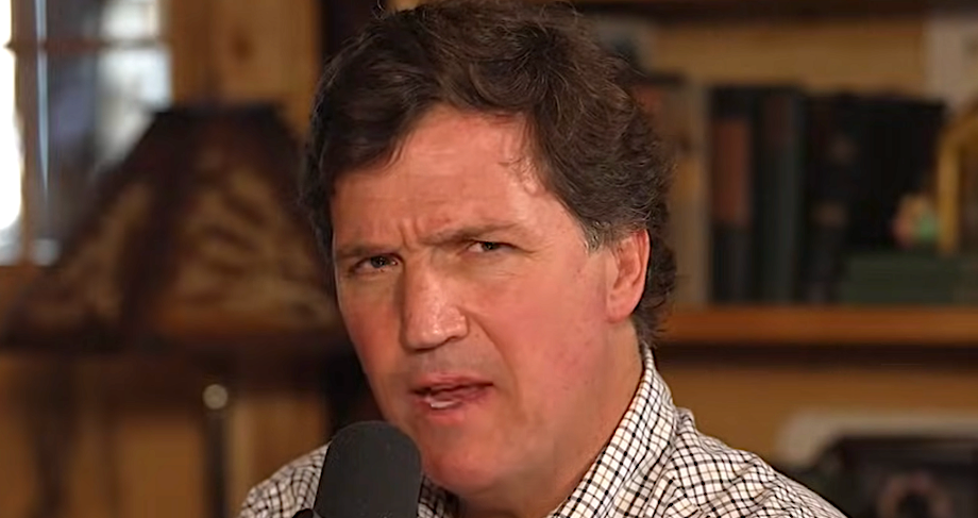
Tucker Carlson once again sparked outrage and eye-rolls in conservative circles when he suggested that “globo homo” — his term for progressive global elites — was behind efforts to remove Venezuelan dictator Nicolás Maduro. In a Facebook clip titled “Are we carrying out regime change in Venezuela in the name of gay marriage? It seems that way”, Carlson argued that U.S. actions against Maduro were being guided not by strategy or national interest, but by social liberals support of gay marriage, abortion, and transgender rights.
Carlson went so far as to call Venezuela “one of the most conservative countries” in the Western Hemisphere, citing Maduro’s strict bans on gay marriage, abortion, and sex-change procedures. He pointed to opposition politician María Corina Machado, who won the 2023 opposition primary but was later blocked from running in the 2024 election, and noted her support for gay marriage as evidence that “pro-gay forces” were secretly driving regime change.
“So those of you who thought this whole project was globo homo — not crazy actually,” Carlson said, framing a complex political situation as if it were all a culture war conspiracy.
Critics were quick to pounce. Many called Carlson’s claims absurd and conspiratorial, noting that Maduro’s authoritarian regime had long been opposed by a broad coalition for geopolitical and economic reasons, not because of social issues. Analysts say Carlson’s theory dramatically oversimplifies international politics, filtering foreign policy through a cultural lens that makes little sense when confronted with reality.
Ben Shapiro weighed in on Saturday, offering a correction. “It was not ‘globo homo’ that ousted Nicolás Maduro,” Shapiro said. “It was a conservative Republican president. A gutsy president who makes the calls to preserve America’s national security and her foreign interests.” By reframing the story, Shapiro emphasized strategy over culture war theatrics.
This isn’t the first time Shapiro has mocked Carlson for his take on Venezuela. Speaking to Megyn Kelly in November, he reacted to Carlson’s claims about Maduro being socially conservative with a blunt, “Who gives a sh*t?!” The exchange underscores the growing feud between the two, with Shapiro accusing Carlson of undermining the conservative movement with over-the-top rhetoric, while Carlson counters that Shapiro prioritizes foreign interests over American values.
Observers see this clash as a symptom of a larger divide in conservative media: should global events be interpreted through cultural issues, or through strategy, security, and national interest? Political commentator Laura Fineman notes, “Carlson’s Venezuela theory is more about shock and spectacle than policy. Shapiro’s response shows a preference for analysis grounded in reality rather than ideology.”
Carlson’s “globo homo” claims have generated laughs, criticism, and incredulity in equal measure. By suggesting that progressive social forces were orchestrating Maduro’s removal to advance gay rights, Carlson framed international geopolitics as a bizarre extension of domestic culture wars. Shapiro, meanwhile, reminded viewers that foreign policy is rarely driven by any one social agenda, and that Maduro’s fall came from calculated political moves, not conspiratorial forces.
The debate highlights a persistent tension within conservative commentary: are cultural concerns the defining lens through which to view global politics, or should strategy and real-world consequences dominate? Carlson’s wildly implausible framing has made him a lightning rod, while Shapiro’s measured pushback positions him as the voice of grounded conservatism.
For now, Carlson’s “globo homo” theory is dominating social media chatter, leaving many to shake their heads — and leaving Shapiro to quietly remind viewers that, in real life, Maduro’s removal was a political, not cultural, story.
Rob’s latest exclusives and insider reporting can be found at robshuter.substack.com
His forthcoming novel, It Started With A Whisper, is now available for pre-order
Tucker is a NUT!
Tucker is such a lame idiot!
Maduro’s fall was all about oil, nothing more! And certainly not about drugs either. Basically Carlson is saying that Trump is gay? Nooooo!
MAGA stupidity is becoming a fact