


For decades, Tucker Carlson was one of the most recognizable conservative voices in American media.
Whether through cable news appearances, political commentary, or his years as a prominent defender of Republican causes, Carlson built a reputation as someone deeply, and sometimes questionably, aligned with the political right.
That is why his latest remarks have generated so much attention.
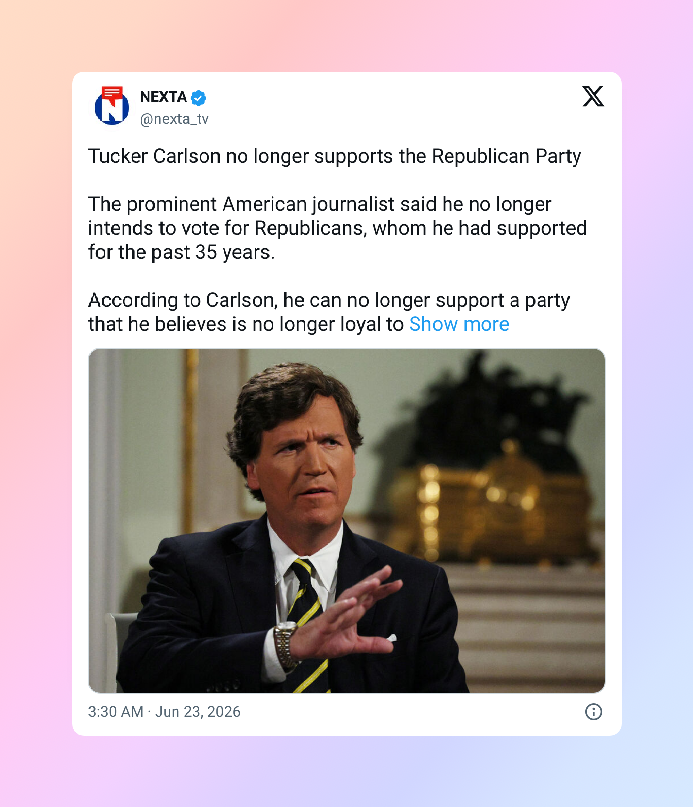
Speaking on a recent episode of the Can’t Be Censored podcast, Carlson announced that he no longer plans to support the Republican Party, ending what he described as a thirty-five year relationship with the party.
“I would not support the Republican party, there’s no chance I would support the Republican party. How could I support a political party that is not loyal to the United States,” Carlson said.
He continued,
“I voted Republican my entire life, I have been a consistent defender for 35 years of the Republican party, but there is no defending this. I’m out.”
Tucker Carlson: I would not support the Republican party, there’s no chance I would support the Republican party. How could I support a political party that is not loyal to the United States. I voted Republican my entire life, I have been a consistent defender for 35 years of the… pic.twitter.com/dYX0DK9XAx
— Headquarters (@HQNewsNow) June 22, 2026
Not Republican. Not Democrat.
For anyone wondering whether Carlson’s comments signal a move toward the Democratic Party, he was quick to shut down that speculation.
“I would not support the Republican Party,” Carlson said. “There’s no chance I would support the Republican Party. I’m not going to support the Democratic Party. I don’t know what I’m going to do.”
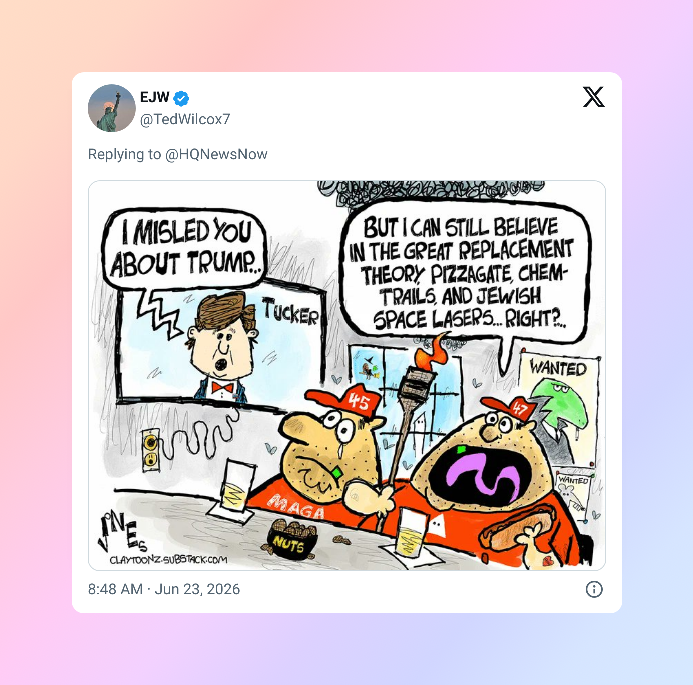
Carlson expanded on his frustration by pointing to what he views as a failure by political leaders to represent their voters.
“I worked at Fox News, CNN, MSNBC. I’ve been a consistent defender for 35 years of the Republican Party,” he explained. “There’s no defending this because it’s amoral and it’s exactly the opposite of what a political party in a democracy is charged with doing, which is representing its own voters, its own citizens, its own nation. And they’re not doing that.”
The comments mark one of the strongest public breaks Carlson has ever made with the party he spent much of his career supporting.
RELATED: Why Is Tucker Carlson Pretending Using Homophobic Slurs Equates to Free Speech?
A Growing Divide on the Right
Carlson isn’t the only prominent conservative expressing frustration. Representative Marjorie Taylor Greene echoed similar sentiments on social media, writing:
“Tucker is not the only one who is done supporting the Republican Party.
There is A LOT of us that are absolutely fed up and will not support a party that betrays its voters and country.”
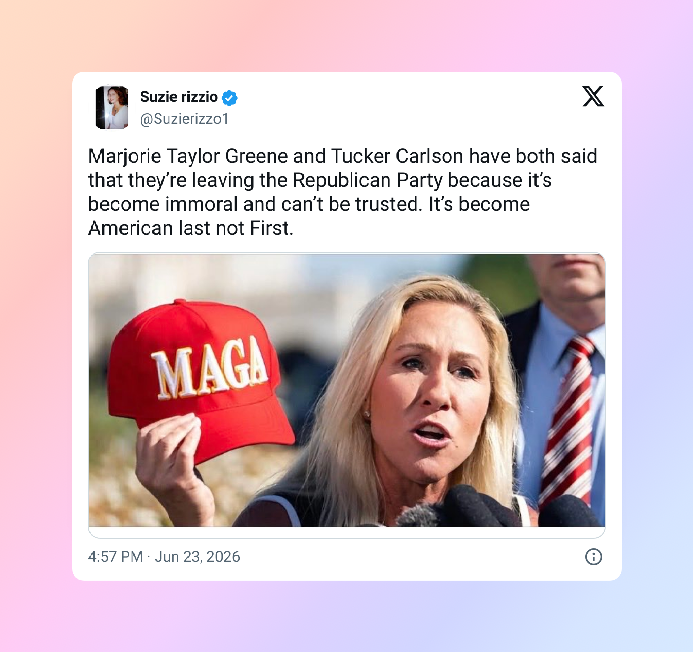
At the same time, Greene made it clear that dissatisfaction with Republicans does not automatically translate into support for Democrats.
“That does not mean we are turning into Democrats either,” she wrote. “But we are DONE with the America LAST Republican Party.”
The Road to This Moment
Carlson’s announcement did not come entirely out of nowhere.
Over the past several months, the former Fox News host has increasingly distanced himself from some of the positions and figures he once defended. Earlier this year, Carlson publicly acknowledged that he had “misled” audiences on certain issues and has since become more vocal in criticizing decisions related to the conflict involving Iran.
Those criticisms have also put him at odds with President Donald Trump, a figure long associated with the MAGA movement that Carlson frequently supported.
Trump responded sharply to Carlson’s recent criticisms.
“Tucker has lost his way,” Trump said. “I knew that a long time ago, and he’s not MAGA.”
Trump continued, “MAGA is saving our country. MAGA is making our country great again. MAGA is America first, and Tucker is none of those things. And Tucker is really not smart enough to understand that.”
What Happens Next?
The biggest question may be the simplest one.
If Tucker Carlson is no longer a Republican and has no intention of becoming a Democrat, where exactly does that leave him?
For now, Carlson appears to be positioning himself outside of the traditional party structure altogether. Whether that becomes a long-term political identity, a protest against current leadership, or the beginning of a larger movement remains to be seen.
One thing is certain: when one of the most influential conservative media figures of the last generation says, “I’m out,” people are going to pay attention.