


Disclaimer: The information provided here is meant to increase your awareness about health and the potential benefits of the use of the products described in this article. It is not intended as medical advice, diagnosis, or treatment. Before starting any new health program or supplement regimen, consult a healthcare provider or a qualified medical professional.
Anxiety is not abstract. It shows up in your jaw before a hard conversation, in your chest the night before something big, in the background hum that follows you through an ordinary Tuesday. The queer community carries more of it than most — research consistently links minority stress to higher rates of anxiety disorders among LGBTQ+ people, and cannabis has worked its way into a lot of queer wellness routines for exactly that reason.
The problem is that walking into a dispensary and asking for “something for anxiety” is like walking into a pharmacy and asking for “something for pain.” Most budtenders will point you toward whatever’s moving, not what actually works.
The strain name is the least important thing on the label. What drives the experience is the THC:CBD ratio, the terpene profile, and how much you take. Get those right and cannabis can genuinely take the edge off — get them wrong and you’re in for a rough hour.
Here are six strains that get them right.
Top 6 Weed Strains for Anxiety Relief at a Glance
- Blue Dream Feminized — Best Sativa-Dominant Strain for Anxiety and Focus
- Northern Lights — Best Classic Indica for Anxiety and Stress Relief at Night
- White Widow — Best Hybrid Cannabis Strain for Social Anxiety and Stress
- Granddaddy Purple — Best Indica-Dominant Strain for Anxiety and Depression Relief
- La Kush Cake — Best High-THC Autoflower Strain for Calming Anxiety and Muscle Tension
- Harlequin — Best High-CBD Cannabis Strain for Clear-Headed Anxiety Relief
Best Weed Strains for Anxiety — Reviews
Each strain below was chosen for a specific anxiety use case. The effects listed come directly from the terpene and cannabinoid profiles, not from marketing copy. Here’s what each one actually does, who it’s best suited for, and where it falls short.
1. Blue Dream Feminized — Best Sativa-Dominant Strain for Anxiety and Focus
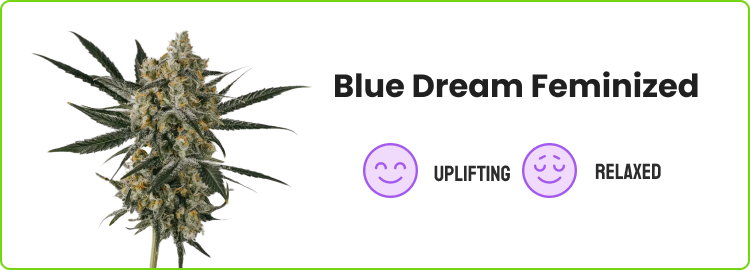
Type: Sativa-dominant hybrid
THC: ~17–21% | CBD: Low
Dominant Terpenes: Myrcene, caryophyllene, pinene
Effects: Gentle cerebral lift, sustained energy, calming without sedation, maintained mental clarity
The thing Blue Dream does well is what most anxiety strains can’t pull off: it calms you down without shutting you off. The sativa genetics give you an energizing cerebral effect that keeps you engaged and present. Myrcene rounds the edges, preventing the sharpness that tips sensitive users into racing thoughts. Caryophyllene adds a quieter layer of anti-anxiety support in the background.
It’s a daytime strain in the truest sense. Pre-event nerves before a first date, focus anxiety when working from home, the particular unease of showing up somewhere new — Blue Dream handles all of that without putting you on the couch. For queer people who carry low-grade social anxiety as a baseline, that specific combination is genuinely useful. It’s the kind of strain you can take before something, not just after.
The pinene content can feel sharp for some people, especially at higher doses. Low CBD also means there’s less buffer if you overshoot. Start low, particularly if THC sensitivity is part of your history with cannabis.
Pros:
- Calming without sedation — keeps you functional and present through the day
- Myrcene moderates the stimulating sativa effects meaningfully
- Energizing cerebral effects without triggering anxious thought loops
- Well-established genetics with wide availability as feminized seeds
Cons:
- Low CBD content offers less protection against THC overconsumption
- Not suitable for severe anxiety or people prone to panic attacks
- Beginners need to start at very low doses
2. Northern Lights — Best Indica Strain for Anxiety and Sleep
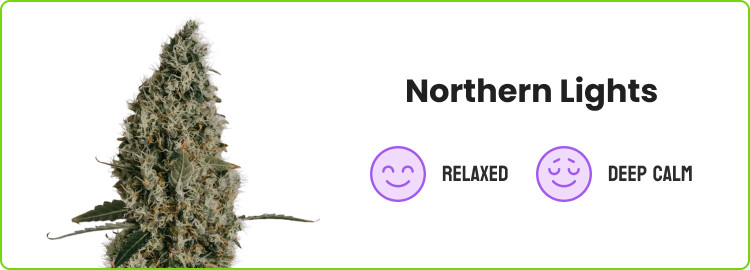
Type: Pure indica
THC: Moderate–high | CBD: Low
Dominant Terpenes: Myrcene, terpinolene, caryophyllene
Effects: Full-body relaxation, quieted mental chatter, improved sleep quality, deep calm
Northern Lights doesn’t argue with your anxiety. It just turns the volume down. One of the most studied and recognized cannabis strains in history, its reputation for calming anxious thoughts and producing deep physical relaxation is well-earned — and consistent across decades of use.
The myrcene-dominant profile drives the sedation. This is an evening strain, full stop. It won’t help you function. It’ll help you stop needing to. There’s a specific kind of chronic low-grade stress that builds over time without a clear release valve — the kind a lot of queer people know well, the weight of constant hypervigilance and emotional labor that compounds over a long week. Northern Lights is built for the nights when your brain won’t stop cycling through the same thoughts. It’s a reset button, not a productivity tool.
Plan your evening around it. Seriously.
Pros:
- Consistently reliable calming effects with a well-documented terpene profile
- Strong track record for improved sleep quality and nighttime anxiety relief
- Easy to grow — a practical choice for seed buyers who want predictable results
- Full-body relaxation that addresses both physical tension and mental anxiety
Cons:
- Heavy sedation limits this to nighttime use only
- Higher THC content requires careful dosing, especially for beginners
- Some users find the experience too mentally flat for regular rotation
3. White Widow — Best Balanced Hybrid Strain for Social Anxiety
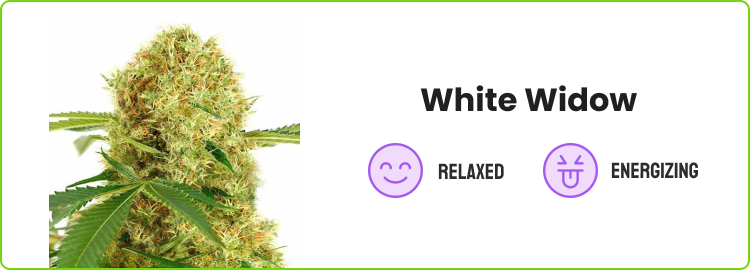
Type: Balanced hybrid (50/50 indica/sativa)
THC: ~20% | CBD: Moderate
Dominant Terpenes: Caryophyllene, myrcene, limonene
Effects: Mild euphoria, social ease, mood lift, body relaxation without sedation
White Widow is the rare hybrid that actually behaves like one. You get body calm from the indica side and enough mental lift from the sativa side to stay present and engaged. It doesn’t lock you to the couch. It doesn’t send your thoughts spiraling either. That balance is genuinely difficult to find in a single strain, and it’s why White Widow has stayed relevant for so long.
Limonene contributes mood elevation without pushing toward overstimulation. Caryophyllene works directly on CB2 receptors to ease stress. Combined, the terpene profile does real, functional work here.
Social situations carry particular weight for a lot of queer people — a bar you’ve never been to, a friend group you’re still reading, a family gathering where you’re the uncertain variable in the room. White Widow is well-suited for those scenarios. It calms you down without sedating you before you walk in the door, which is exactly what social anxiety relief actually needs to do.
Pros:
- Genuinely balanced effects — not leaning too far toward sedation or stimulation
- Limonene lifts mood without triggering anxious overstimulation
- Versatile enough for day or early evening use
- Caryophyllene brings CB2-active terpene support to the calming effects
Cons:
- Moderate THC can still cause anxiety at higher doses
- Not the right choice for severe anxiety that needs deeper sedation to resolve
- Experienced users seeking heavy relaxation may find it underwhelming
4. Granddaddy Purple — Best Indica-Dominant Strain for Anxiety and Depression Relief
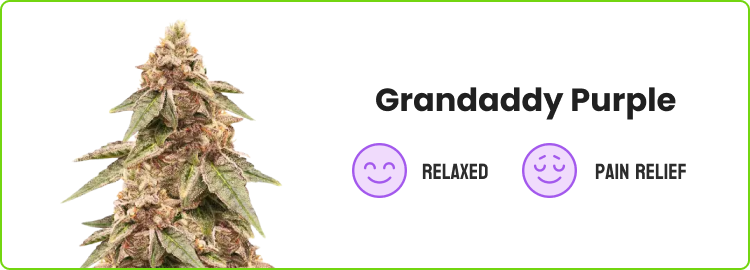
Type: Indica-dominant hybrid
THC: High | CBD: Low
Dominant Terpenes: Myrcene, caryophyllene, linalool
Effects: Deep body relaxation, muscle tension release, mental quiet, mood lift, sedation
The linalool content is what separates Granddaddy Purple from most other indica-dominant strains on this list. Linalool is the same terpene that gives lavender its calming reputation, and it has been used as an anxiety remedy for over 2,000 years. Pair it with myrcene and caryophyllene, and you have one of the most potent natural terpene combinations for anxiety relief you’ll find in any cannabis strain.
GDP works on the body as much as the mind. Muscle tension, jaw clenching, tightness across the shoulders — the physical symptoms anxiety leaves behind long after the trigger passes. Most strains on this list address the mental experience of anxiety. GDP addresses the physical residue too. For people who carry stress in their bodies (and a lot of us do), that distinction matters.
If the goal is a complete mental and physical reset, this is the strain built for that. The best weed strains for anxiety and depression relief tend to share these qualities: deep sedation, a mood lift without a manic edge, and physical effects that reach the places your mental state never quite manages to release on its own.
Pros:
- Linalool and myrcene combination is one of the strongest calming terpene pairings in cannabis
- Addresses both mental anxiety and physical tension in one session
- Widely recognized for profound relaxation with a mood lift
- Effective for anxiety-related sleep issues
Cons:
- Very sedating — this strain will dictate your evening
- High THC requires genuine dose discipline, especially for newer users
- Not appropriate for beginners without some prior guidance
5. La Kush Cake — Best Autoflower Strain for Winding Down
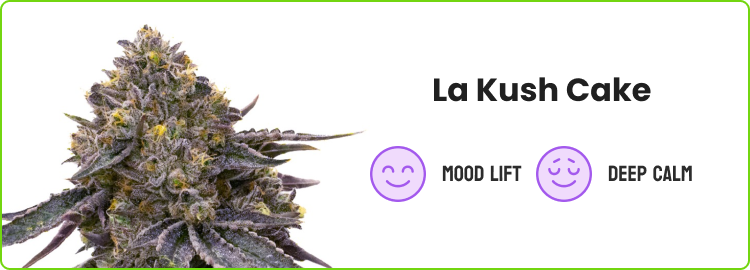
Type: Indica-dominant autoflower hybrid
THC: High | CBD: Low
Dominant Terpenes: Caryophyllene, limonene, myrcene
Effects: Physical stress release, deep calm, mild mood lift, body sedation
The caryophyllene-forward profile is worth calling out specifically: caryophyllene is the only known terpene that directly binds CB2 receptors. That’s not a small detail. It means La Kush Cake isn’t just producing a calming aroma — it’s actively engaging the same receptor system that regulates stress and inflammation responses. In a market full of vague terpene claims, that distinction is concrete and meaningful.
The autoflower genetics are a practical bonus for anyone growing at home. No light schedule management, faster harvest cycles, easier cultivation overall. For a home grow focused on anxiety relief and calming effects, this is one of the more efficient and accessible choices available.
La Kush Cake works best when anxiety has settled into the body as physical tension rather than active thought loops — the kind of end-of-day tightness that no amount of breathing exercises seems to touch. It’s a wind-down strain, best used as part of a deliberate evening routine rather than something picked up casually.
Pros:
- Caryophyllene directly engages CB2 receptors for targeted stress relief
- Autoflower genetics lower the barrier for home growers significantly
- Strong physical relaxation suited to tension-based anxiety
- Consistent, potent effects across grows
Cons:
- High THC without significant CBD makes overdosing an easy mistake
- Not appropriate for daytime or functional use
- Beginners and anxiety-sensitive users need to approach this one with real care
6. Harlequin — Best High-CBD Strain for Anxiety Without the High
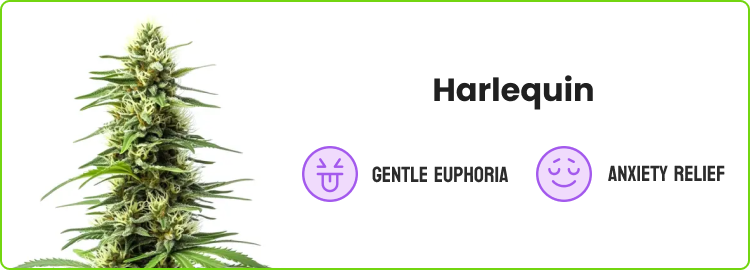
Type: Sativa-dominant hybrid
THC: Low–moderate | CBD: High (5:2 CBD:THC ratio)
Dominant Terpenes: Myrcene, pinene, caryophyllene
Effects: Gentle euphoria, mental clarity, consistent anxiety relief, no overwhelming psychoactive effects
Harlequin is the most important strain on this list for one specific type of person: anyone who’s had a bad THC experience and written off cannabis for anxiety entirely. A 5:2 CBD:THC ratio changes the equation. CBD acts as an allosteric modulator — it softens THC’s intensity and enhances the brain’s natural calming mechanisms without eliminating the experience altogether.
CBD also interacts with serotonin receptors (5-HT1A) directly. That’s the same receptor pathway that SSRIs target. The mechanism is different and the scale is different, but the direction is the same: reduced anxiety and improved mood without heavy sedation.
You feel steady. You stay clear. That combination is not the default with high-THC strains, and it’s the reason Harlequin has a loyal following among medical cannabis patients and anyone managing anxiety during working hours. For people hesitant about cannabis because of past experiences, stigma, or the simple need to stay functional through a demanding day — this is the entry point. It doesn’t ask you to choose between relief and clarity.
Pros:
- 5:2 CBD:THC ratio delivers consistent anxiety relief without mental cloudiness
- CBD interaction with serotonin receptors provides a grounded mechanism for mood support
- Ideal for beginners and high-THC sensitive users
- Well-suited for daytime anxiety management when function matters
Cons:
- Lower THC means less profound physical relaxation
- Not the right pick for anxiety that requires sedation to resolve
- Availability can be inconsistent compared to high-THC strains
How Cannabis Interacts With Anxiety and Why It Can Go Either Way
Cannabis and anxiety have a complicated relationship. The same plant that helps one person decompress after a brutal week can send another into a spiral of paranoia and racing thoughts. Understanding why that happens is more useful than any list of supposedly “safe” strains.
Your body has an endocannabinoid system (ECS) that regulates mood, fear responses, and sleep. THC and CBD interact with it, but not the same way. THC binds to CB1 receptors in the brain. At low doses, this interaction can reduce anxiety and quiet mental chatter. At high doses, it can trigger paranoia, amplify anxious thinking, and make symptoms significantly worse. That’s not a contraindication — it’s how the receptor works. Dosage is everything.
This is called THC’s biphasic effect: low doses calm, high doses can escalate anxiety. It’s the most important pharmacological fact for first-time cannabis users to carry. More THC is not better. For anxiety specifically, it is frequently worse.
CBD operates differently. It acts as an allosteric modulator, changing how other receptors respond rather than binding directly to CB1. It also interacts with serotonin receptors (5-HT1A), which is why high-CBD strains can provide meaningful anxiety relief without significant psychoactivity. High-CBD strains don’t necessarily get you high. They calm you down.
Terpenes complete the picture. Myrcene promotes relaxation and physical sedation. Linalool, the compound found in lavender, has documented use as an anxiety remedy for over 2,000 years. Beta-caryophyllene is the only known terpene to directly bind CB2 receptors, giving it a functional role beyond aroma. These aromatic compounds work in synergy with cannabinoids, a phenomenon called the entourage effect, meaning the full chemical profile of a strain shapes its effects more than any single ingredient does.
The takeaway is practical: a strain with high THC, low CBD, and none of these calming terpenes can worsen anxiety regardless of its name or reputation. The chemical profile tells you what to expect. The label rarely does.
Choosing the Right THC:CBD Ratio for Anxiety Relief
High-CBD, Lower-THC Strains
Ratios like 5:2 or 20:1 (CBD:THC) are the safest entry point for anxiety-prone users. CBD softens THC’s intensity and provides its own calming effects through serotonin receptor interaction. If you’ve had bad experiences with cannabis before, or if anxiety is your primary concern, start here. Harlequin is the strain from this list that fits this profile directly.
Balanced THC:CBD Strains
Near-equal CBD:THC ratios give you mild euphoria alongside genuine stress relief. CBD acts as a buffer, keeping the psychoactive effects present but manageable. White Widow sits in this zone: functional, socially appropriate, and unlikely to overwhelm.
Higher THC With Calming Terpenes
Most of this list lives here. Northern Lights, Granddaddy Purple, and La Kush Cake all carry higher THC paired with myrcene, linalool, and caryophyllene profiles. The terpenes moderate the experience toward calm rather than stimulation. These work well with dose discipline. Microdosing at 2–5mg THC is a smart starting point before committing to a full session.
What to Avoid
High-THC strains with stimulating terpene profiles — heavy pinene, terpinolene — and no CBD buffer are the most common source of anxiety-worsening experiences with cannabis. Strains like Sour Diesel and Green Crack are popular and widely available. They’re also regularly reported as too cerebral for anxiety-sensitive users, with energizing effects that can tip quickly into restlessness and paranoia.
On consumption method: inhalation offers faster onset and shorter duration, which gives you better dose control in real time. Edibles last longer and are easier to accidentally overshoot. For managing anxiety specifically, the faster feedback loop of inhalation helps you calibrate before you’ve committed to several hours of an experience. If you are exploring cannabis for different wellness goals, such as enhanced intimacy or arousal, check out our guide on the best weed strains for sex.
How to Pick the Best Cannabis Strains for Anxiety
Check the CBD to THC Ratio First
High-CBD strains and ratios like 5:2 or 20:1 are the safest starting point for anxiety-focused cannabis use. The higher the CBD relative to THC, the more controlled the experience tends to be. The CBD content is the first number worth finding on any label.
Know Your Terpenes Before You Buy
Myrcene, linalool, and beta-caryophyllene are the three terpenes most consistently linked to calming effects. Ask to see the terpene profile breakdown before purchasing. A strain that lists these has a chemical basis for its calming claims. One that doesn’t is speculative.
Start With Low Doses
2–5mg THC is a reasonable starting point for anxiety management. THC is biphasic: high doses increase anxiety symptoms rather than ease them. You can always take more. You can’t undo a dose that’s already in your system.
Match the Strain to the Time of Day
Indica-dominant strains and high-CBD options work best for evening anxiety and sleep support. Balanced hybrids and high-CBD sativa-leaning strains handle daytime anxiety without compromising function. Matching the strain to your context is just as important as the strain choice itself.
Frequently Asked Questions About Weed Strains for Anxiety
What are the best weed strains for anxiety?
Blue Dream, Northern Lights, White Widow, Granddaddy Purple, La Kush Cake, and Harlequin are among the most consistently recommended cannabis strains for anxiety. The right choice depends on time of day, your sensitivity to THC, and whether you need sedation or mental clarity. High-CBD strains like Harlequin are best for beginners and daytime use. Indica-dominant strains like Northern Lights and Granddaddy Purple are better suited for nighttime anxiety relief.
Can weed make anxiety worse?
Yes. High doses of THC (particularly in strains with low CBD content) can trigger paranoia and worsen anxiety symptoms significantly. THC’s biphasic effect means low doses reduce anxiety and high doses can escalate it. Dosage management matters more than strain selection alone.
What’s the difference between indica and sativa strains for anxiety?
Indica-dominant strains generally provide deeper physical relaxation and are better suited for evening anxiety. Sativa-dominant strains can increase anxiety in sensitive users due to their stimulating cerebral effects. That said, the terpene and cannabinoid profile of a strain is a more accurate predictor of its effects than the indica/sativa classification.
Are high-CBD strains better for anxiety?
For many people, especially beginners and those with THC sensitivity, high-CBD strains offer more consistent anxiety relief without the risk of psychoactive effects worsening their symptoms. CBD interacts with serotonin receptors and moderates THC’s intensity. Strains with a 5:2 or higher CBD:THC ratio are generally considered safer starting points for anxiety management.
Is cannabis a treatment for anxiety disorders?
Cannabis is not a substitute for professional medical treatment. Many people incorporate it into a wellness routine to help manage anxiety symptoms, but clinical anxiety disorders require care from a qualified healthcare professional. If you’re managing a diagnosed condition, speak with your doctor before adding cannabis to your routine.