


Before queer roles came with awards buzz and social media stan accounts, Antonio Banderas was already out here doing the work—and doing it boldly (metaphorically and literally).
Long before names like Pedro Pascal or Andrew Scott dominated the “internet boyfriend/daddy” conversation, Banderas was stepping into queer roles in the ‘80s and ‘90s when the industry was, let’s be honest, far less welcoming. At a time when many straight actors avoided these parts out of fear of being typecast, Banderas leaned in.
And not quietly.

Law of Desire: Obsession Never Looked So Good
Let’s rewind to Law of Desire, the Pedro Almodóvar-directed drama that put Banderas on the map in a very specific (and very steamy) way.
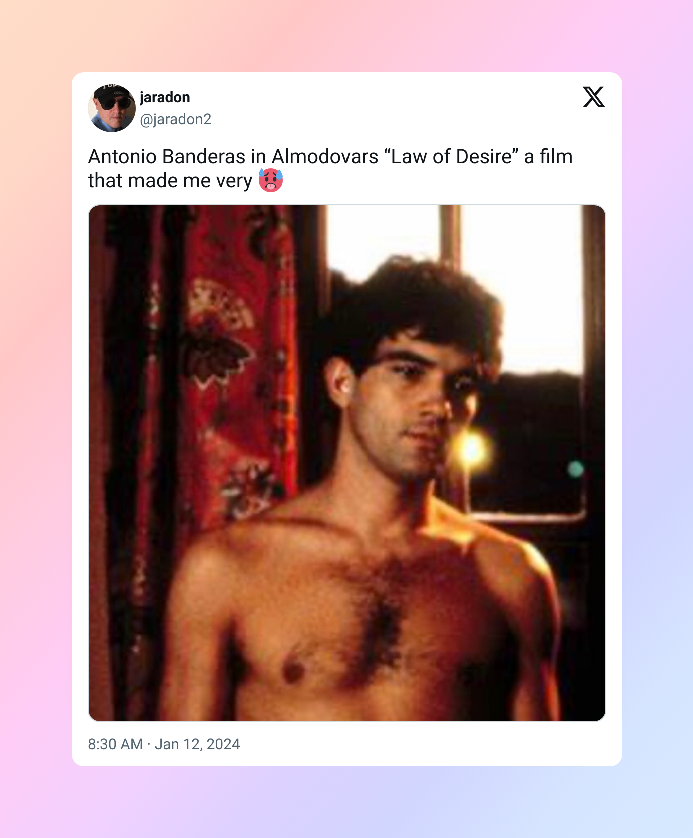
Playing Antonio Benítez, a repressed young man from a conservative, religious family, Banderas delivers a performance that is equal parts magnetic and chaotic. After discovering gay sex, his character becomes completely consumed by desire—fixated on a filmmaker he falls for with intense, almost dangerous devotion.
At the time, the film’s explicit scenes raised eyebrows. But it also broke ground, presenting queer characters as layered, emotional, and unapologetically human. And Banderas? Shirtless, smoldering, and wearing that curious grin—he wasn’t just acting, he was making a statement.
View this post on Instagram
Philadelphia: Love in the Face of Loss
By 1993, Banderas brought that same commitment to a very different kind of role in Philadelphia.
In one of the first major Hollywood films to center on AIDS, he played Miguel Álvarez, the loving partner of a man battling the disease. It was a quieter role, but no less powerful. Miguel wasn’t defined by tragedy—he was defined by loyalty, care, and unwavering love.
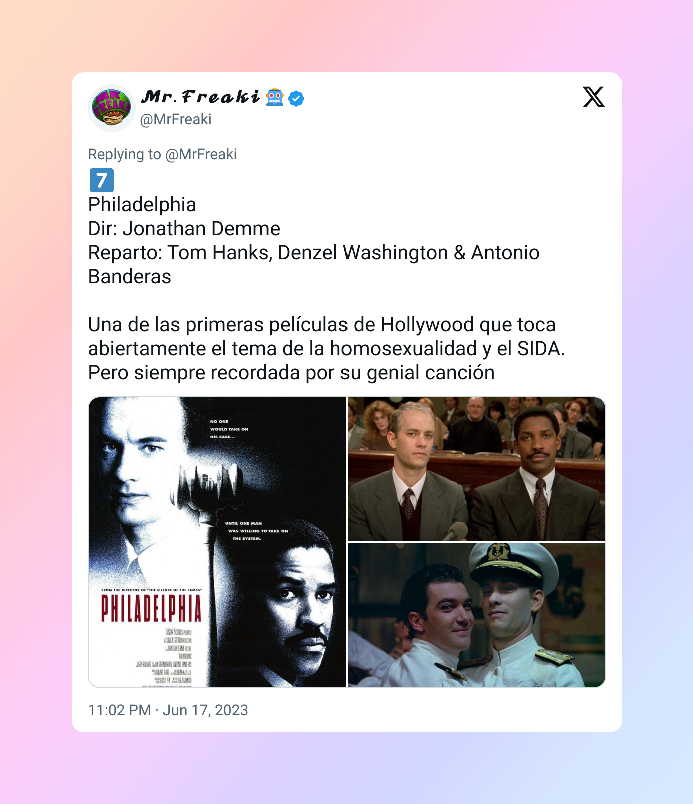
And yes, there was almost more. In an interview with Attitude, Banderas revealed that he and co-star Tom Hanks filmed an intense bed scene that was ultimately cut, intended to deepen the emotional connection between their characters.
The film itself attracted major talent—including Mary Steenburgen and Jason Robards—and, as Banderas pointed out in a 1995 interview, that mattered. At the time, not every actor was willing to take that risk. But for those involved, the story was bigger than fear.
Director Jonathan Demme’s ‘Philadelphia’ starring Tom Hanks, Denzel Washington, Jason Robards, Mary Steenburgen, and Antonio Banderas opened in theaters this day 30 years ago. 👥💼⚖️ #OTD pic.twitter.com/0X1Y5yJNIC
— 𝚂𝚎𝚌𝚘𝚗𝚍𝚊𝚛𝚢 𝙿𝚛𝚘𝚝𝚘𝚌𝚘𝚕 (@2ndaryProtocol) December 23, 2023
“All that stuff is changing,” Banderas said then, also highlighting the work of Elizabeth Taylor in AIDS awareness. “None of them thought twice about it.”
Here is a great interview from 1993 where Banderas talks about Philadelphia and Law of Desire. The interviewer was pretty great with the questions and remember, this is 1993.
Pain and Glory: A Life Revisited

Decades later, Banderas returned to queer storytelling in Pain and Glory, once again collaborating with Pedro Almodóvar.
This time, he played Salvador Mallo, a gay film director reflecting on his life while dealing with personal and health struggles. The role is introspective, stripped back, and deeply human—a far cry from the explosive energy of his earlier work, but just as impactful.
It’s a reminder that Banderas’ connection to queer narratives didn’t end in the ‘90s—it evolved.
RELATED: Something old, something new, we’ve got some movie recommendations for you
A Personal Connection That Hits Different
Off-screen, Banderas has also spoken about the LGBTQ community in deeply personal terms. In an interview promoting Pain and Glory, he shared that a drag performer once saved his life after a motorbike accident when he was just 16 years old.
It’s a detail that adds another layer to his story—one that connects his life to the very community he has portrayed on screen.
Then vs. Now: A Changing Landscape

It’s important to remember the context. In the ‘80s and ‘90s, taking on queer roles came with real professional risk. Today, the industry has shifted, with more openly LGBTQ actors bringing authenticity to stories that reflect their own identities.
But that progress didn’t happen in a vacuum.
Actors like Banderas helped push things forward—taking roles others avoided and portraying queer characters with depth, complexity, and, yes, a little bit of sex appeal.
SUGGESTED: Lee Pace Joins Kidman and Bullock in ‘Practical Magic 2’! Watch the Trailer Now!
Still That Guy
From obsessive lovers to devoted partners to reflective artists, Antonio Banderas has given us queer characters that linger.
And while the industry has evolved, those performances still stand as a reminder: sometimes, the ones who go first don’t just break barriers—they make it look good too.