


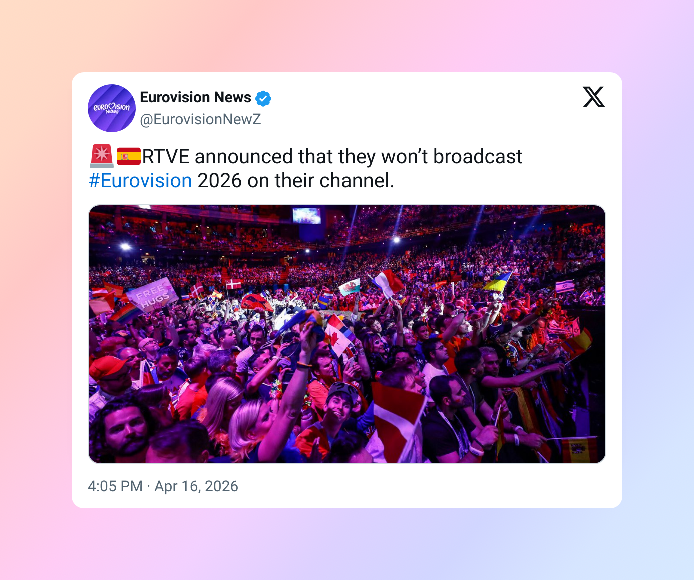
For the first time since 1961, Spain will not be broadcasting the Eurovision Song Contest. According to initial reports from Eurovision Fun, Spanish public broadcaster RTVE has confirmed it will not air the 2026 edition of the long-running competition. The decision marks a significant shift for a country that has maintained a continuous relationship with the contest for over six decades.
RTVE, formally known as Radiotelevisión Española, is Spain’s national public radio and television broadcaster. Its absence from Eurovision coverage represents more than just a programming change—it signals a broader stance on the current direction of the contest.
A Clear and Direct Reasoning
Unlike more cautious public statements often associated with international broadcasting decisions, RTVE did not soften its explanation. The network explicitly cited the continued inclusion of Israel in the Eurovision lineup as the reason behind its withdrawal from broadcasting the 2026 contest.
Officials from RTVE stated that Eurovision’s long-standing mission of neutrality has become “impossible to maintain” under current circumstances. They further described the atmosphere surrounding the event as one marked by political distrust, suggesting that the competition’s foundational values are being challenged.
This move distinguishes Spain from other participating nations that have opted not to compete. Rather than simply skipping participation, RTVE has chosen not to air the event at all—an action that removes the contest from Spanish screens entirely.
SUGGESTED: Best Gay Streaming Apps for LGBTQIA+ Entertainment
A Growing List of Absences
Spain is not alone in stepping back from Eurovision 2026, although its approach is notably more definitive. Countries including Netherlands, Ireland, Slovenia, and Iceland have confirmed they will not be sending representatives to the contest, which is set to take place in Vienna.
While these nations have opted out of competing, they have not necessarily withdrawn from broadcasting. Spain’s decision to pull the broadcast entirely places it in a distinct category, underscoring the seriousness of its position.
RELATED: Malta Sends a Sexy Cowboy to Eurovision—and His Name Is Aidan
Previous Protests Add Context
The tensions surrounding Eurovision are not new. In December, Nemo, Switzerland’s winner of Eurovision 2024, announced they would return their trophy. The decision was framed as a protest against Israel’s inclusion in the 2025 contest, adding to the growing list of public responses from within the Eurovision community itself.

Nemo’s action drew attention at the time, highlighting that concerns about the contest’s direction extend beyond broadcasters and into the artist community. Together with RTVE’s latest announcement, it illustrates a pattern of escalating responses tied to the same issue.
What This Means for Eurovision
RTVE’s decision introduces a new layer to the ongoing conversation about Eurovision’s identity and governance. As one of the contest’s longest-standing participants and broadcasters, Spain’s absence—particularly from a broadcast perspective—carries weight.
Whether this move will influence other broadcasters or remain an isolated decision remains to be seen. What is clear is that Eurovision 2026 will unfold under increased scrutiny, with questions about neutrality, participation, and representation continuing to shape the narrative around the event.
For now, Spain’s viewers will experience Eurovision differently—by not experiencing it at all.