


Texas has found a new target in its ongoing culture war ecosystem, and this time it isn’t books, drag shows, or what teenagers are watching on Netflix—it’s a pool party.
RELATED: Out Gay Congressman Robert Garcia May Soon Represent Huntington Beach

Ahead of June 7’s “Big Gay Swim Day,” state officials have sued the City of Denton in an attempt to block the event, arguing that even a Pride-themed swim gathering may run afoul of Texas’ bathroom law regime. The result is a very 2026 combination of chlorine, legal filings, and political messaging dressed up as public safety.
The Lawsuit and the Pool That Became a Battleground
At the center of the lawsuit is Texas Attorney General Ken Paxton, whose office announced legal action against the city over its handling of facilities at the Quakertown Civic Center pool. The concern, according to the state, is that organizers PRIDENTON and OUTreach Denton previously advertised plans that suggested sex-segregated changing rooms could be converted into “gender-neutral” spaces for the event.

The state’s argument leans on the Texas Women’s Privacy Act, also known as Senate Bill 8, which requires publicly owned “private spaces” to be designated based on biological sex and obligates cities to prevent access by the opposite sex in designated areas. The law also carries escalating financial penalties, turning bathroom policy into something closer to a high-stakes compliance test than a municipal guideline.
RELATED: Anti-Gay Post by GOP Rep. Andy Ogles Draws Backlash From His Own Party
As the attorney general’s office put it in its release:
“The lawsuit seeks to prevent the unlawful event from proceeding as planned on June 7 and requests temporary and permanent injunctive relief barring the City of Denton from permitting future violations of the Texas Women’s Privacy Act at its facilities,” read an Office of the Attorney General news release.
And in a statement that reflects the tone of the broader enforcement push, Paxton added:
“Cities cannot disregard Texas law by allowing men to change with young kids in spaces designated for women,” Paxton said in a statement. “The City of Denton had an opportunity to prevent this violation and chose to do nothing. That dereliction of duty will not stand, and I will ensure that Texas cities follow our state’s laws to protect women and children from men invading their spaces.”
The legal theory being tested is whether a temporary “gender-neutral” changing setup—especially one that allows multiple users—constitutes a violation under the statute. According to the state, it does.
Denton Says the City Already Tried to Stay Out of Trouble
Denton, however, says the situation is far less dramatic than the lawsuit suggests. City officials emphasize that the rental is private, not city-sponsored, and that they had already taken steps to comply with state law before the attorney general’s filing.

Kayla Herrod, Denton’s interim director of marketing and communications, told USA TODAY:
“The City of Denton is aware of the lawsuit filed by the Texas Office of the Attorney General,” Herrod said. “Prior to any action by the Attorney General, staff proactively took all necessary measures to ensure full compliance with state law in advance of PRIDENTON’s rental of the Civic Center Pool on June 7, including informing the organizers that certain elements of their advertising conflicted with state law and advising them of the requirement to comply.”
She also said the city plans to formally respond to the attorney general’s office and maintain that the necessary steps were already taken to ensure the Civic Center Pool changing rooms comply with state law.
A May 21 email included in court filings supports the city’s position, showing officials had already informed organizers that existing signage needed to remain visible and unchanged, and that temporary alterations would not be permitted.
Big Gay Swim Day and the Reality Behind the Rhetoric
Behind the legal back-and-forth is a broader political reality: Pride Month in Texas continues to double as both celebration and courtroom material. And “Big Gay Swim Day,” organized by PRIDENTON and OUTreach Denton, has become an annual community event since 2022—marketed as a space for swimming, dancing, and existing without fear of judgment or harassment.

The organizations did not mince words in response to the lawsuit, calling it:
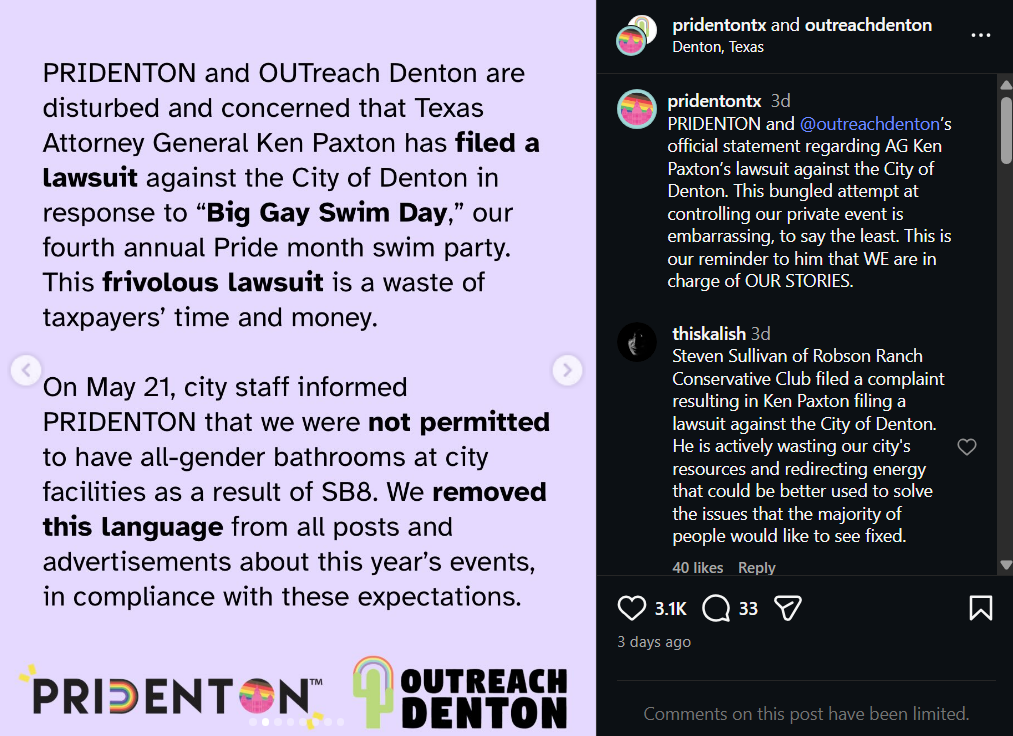
“frivolous” and a “waste of taxpayers’ time and money.”
They added:
“On May 21, (Denton) city staff informed PRIDENTON that we were not permitted to have all-gender bathrooms at city facilities as a result of SB 8. We removed this language from all posts and advertisements about this year’s events, in compliance with these expectations,”
and continued:
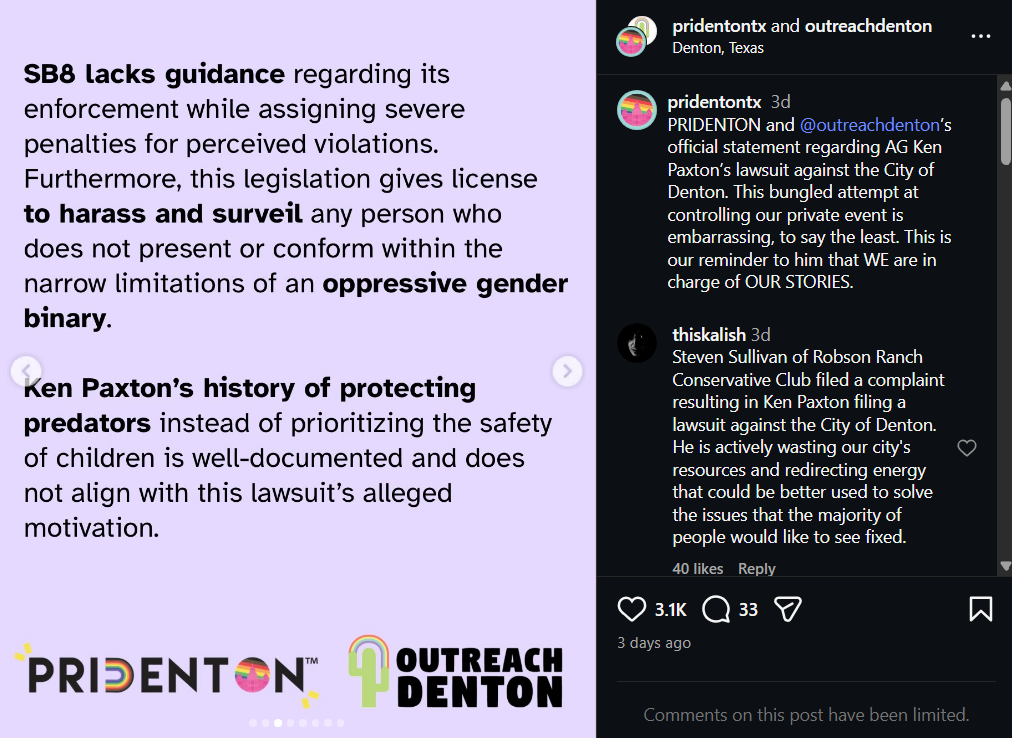
“The statement further says that SB 8 ‘lacks guidance regarding its enforcement while assigning severe penalties for perceived violations.'”
They also described the intent of the event in more human terms than legal filings usually allow:
“Big Gay Swim Day” has been around since 2022 and is an event where invited community members can swim, dance, and exist without fear of judgment or harassment.
The Texas Politics Behind the Legal Splash
The political backdrop includes Gov. Greg Abbott, who signed the law, and state Sen. Mayes Middleton, the bill’s author and current Republican candidate for attorney general.

What emerges is a familiar pattern in Texas governance right now: a Pride event, a statute written in the language of privacy enforcement, and a lawsuit arguing that even temporary reconfigurations of a pool’s changing room structure are legally consequential.

Or, stripped of legal phrasing, a summer swim event has become the latest front in a state-level argument about who gets to use what space—and under what assumptions everyone is expected to behave while they’re there.
Source: USA Today
The pedophiles running the state of Texas will take every change the get to get a peek or fondle of boys and girls to “check their gender.” As my mom said “THEY are the perverts!”
So very glad I was able to escape TX in 2014 and move home to Canada. I could see the writing on the wall.
Agreed. When I lived there it was a great place to be. That was before the MAGAt infestation.