


Geno Segers and Boy George are proving that in 2026, the biggest drama isn’t always what happens under the spotlight. If there’s one thing more dramatic than a standing ovation on Broadway, it’s watching someone’s casting announcement age like unrefrigerated oat milk. Whether you call it accountability, consequences, or the ever-polarizing “cancel culture,” this week served up two headline-grabbing exits from major productions—and the discourse is, naturally, louder than a theater kid warming up backstage.
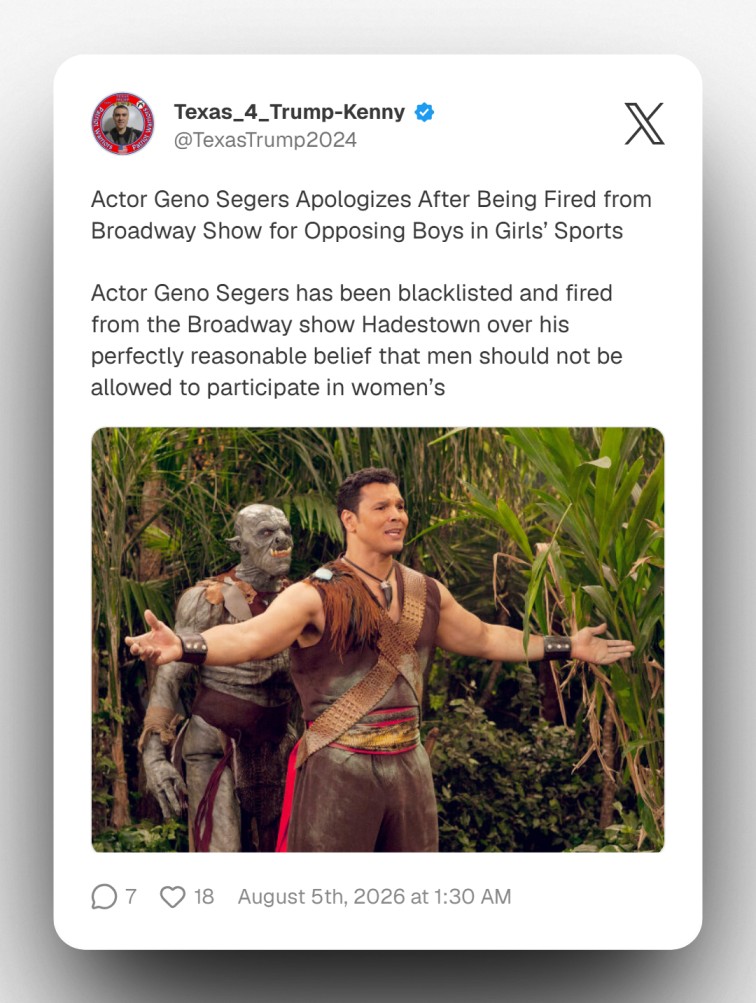
Former Disney star Geno Segers is out of Hadestown. Boy George is out of Jesus Christ Superstar. Different controversies, different politics, same uncomfortable truth: in entertainment, what happens offstage can quickly become the main event.
RELATED: Perez Hilton’s Well-Being Comes First After Alarming Livestream
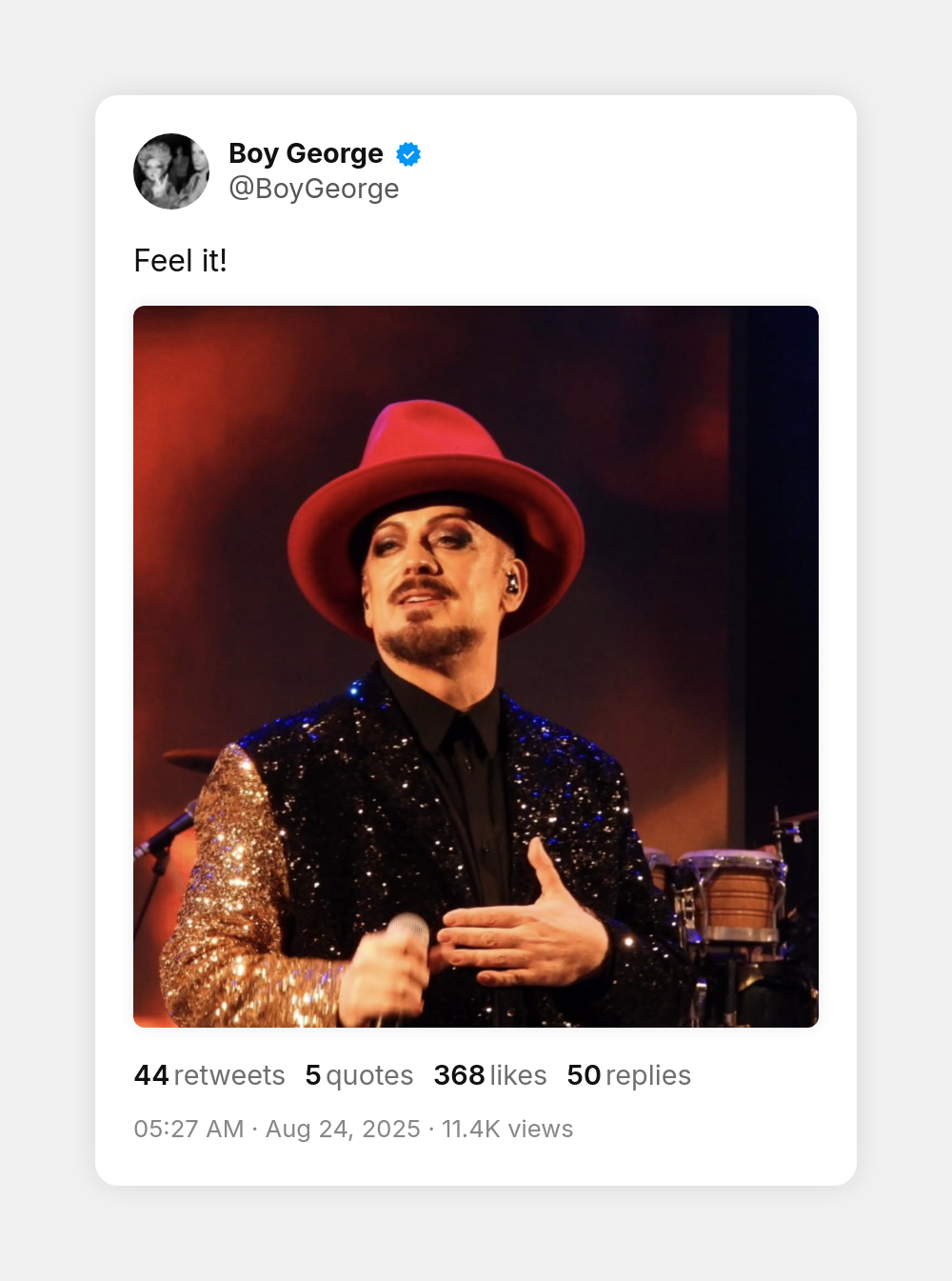
Hadestown Says “No Thanks”
Former Pair of Kings actor Geno Segers was set to play Hades, God of the Underworld, in Broadway’s acclaimed musical Hadestown. Instead, he exited the production before opening night after social media posts about transgender people drew widespread criticism.
RELATED: ‘Glee’ Reboot? Ryan Murphy Says It’s Time to Revisit McKinley High
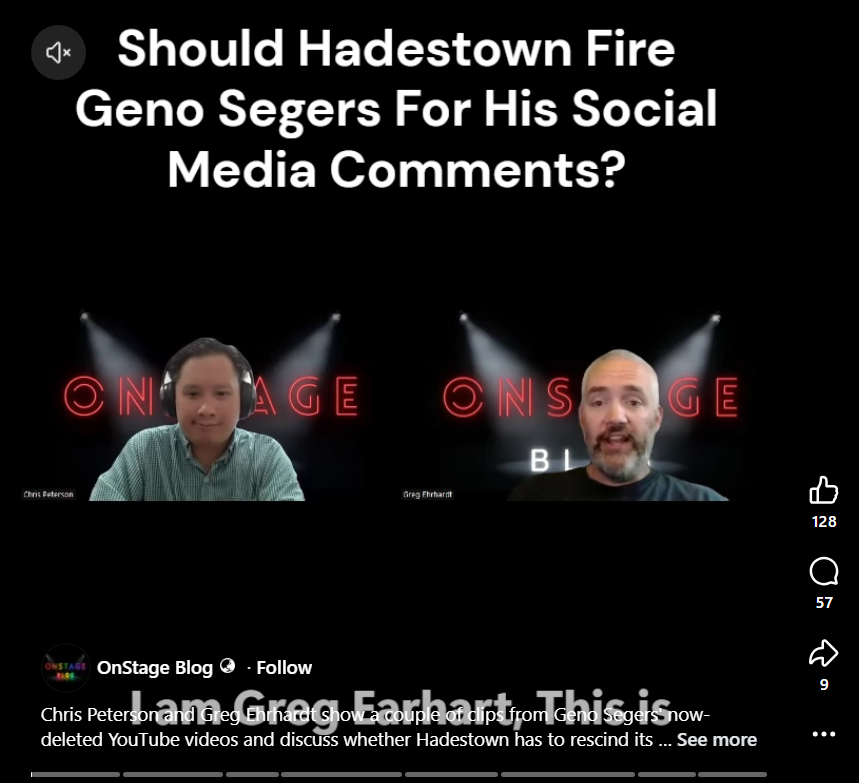
According to OnStage, Segers had shared videos titled “TRANS FAIRNESS?”, “NO MORE TRANS?” and “HE… I MEAN SHE BROKE THE RECORD.” In those videos, he argued against trans inclusion in women’s sports and mocked the practice of sharing pronouns.
Soon afterward, the show’s producers confirmed his departure.
The producers of Hadestown and Geno Segers have mutually agreed that Mr Segers will no longer join the Broadway production. The producers did not publicly state a reason for the decision, but the announcement followed criticism over Segers’ social media activity.
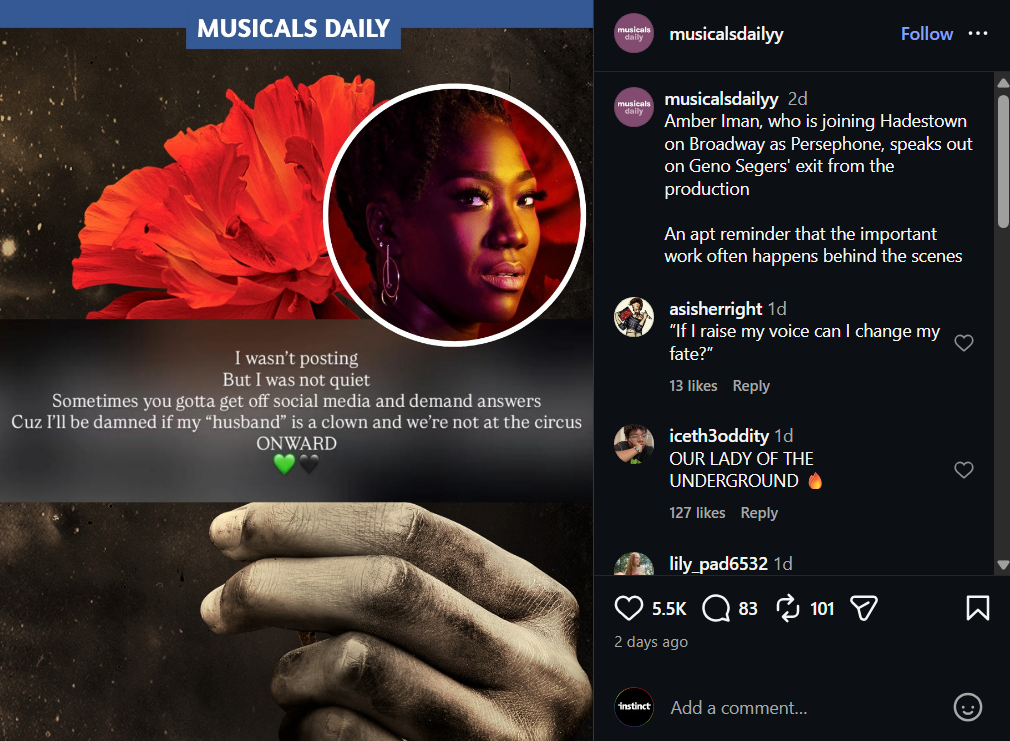
Amber Iman, who is set to play Persephone opposite Hades, shared her reaction after pressing for answers behind the scenes.
“I wasn’t posting, But I was not quiet,” she said on her Instagram stories on 2 August.
“Sometimes you gotta get off social media and demand answers. Cuz I’ll be damned if my ‘husband’ is a clown and we’re not at the circus. ONWARD.”
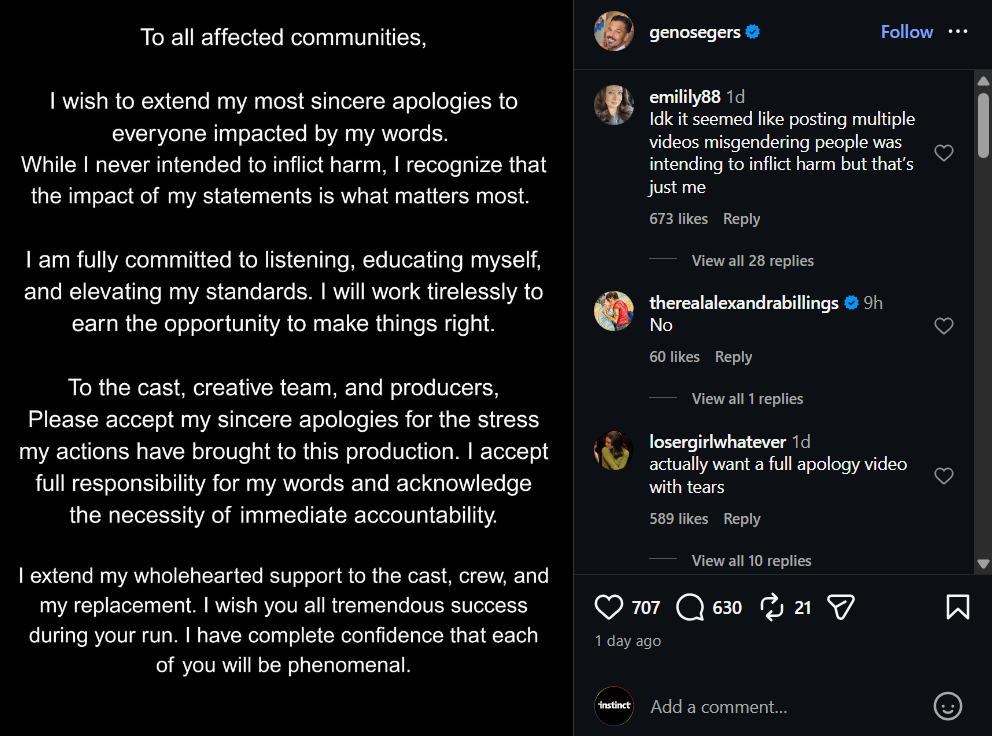
A day later, Segers issued a public apology.
“I am fully committed to listening, educating myself, and elevating my standards,” the post continued. “I will work tirelessly to earn the opportunity to make things right.”
He also apologized directly to the cast, creative team and producers.
“I accept full responsibility for my words and acknowledge the necessity of immediate accountability.”
For many LGBTQ+ commenters, the situation was viewed less as “cancel culture” and more as accountability, particularly given the ongoing debates surrounding transgender rights and inclusion.
Boy George Sparks Another Firestorm
Across the Atlantic, Boy George found himself at the center of another controversy after releasing an AI-generated reggae song titled We Will Dance Again, featuring both its Hebrew title and English translation. The track defends Israel’s military campaign in Gaza and criticizes those who accuse Israel of genocide.
Among its most debated lyrics are:
“You say genocide, I say war / When you’re attacked, that’s what the army’s for.”
and
“Does it get ugly? You bet it does / When I know you wanna kill every last one of us.”
The song also criticizes musicians who have publicly supported Palestine.
“You condemn the Jews, with selective memory / Musicians holding flags, mouthing like sheep / Propaganda fuelled by the internet feels so weak.”
In Buddhism we understand that every action comes with a consequence. Due to my decision to stand up for my Jewish friends I am losing a few people from my life. Today I parted company with Tony Pontius who has run my record label BGP for a number of years. I wanted to release… pic.twitter.com/jOArrkCktF
— Boy George (@BoyGeorge) July 31, 2026
The song quickly drew widespread backlash online. Fellow musician Martyn Ware described it as an “overtly pro-genocide, anti-Palestinian piece of musical propaganda” and said Boy George should be “ashamed,” while calls circulated for protests outside the London Palladium.
Soon afterward, Boy George’s manager, Paul Kemsley, announced that the singer would no longer appear as King Herod in Jesus Christ Superstar.
“After careful consideration, I have decided, in my capacity as Boy George’s manager, that he will no longer be appearing in Jesus Christ Superstar at the London Palladium.”
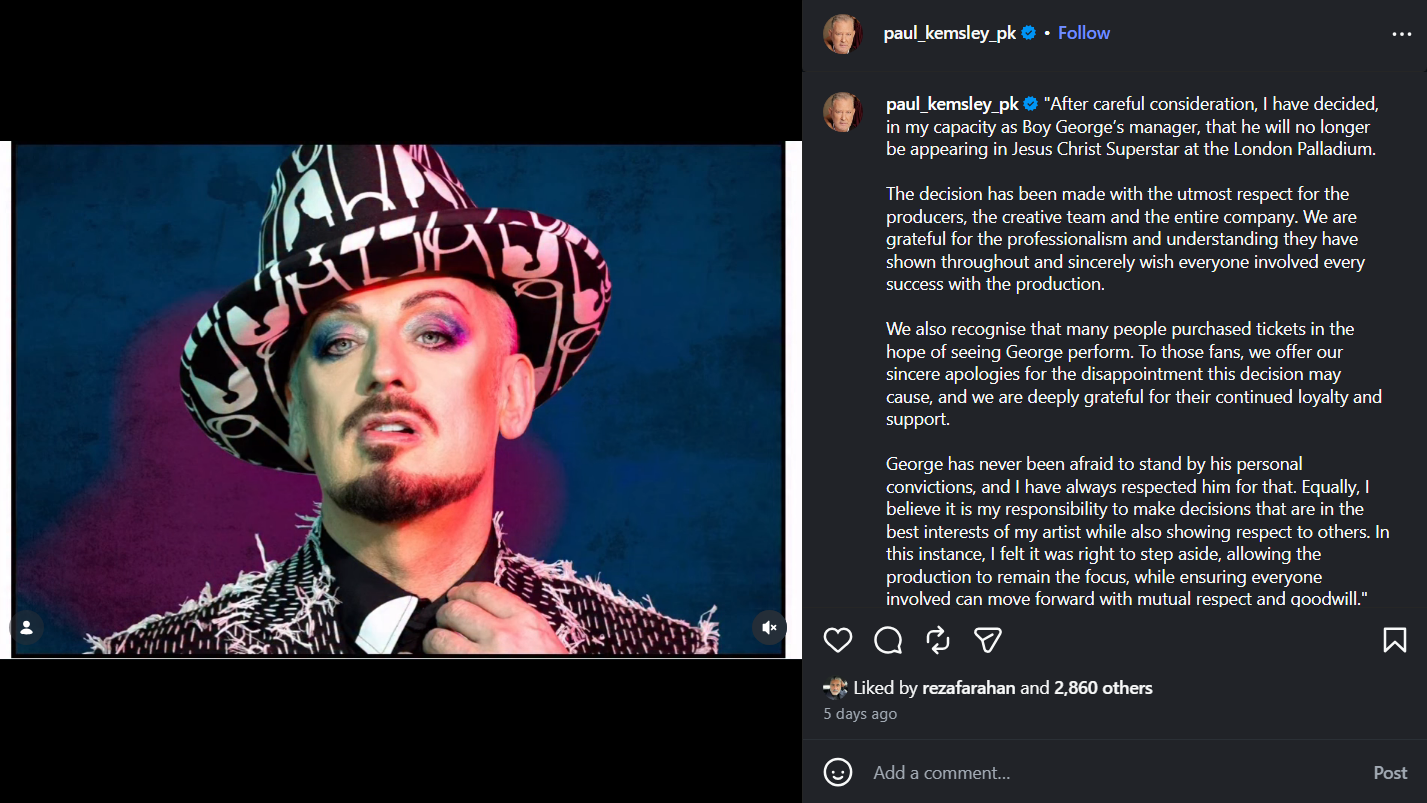
Kemsley said the decision was made with respect for everyone involved in the production.
“George has never been afraid to stand by his personal convictions, and I have always respected him for that.”
“Equally, I believe it is my responsibility to make decisions that are in the best interests of my artist while also showing respect to others.”
“In this instance, I felt it was right to step aside, allowing the production to remain the focus, while ensuring everyone involved can move forward with mutual respect and goodwill.”
Richard Armitage will now cover Boy George’s scheduled performances as King Herod.
Boy George Isn’t Backing Down
If anyone expected Boy George to quietly disappear from the spotlight, they clearly haven’t been paying attention for the past four decades.
Following news of his departure from the production, he posted an AI image of himself sporting a Groucho Marx moustache alongside the caption:
“To quote Groucho Marx I would never want to be part of any club that would have me as a member!”
He also continued defending his position on social media.
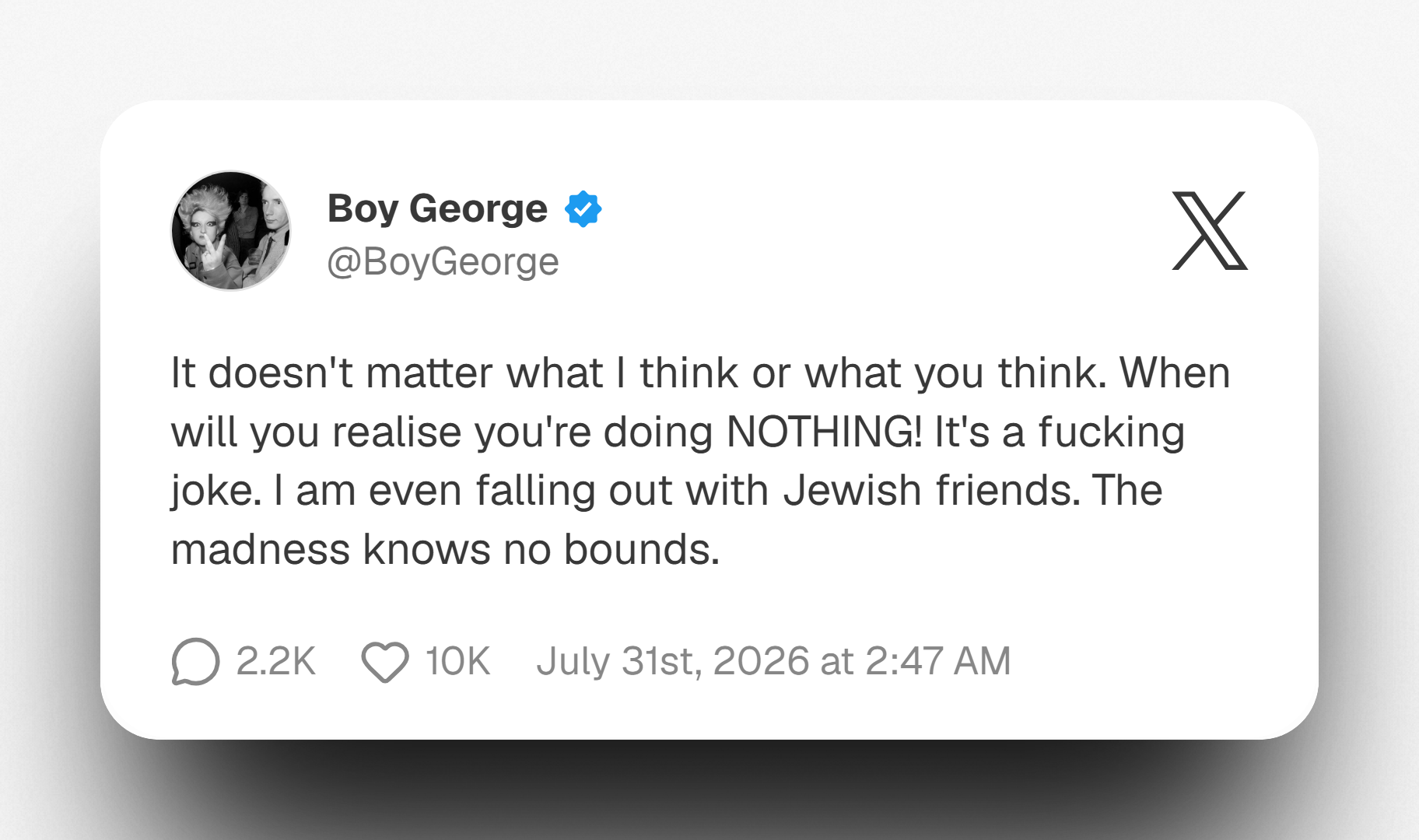
On X, he wrote:
“It doesn’t matter what I think or what you think. When will you realise you’re doing NOTHING! … I am even falling out with Jewish friends. The madness knows no bounds.”
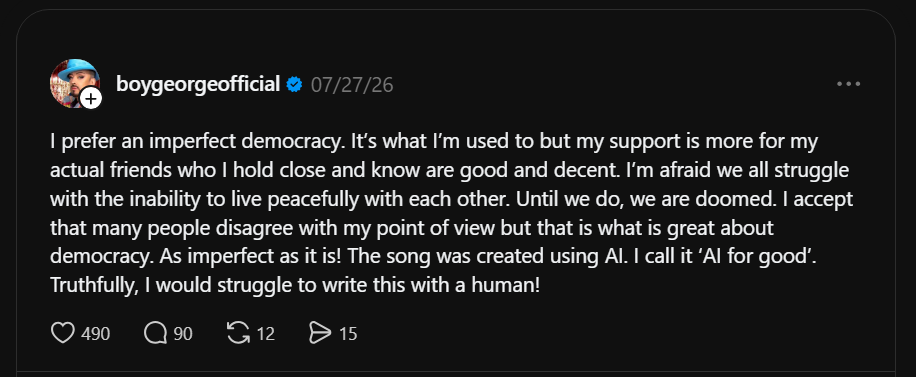
On Threads, he added:
“I’m afraid we all struggle with the inability to live peacefully with each other. Until we do, we are doomed. I accept that many people disagree with my point of view but that is what is great about democracy. As imperfect as it is!”
George explained that the phrase “We Will Dance Again” resonated with him because of its association with survivors of the Nova music festival attack.
“I saw the slogan ‘we will dance again’ and it resonated. Writing has to reflect the world we live in. Why not put the word ‘genocide’ in a song? Why are people suddenly uncomfortable with that word?”
He also revealed the track was created using artificial intelligence.
“I call it ‘AI for good’. Truthfully, I would struggle to write this with a human!”
The controversy extended beyond the theater. Boy George confirmed he had parted ways with his record label after disagreements over releasing the song.
“In Buddhism we understand that every action comes with a consequence.”
“Due to my decision to stand up for my Jewish friends I am losing a few people from my life.”
“Today I parted company with Tony Pontius who has run my record label BGP for a number of years.”
“I wanted to release ‘We Will Dance Again’ but he was unequivocal and said ‘I want nothing to do with this song’ and I responded ‘ok, we are done’.”
“When someone is gutless it really does not hurt to say goodbye. My faith in humanity will not diminish, and the truth will always win. I will release it!”
His manager later reiterated the decision to withdraw from the production while apologizing to disappointed ticket holders and thanking the producers and creative team for their professionalism.
Accountability, Backlash, and the Never-Ending Debate
The phrase “cancel culture” gets tossed around so often it has practically earned its own Equity card. But these two stories also illustrate how differently public backlash is interpreted depending on the issue at hand.

One controversy centered on transgender rights. The other revolved around one of the world’s most divisive geopolitical conflicts. Neither debate has produced universal agreement, and both continue to spark passionate reactions from supporters and critics alike.
What is clear is that public figures increasingly face scrutiny not only for what they do onstage, but also for what they post, say, or release away from the spotlight. Audiences, producers, and collaborators often weigh those actions when deciding whether a performer remains the right fit for a project.
The curtain may still rise every night, but in today’s entertainment world, the internet almost always gets the final encore.
Source: FoxNews and The Guardian
Boy George did a normal thing that any decent person needs to do – he used his brain and did not fall under the mass self-annihilating hypnosis of ‘anti-Zionists’, modern-day anti-Semites. The selective accusation of genocide is tired, but for the masses it feels like standing up for something. Mind you, the same masses are silent about slaughter in Iran, Ukraine, Sudan, and the list goes on.
Boy George – you are a decent human being, and you did the right thing. I hope more “celebrities” stand for truth and what is right. Where is Madonna?