



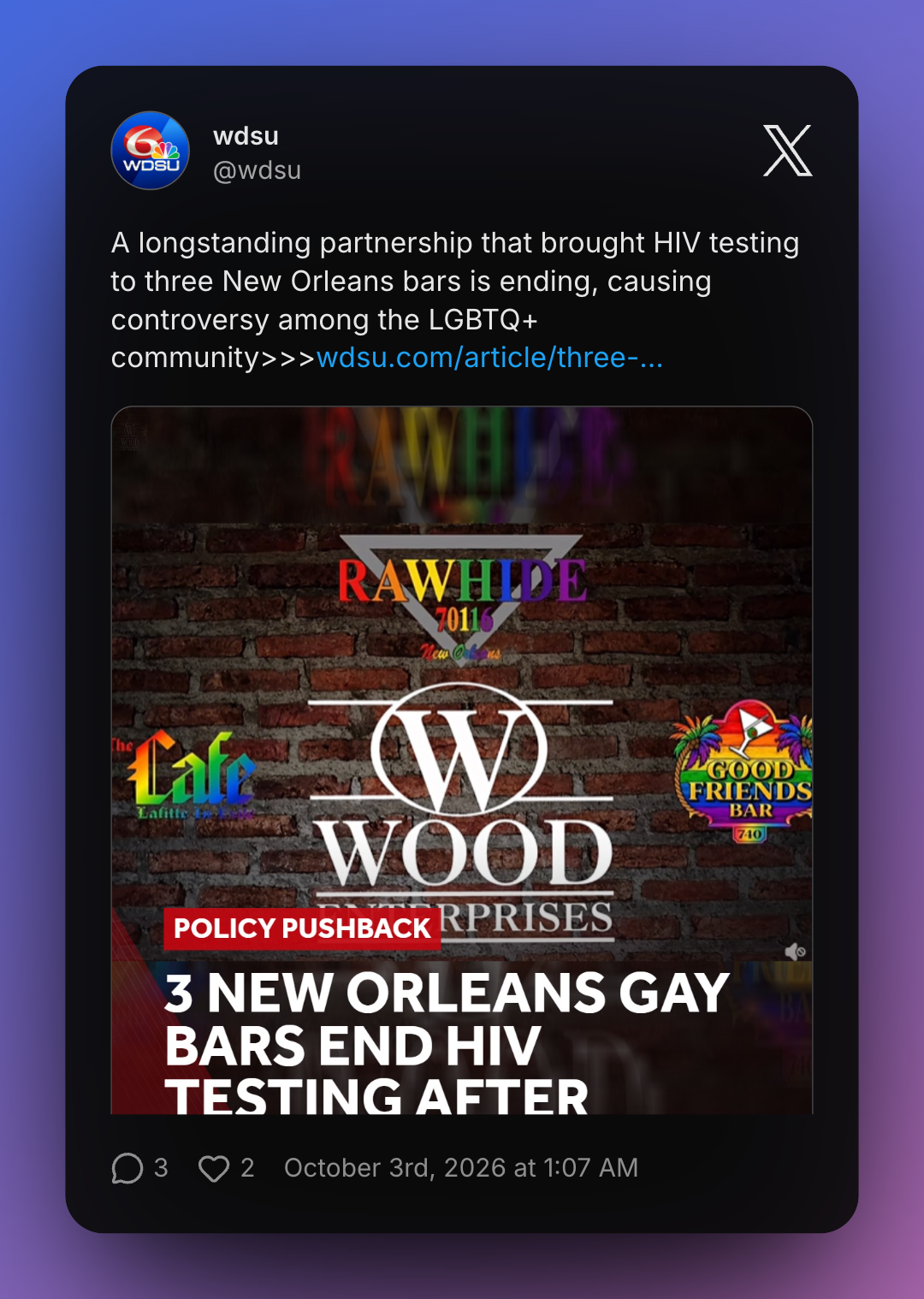
Convenient HIV testing at three gay bars in New Orleans is coming to a close, drawing criticism from LGBTQ+ community members and patrons who have relied on the service, according to WDSU.
And honestly, it is easy to understand why people are concerned. For some patrons, having HIV testing available in a familiar, LGBTQ+-friendly environment can make getting tested feel more accessible, less intimidating, and easier to fit into everyday life.
But there is more to the story than “gay bars stopped HIV testing.”
Testing at Good Friends, Café Lafitte in Exile, and Rawhide Lounge, all under Wood Enterprises, has stopped for now, but the reason behind the decision is being disputed. Wood Enterprises says the issue is not HIV testing itself. Instead, management says CrescentCare volunteers were not following the company’s policy requiring third-party organizations to coordinate dates and times with the business office before coming onto the premises.
READ: From Outbreak to National Crisis: Fiji Addresses Current HIV Problem
So, What Actually Happened?
Anne Breaud, Director of Operations/General Manager, said the situation “was never about HIV testing or counseling.” According to Breaud, the dispute was about CrescentCare volunteers allegedly coming into the establishments, setting up where they wanted, and failing to coordinate their dates and times with the business office.
Breaud said the volunteers were told they needed to make an appointment with management to discuss the matter. Wood Enterprises then barred them from the establishments until they complied with the company’s policies.
That distinction matters. According to Wood Enterprises, the issue was not a decision to oppose HIV testing, but a disagreement over how an outside organization was operating inside its establishments.
At the same time, the concerns from patrons shouldn’t simply be brushed aside. Whatever happened behind the scenes, the immediate result is that a testing service people knew and trusted is no longer available at these three bars.
The “Especially Them” Comment
The criticism has also focused on how the situation was communicated.
According to WDSU, a former bartender at one of the three bars asked Breaud whether CrescentCare was included in “the ban.” Breaud replied, “especially them.”
The exchange drew criticism from people who viewed the remark as dismissive of CrescentCare and its work.
For patrons already worried about losing a convenient place to get tested, that kind of exchange can understandably make the situation feel even more concerning.
Wood Enterprises said outside services need management approval. The company also shared a policy on Good Friends’ Facebook page stating that anyone entering its establishments for a reason other than being an employee or customer must receive management approval.
Is CrescentCare Actually Banned?
Here’s where the wording gets important.
In a statement to WDSU, Breaud said CrescentCare isn’t actually banned. Instead, the organization must receive approval before conducting HIV testing at the three locations.
So while testing is currently not taking place at the three bars, Wood Enterprises says CrescentCare could potentially return if the organization follows the required management-approval process.
CrescentCare, however, has a different account.
CrescentCare Responds
CrescentCare said, “Our commitment to accessible HIV testing has not changed.”
The organization said its community testing partnerships involve working with host locations to “gain permission, confirm access, availability, procedures and logistics” before providing services. CrescentCare described the decision to end testing at the Wood Enterprises locations as unexpected and disappointing.
The organization also emphasized that it is “still here” and “still testing and providing medical care and treatment,” while remaining open to conversations with Wood Enterprises about restoring the partnership.
That matters because accessibility is not just about whether testing technically exists somewhere in the city. Location, familiarity, convenience, privacy, and comfort can all influence whether someone actually gets tested.
For patrons who had incorporated testing at these bars into their healthcare routine, losing that option can feel like a real loss even if other testing sites remain available.
CrescentCare also thanked community supporters, including The Phoenix Bar, and said it is open to partnering with additional organizations interested in hosting testing events.
In other words, CrescentCare disputes the idea that its teams simply arrived without any coordination.
Wood Enterprises Says It Supports Testing
Wood Enterprises’ own statement is equally clear on one point: “Wood Enterprises is not against HIV testing or any proactive health care for individuals in our community.”
The company said anyone entering its establishments for reasons other than being an employee or patron must receive management approval, citing policies designed to protect customers and employees.
So based on the statements from both sides, it would be inaccurate to reduce the situation to “New Orleans gay bars don’t want HIV testing.”
The more precise description is that HIV testing at these three locations has stopped amid a disagreement between Wood Enterprises and CrescentCare over management approval and procedures for outside services operating inside the bars.
HIV Testing Has Not Stopped
Most importantly, CrescentCare continues to provide HIV and STI testing and treatment at other New Orleans locations at 1631 Elysian Fields Avenue and at 2515 Canal Street. So yes, a convenient testing option at three New Orleans gay bars has been disrupted. And yes, patrons are allowed to be disappointed, frustrated, or concerned about that.
Community-based testing can make healthcare more approachable, particularly in spaces where LGBTQ+ people already feel comfortable. Losing that familiar option is worth taking seriously, even if testing remains available elsewhere.
But the facts matter, too.
This is not simply a story about bars rejecting HIV testing. It is a dispute between a business and a community healthcare organization over how testing services are coordinated and conducted on the premises.
Hopefully, that distinction doesn’t get in the way of the bigger goal: making sure people have easy, welcoming, stigma-free ways to get tested.
Because whether you’re walking into a clinic, a community center, or your favorite gay bar, the important thing is that you have a place where you feel comfortable taking care of your health.