


Kim Davis once made two men fight for the right to get married. More than a decade later, the former Kentucky county clerk is still dealing with the consequences of that decision, and this time, it’s her finances attracting attention. A federal judge has given Davis four days to explain why she allegedly failed to disclose inherited property while facing a court-ordered payment of around $565,000 to the very couple whose marriage license she refused to issue.
RELATED: Chris Watts Accused of Having Gay Sex With Male Inmates in Prison

The latest development adds another chapter to one of America’s most notorious marriage equality controversies. David Ermold and David Moore aren’t simply waiting for a check from the woman who denied them a marriage license in 2015. Their attorneys now allege that Davis concealed valuable assets and transferred inherited property to relatives, potentially putting money owed to the couple beyond their reach.
RELATED: Kim Davis Accused of Moving Assets to Avoid Paying Gay Couple
The missing money question
The dispute centers on financial disclosures Davis submitted during efforts to determine how she could satisfy the judgment.
According to WKYT, she reportedly told the court she owned no real estate, had made no qualifying asset transfers, and had no interest in any estate or trust.
Ermold and Moore’s lawyers say certified records from Rowan County paint a rather different picture. They allege that Davis inherited a 50% interest in her mother’s estate, which included three parcels of land worth more than $400,000, following her mother’s death in 2025. They further allege that she subsequently signed deeds transferring the properties to family members.
The timing and nature of those transfers have raised questions about whether she was attempting to keep her inheritance out of reach while the couple pursued the money awarded to them.
Their attorneys had specifically requested records concerning property ownership, significant asset transfers over the previous five years, and interests in trusts or estates. Davis’ responses allegedly failed to disclose the inheritance and subsequent transfers.

The couple has asked the court to invalidate the property transfers, prevent further movement of her assets, and apply available estate funds toward the judgment. Those requests have not yet been granted, but the financial disclosures are now under scrutiny.
Kim Davis has four days to explain herself
Magistrate Judge Edward B. Atkins isn’t treating the discrepancy as a minor paperwork problem.
In a November 6 filing, Atkins pointed out that Davis had not disputed the existence of the certified public records documenting the inheritance and property transfers.
“[Davis] does not deny the existence of these certified public records [showing the inheritance and transfer of her mother’s property],” Atkins wrote. “[She] does not address if or why these documents are outside of the scope of Plaintiffs’ requests, and gives no reason for not producing complete responses and documents.”
The judge ordered Davis to provide corrected financial disclosures and explain by November 16 why she should not face contempt of court sanctions for her allegedly misleading responses.
To be clear, the court has not yet determined that Davis deliberately concealed her inheritance or ordered the disputed property transfers reversed. Those are allegations raised by the couple’s legal team. But the judge’s demand for an explanation puts the former clerk in a decidedly uncomfortable position.
Remember why these two men are owed around $565K?
The people on the other side of this financial dispute aren’t strangers to Davis. Ermold and Moore were among the same-sex couples caught up in her refusal to issue marriage licenses after the Supreme Court legalized same-sex marriage nationwide in 2015.
Davis, who was serving as Rowan County clerk at the time, refused to issue licenses on religious grounds, insisting she was acting “under God’s authority” because she believed marriage should only be between a man and a woman.
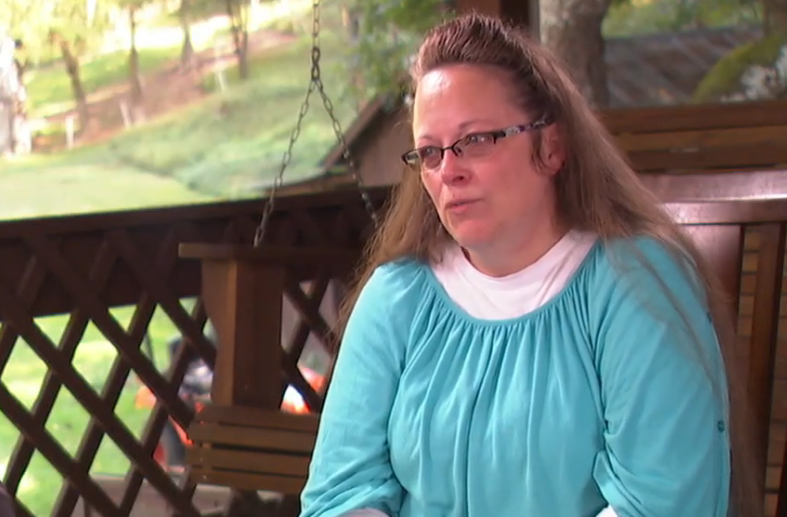
The consequences were immediate. Same-sex couples were repeatedly denied licenses, and Davis eventually spent five days in jail for contempt of court. The couples were finally able to obtain their licenses through a deputy clerk while she was behind bars.
Her staff later issued the licenses without Davis’ name appearing on the documents. Kentucky lawmakers subsequently changed state law to remove county clerks’ names from marriage licenses altogether.
But the legal battle didn’t end with her release.
In 2022, a judge ruled that Davis had violated the constitutional rights of same-sex couples. The decision rejected the idea that her personal religious freedoms could excuse her from respecting the constitutional rights of people she was legally obligated to serve.
Ermold and Moore continued pursuing damages over the emotional distress, humiliation, and other harm they said they experienced as a result of her actions.
The bill for refusing marriage equality
Davis once enjoyed considerable political support from then-Kentucky Gov. Matt Bevin, who praised her as “an inspiration… to the children of America.” Her legal fight was backed by Liberty Counsel, an anti-LGBTQ+ legal organization designated as a hate group by the Southern Poverty Law Center.
That political and legal support, however, did not erase the judgment against her.
Now, more than ten years after the original marriage license controversy, the focus has shifted from Davis’ objections to marriage equality to her obligation to pay the people affected by her actions.
For Ermold and Moore, the roughly $565,000 award is more than a financial dispute. It follows years of legal proceedings over a basic right that should never have been withheld in the first place.
Whether the inherited properties will ultimately be used to satisfy the judgment remains to be seen. Davis, meanwhile, has until November 16 to explain the discrepancies in her financial disclosures.
She once insisted that her religious convictions should take precedence over a same-sex couple’s right to marry. Now, the court wants to know whether her financial disclosures will take precedence over the records showing what she inherited.
Apparently, the paperwork isn’t quite finished.