


Remember Kim Davis? The former Kentucky clerk who became one of the biggest names in the fight over marriage equality is making headlines again, and yes, it still revolves around the same legal battle. More than a decade after refusing to issue marriage licenses to same-sex couples, Davis is now accused of trying to keep $565,000 out of the hands of the gay couple who won a federal civil rights judgment against her.

Apparently, this courtroom saga just keeps finding new sequels nobody asked for.
RELATED: Kim Davis’ Bid to Undo Same-Sex Marriage? Rejected!
According to a newly filed lawsuit in Kentucky, Davis allegedly transferred inherited property to family members after inheriting part of her mother’s estate, with attorneys for David Ermold and David Moore arguing the moves were designed to keep those assets beyond the reach of creditors. In other words, the fight has shifted from marriage licenses to property deeds—and the receipts are allegedly sitting in county records.
RELATED: Lauren Boebert’s Wild Amazon Warehouse Moon Landing Theory
Kim Davis and the inheritance that sparked another lawsuit
The latest complaint was filed in Rowan Circuit Court by attorneys representing Ermold and Moore, the Kentucky couple whose attempt to obtain a marriage license from Kim Davis in 2015 became one of the defining moments in the aftermath of the Supreme Court’s marriage equality ruling.
Their attorneys want a judge to undo several property transfers made after she inherited a half-interest in her mother’s estate.
Attorney Michael Gartland isn’t mincing words.
“This is a slam dunk in any court.”
He added:
“The minute her mother died, those properties were half hers with her brother, and that’s a problem for her.”
Court filings allege Davis inherited a 50% interest in an estate valued at roughly $735,230 in early 2025. Soon afterward, property records show several transfers involving a family home, a 50-acre farm, and another residence.
According to the lawsuit, those properties were transferred to relatives and a family trust “for the love and affection which the parties have for each other … and for no monetary consideration whatsoever.”
The plaintiffs argue those transfers effectively removed Davis’ ownership while leaving valuable assets out of reach as they continue trying to collect on the judgment.
Ten years later, Kim Davis still can’t escape this case
This legal fight traces all the way back to 2015, when Kim Davis refused to issue marriage licenses to same-sex couples following the Supreme Court’s landmark Obergefell v. Hodges decision.

Rather than issue licenses, she stopped issuing them altogether, citing her Christian faith. Four couples eventually sued, arguing their constitutional rights had been violated.
The standoff became national news after she refused to comply with a federal judge’s order and spent five days in jail for contempt of court. Kentucky later changed its marriage license forms by removing county clerks’ names, allowing her to return to work, but the lawsuits continued winding their way through federal courts.
Those courts ultimately ruled against her.
After multiple appeals—including unsuccessful arguments centered on qualified immunity and religious freedom—the judgment remained intact when the U.S. Supreme Court declined to hear the case.
The total bill now stands at $565,285.91.
According to Gartland, however, collecting it has proven to be another battle entirely.
“a penny”
That’s how much he says his clients have received so far.
Court documents also show Davis stated under oath that she did not currently own property or have an interest in any trust. The new lawsuit argues those answers omitted key details about the inheritance and subsequent transfers.
Gartland believes the paper trail speaks for itself.
“This is the best fraudulent transfer case I’ve ever dealt with.”
He continued:
“It’s just — it’s just that simple; it’s open and shut.”
Meanwhile, attorney Joseph Buckles said discovering the transfers required digging through probate files and county records.
“Thank God the public records exist, because you don’t know what you don’t know.”
Kim Davis says she answered exactly what was asked
Not surprisingly, Davis’ legal team strongly disagrees.
Matthew Staver, founder and chairman of Liberty Counsel, argues his client did not provide false testimony because the attorneys questioned her about property she currently owned—not property she had owned before transferring it.
“She did not lie.”
He added:
“They asked a specific question, and she answered it exactly, truthfully the way they had asked it.”
Staver also told the Herald-Leader that Davis transferred the inherited property to carry out her mother’s wishes, although court records reportedly do not reflect those instructions in a formal will.
Whether that explanation satisfies Kentucky’s Uniform Voidable Transactions Act will now be up to the courts.
Under that law, judges can reverse transfers if they determine property was moved to “hinder, delay, or defraud” creditors or transferred without reasonably equivalent value while debts remained unpaid.
That’s exactly what Ermold and Moore’s attorneys argue happened here.
The legal bills keep growing while the headlines refuse to retire
If there’s one thing this story proves, it’s that some culture-war battles don’t simply fade into history—they evolve into years of depositions, appeals, property records, and increasingly complicated financial disputes.
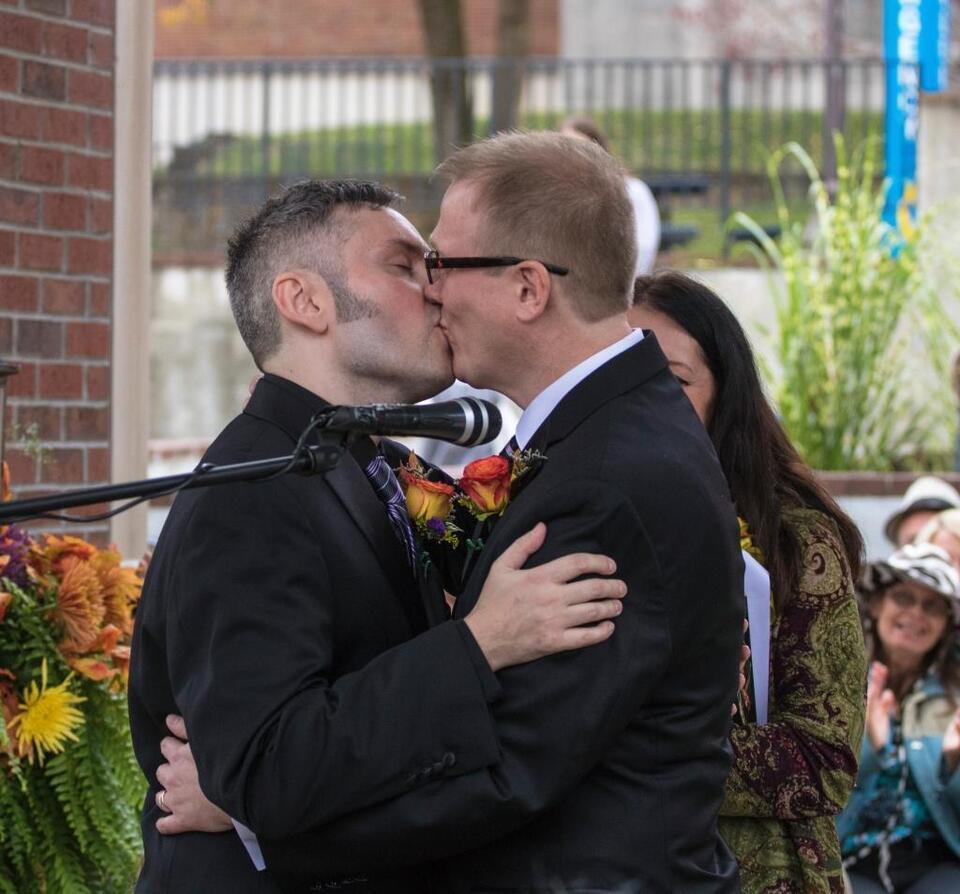
David Ermold and David Moore married in October 2015 in Morehead, Ky. The couple had previously been denied a marriage license by Rowan County Clerk Kim Davis. Photo provided by David Ermold.
For David Ermold and David Moore, the fight stopped being about obtaining a marriage license long ago. Their attorneys say it’s now about enforcing a judgment the courts have repeatedly upheld.
As Buckles put it:
“They’re not out for vengeance, but, I mean, they have been seriously harmed by this.”
Whether the latest lawsuit succeeds remains to be seen. But one thing is certain: more than ten years after Kim Davis first refused to issue those marriage licenses, the legal drama still hasn’t reached its final chapter.
And if this latest filing is any indication, the courthouse remains booked.
Source: Kentucky
Oh no, not another “Christian” criminal. Lock her up.